Sign In
Upcoming Event
 Free Newsletter


PHOTO: DEPOSIT PHOTOS
PHOTO: DEPOSIT PHOTOS
OPINION: Energy costs, grid strain are reshaping the market
David Greek//November 17, 2025//


 Listen to this article
The basics:
- AI-driven data centers are accelerating electricity demand and stressing NJ’s power grid
- Rising energy costs and grid congestion threaten industrial projects, especially cold storage facilities
- Developers must treat electricity as core infrastructure, writer says
- Small Modular Reactors and AI-enabled efficiency systems offer promising near-term solutions
U.S. Rep. Alexandria Ocasio-Cortez last month secured a Department of Energy study examining how AI-driven data centers are driving up electricity costs and straining grid reliability. The fact that Congress is pressing for such a review for consumers underscores what industrial developers have long understood: the cost and availability of power is rapidly becoming one of the defining constraints of this decade.
The U.S. Energy Information Administration projects record electricity consumption of 4,179 billion kWh in 2025, with demand rising by 20% by 2030 and a whopping 78% by 2050, according to technology consulting firm ICF International. This surge will be driven by electrified transportation, industrial automation investments, and expanding data center workloads.
In the PJM grid serving New Jersey, Pennsylvania, and 11 other states, forecasts indicate 30 gigawatts of new demand will be added by 2030, with nearly all of it coming from data centers.
With rising demand comes rising costs. PJM capacity auction prices have jumped nearly tenfold in two years, and analysts expect household electricity bills in the Mid-Atlantic to climb more than 60% by 2030. For industrial tenants already squeezed by taxes and insurance, volatile energy costs are a growing concern.
Nowhere is this more evident than in cold storage, where power consumption is significantly higher than in dry warehouses. Refrigeration systems operate 24/7, supported by advanced energy management and humidity control systems. The result is extraordinary demand: 25-to-30 kilowatt-hours per square foot annually. Not surprisingly, these facilities rely on redundant backup systems, including generators and UPS [uninterruptible power supply] units, because a brief outage risks millions of dollars in spoiled goods.
At New Jersey’s current rate of approximately 18.38¢ per kilowatt-hour for commercial users, cold-storage facilities can face up to $15.60 per square foot in electricity costs annually.
The hard truth
Similar thinking
Experts with Regional Plan Association urge PJM to modernize the power grid. Read that opinion piece here.
While New Jersey’s grid remains reliable, it was not designed for the surge of AI-driven logistics, electrified truck fleets, and expanded manufacturing. The PJM interconnection queue is already congested, with projects waiting extended periods for approvals to tie into the grid.
For industrial developers, this can mean delays, cost overruns, and in some cases, project cancellations. Some operators are experimenting with thermal energy storage and other innovations to blunt peak loads and qualify for clean energy incentives. Others face the hard truth: securing enough power capacity at a site can be as daunting as raising capital or obtaining entitlements.
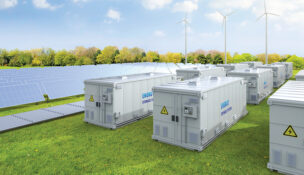
This is why developers must now treat electricity as core infrastructure. That starts with engaging utilities early in the entitlement process to align project timelines with grid upgrades. It also means embedding resilience into design, including onsite generation, battery storage, and microgrids that shield tenants from volatility. Even lease structures are evolving, with some indexed to demand charges or incorporating efficiency standards to balance costs and incentivize conservation.
[D]evelopers must now treat electricity as core infrastructure.
Innovation offers further promise. AI-enabled cooling systems and demand-aware scheduling are already demonstrating measurable reductions in peak loads and operating costs. The most forward-looking projects are addressing energy constraints head-on, gaining a competitive edge by delivering reliable, cost-stable power alongside traditional locational advantages.
Near-term solutions
Unfortunately, creating new sources of generation takes a decade or more, and businesses in New Jersey are increasingly concerned these challenges will not be resolved before we enter a critical period of unmet demand. However, several near-term solutions are gaining momentum.
For one, Small Modular Reactors, or compact nuclear fission reactors that can be assembled on smaller site footprints. These are drawing interest from New Jersey businesses as a timely solution until longer-term power sources such as nuclear become viable.
Already, numerous SMRs are expected to be approved in the 2030s, guaranteeing reliable, carbon-free, and siting-flexible alternatives for large campuses and microgrids.
But New Jersey cannot afford to watch from the sidelines, especially when new generation takes a decade to come online. The choices our leaders make today will determine whether power is a long-term constraint in the state and across the country, or a catalyst for industrial growth and innovation.

David Greek is managing partner of Greek Real Estate Partners. Responsible for the strategic direction of GREP, he spearheads new business initiatives and project acquisitions. He manages site selection, valuation modeling, securing financing, negotiating transactions, and packaging deals for clients. In 2013, he graduated from Georgetown University with a degree in finance and international business. Immediately following graduation, Greek started his career at GREP. He is an active member of NAIOP, the Developers Political Action Committee of NJ, Georgetown Steer’s Center Advisory Board, and guest lecturer at Rutgers and Georgetown universities.