Sign In
Upcoming Event
 Free Newsletter

With no incumbent running, 2025 gubernatorial race is wide open
Matthew Fazelpoor//January 6, 2025//

New Jersey State House in Trenton - DEPOSIT PHOTOS
New Jersey State House in Trenton - DEPOSIT PHOTOS
With no incumbent running, 2025 gubernatorial race is wide open
Matthew Fazelpoor//January 6, 2025//


 Listen to this article
On the heels of a heated U.S. presidential election, there’s no rest for the weary in the Garden State with the 2025 gubernatorial race in full swing. That reality was certainly evident at the recent, annual New Jersey State League of Municipalities Conference in Atlantic City, which generated pre-pandemic-level buzz and attendance. The declared candidates could be seen all around the city – whether in person at different events, or on billboards.
To capture the gubernatorial buzz, NJLM and NJPBS partnered on a forum moderated by NJ Spotlight News Senior Political Correspondent David Cruz featuring several of the declared candidates. While some other entries are certainly possible, the list of candidates to succeed term-limited Gov. Phil Murphy is already relatively long.
The Republican field includes State Sen. Jon Bramnick, R-21st District; former Assemblyman and 2021 gubernatorial candidate Jack Ciattarelli; New Jersey 101.5 host Bill Spadea; and former State Sen. Ed Durr.
The Democratic side features Newark Mayor Ras Baraka; U.S. Rep. Josh Gottheimer, D-5th District; Jersey City Mayor Steve Fulop; U.S. Rep. Mikie Sherrill, D-11th District; New Jersey Education Association President Sean Spiller; and former Senate President Steve Sweeney.
Last month, Rutgers-Eagleton released a poll about the field, which fully took shape following the entry of Gottheimer and Sherrill after the 2024 election. The survey found that job No. 1 for the candidates was to raise their respective name recognition with New Jerseyans.
“Given that next year’s gubernatorial has no incumbent and no clear front-runner yet, large majorities of voters do not know or have opinions on any of the declared or potential candidates,” said Ashley Koning, an assistant research professor and director of the Eagleton Center for Public Interest Polling at Rutgers University New Brunswick. “On either side of the aisle, no candidate is viewed favorably by more than 1-in-5 voters – and at least half of the voters do not take sides on any of the candidates we asked [about].”
“The field vying to succeed Gov. Murphy is already large and likely to grow even more,” said Kristoffer Shields, director of the Center for the American Governor at Rutgers University-New Brunswick. “Name recognition will therefore be crucially important. As the number of candidates rises, so does the risk of getting lost in the sea of names. Candidates will need to act quickly to introduce themselves to voters and separate themselves from the pack as the June primaries will be here before we know it.”
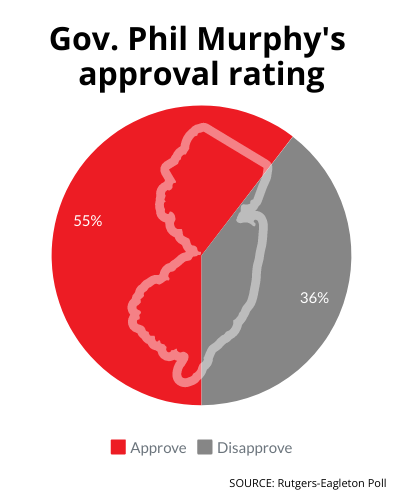 As he heads into his final year in office, that poll found the governor has a 55% approval rate – with 36% disapproving. Murphy has a 50% favorability versus 34% unfavorable. Meanwhile, 45% say that the state is “currently going in the right direction”; 46% say it has “gone off on the wrong track”; and 9% are unsure.
“Voters are a bit more mixed about the direction of the state than they were a little less than a year ago,” said Jessica Roman, director of data management and analysis at Eagleton. “Last December, voters were more negative than positive – 48% ‘wrong track’ to 43% right direction – about New Jersey. Even though this margin has narrowed, however, there really hasn’t been a significant shift in either direction on outlook since 2022.”
Tackling the issues
As the candidates make their pitches, they are each taking their own lanes in how they approach campaigning and the types of issues they seek to tackle.
At the recent New Jersey Business & Industry Association Public Policy Forum, that was on full display as five of the candidates – Ciattarelli, Fulop, Spadea, Spiller and Sweeney – took part in a panel discussion moderated by Rick Thigpen, senior vice president, Corporate Citizenship, PSEG.
During that hour-plus discussion, the candidates shared their visions on several topics, such as how to best engage and support the business community, property taxes, spending, school funding, innovation, affordable housing, corporate governance and tax rates, talent and workforce development, pensions, entrepreneurship and more.
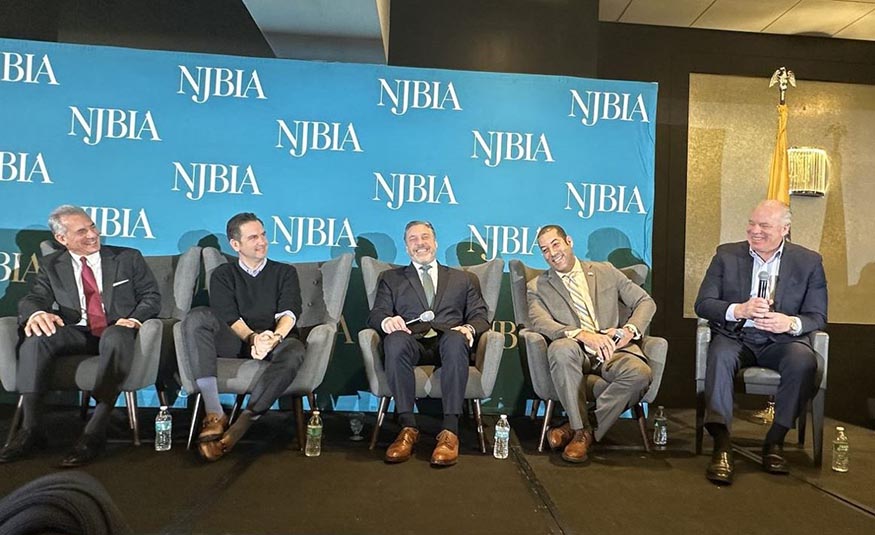
In making the case to the business community, the candidates certainly had many points of disagreements and ideological differences — as well as instances of common ground.
Over the last few weeks, candidates have spoken out on issues such as the failures of NJ Transit, congestion pricing, SALT, local drone sightings, immigration, affordability, energy/offshore wind and others.
Just before that NJBIA forum, the organization released its 66th Annual Business Outlook Survey. The analysis asked high-level business representatives to list the top three actions – in order – a new governor could take to have the greatest positive impact on their business.
They were:
- Lowering property taxes: Listed by all respondents, with 23% ranking it as their top priority and more than 53% putting it in their top three.
- Reducing health insurance costs: Cited in the top three by 51%, including 15% who listed it at the top.
- Lowering corporate taxes: 40% made it a top three item, including 16% who ranked it first.

“That a reduction in property taxes is desired by New Jersey businesses isn’t necessarily surprising, but the idea that they never seem to be in the conversation for property tax relief by policymakers is,” said NJBIA President and CEO Michele Siekerka. “New Jersey businesses have been excluded from any property tax reductions from the ANCHOR and Stay NJ programs, even though they pay nearly half the property taxes in the state annually. A new governor clearly has the opportunity to endear themselves to our job creators by finding them some much-needed property tax savings.”
Election activity and rhetoric is expected to ratchet up in earnest in the new year.
And of course, the campaign comes with the backdrop of President-elect Donald Trump re-taking office Jan. 20. The incoming administration is expected to shake things up immediately in a number of areas, which has the potential to impact the race here in the Garden State.
New Jersey’s off-year gubernatorial race, along with Virginia’s, often serves as the first bellwether for a new administration ahead of the midterms.
“We’re heading into what promises to be a very pivotal year coming up,” said Siekerka during that recent NJBIA forum. “On the heels of the national election now behind us – but with a big governor’s election next year. We know how exciting years of governor elections in New Jersey can be.”