Sign In
Upcoming Event
 Free Newsletter


Panelists at the New Jersey Performing Arts Center’s Business Partners Roundtable event on the Gateway project, from left: Balpreet Grewal-Virk, New Jersey commissioner and co-chair of the Gateway Development Commission and senior vice president, Community Health, RWJBarnabas Health, who served as moderator; Eric Daleo, chief program officer, GDC; Greg Lalevee, business manager, International Union of Operating Engineers Local 825; and Steven Plate, chief, Major Capital Projects, Port Authority of New York and New Jersey.
Panelists at the New Jersey Performing Arts Center’s Business Partners Roundtable event on the Gateway project, from left: Balpreet Grewal-Virk, New Jersey commissioner and co-chair of the Gateway Development Commission and senior vice president, Community Health, RWJBarnabas Health, who served as moderator; Eric Daleo, chief program officer, GDC; Greg Lalevee, business manager, International Union of Operating Engineers Local 825; and Steven Plate, chief, Major Capital Projects, Port Authority of New York and New Jersey.
Gateway Program leaders detail progress – and what’s ahead
Matthew Fazelpoor//October 9, 2023//


The Gateway Program has been taking major steps in recent months to move the long-delayed, much-anticipated project toward reality. A recent panel discussion reflected just how rapidly events are moving on the next iteration of the once-scrapped ARC Tunnel Project.
The discussion, part of New Jersey Performing Art Center’s Business Partners Roundtable series and titled All Aboard: The Gateway Program and Other Northeast Infrastructure Investments, featured Balpreet Grewal-Virk, New Jersey commissioner and co-chair of the Gateway Development Commission and senior vice president, Community Health, RWJBarnabas Health, who served as moderator; Eric Daleo, chief program officer, GDC; Greg Lalevee, business manager, International Union of Operating Engineers Local 825; and Steven Plate, chief, Major Capital Projects, Port Authority of New York and New Jersey.
Over the last few months, the work, which has been described as the most critical infrastructure project in the nation, has secured critical funding, awarded construction contracts and scheduled groundbreakings.
Daleo, who is responsible for leading all program management functions at GDC, which is overseeing the project, said that the overarching concern is making the Northeast Corridor more reliable and resilient for riders.
“The Gateway Program itself consists of a series of projects aimed at essentially enhancing capacity and making the system more resilient,” said Daleo. “And it starts with phase one, which includes the construction of the Portal North Bridge and the Hudson Tunnel Project. Portal North Bridge is a project under construction now – led by New Jersey Transit in partnership with Amtrak to construct a new bridge that essentially connects the Northeast Corridor. Portal North Bridge is one of the focal points of delays on the Northeast Corridor.”
The groundbreaking of that project took place last August. Daleo said that the construction is well underway – recently passing the 25% construction mark.
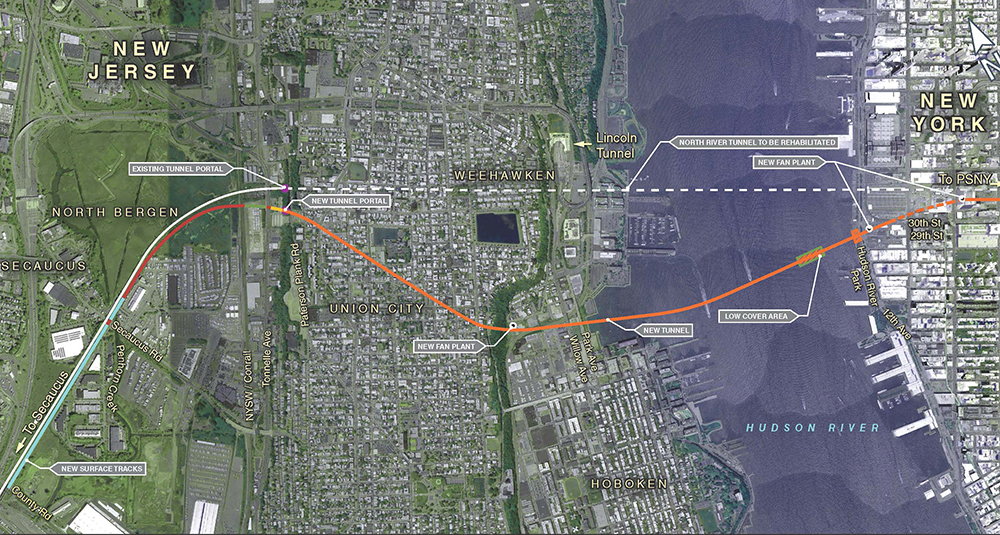
He explained that the Hudson Tunnel Project will build a new rail tunnel under the Hudson River connecting New Jersey – through Hoboken – with New York, into Penn Station.
“And that is to be complemented with – following its construction – the rehabilitation of the existing North River Tunnel. That’s the 100-plus-year-old tunnel, also with two tubes, that was damaged heavily by Sandy. That’s phase one of the Gateway Program,” said Daleo. “Phase two includes other projects, including construction of a Portal South Bridge. This would be the analog bridge. A Sawtooth Bridge project; construction on a Secaucus loop allowing trains to turn around to maximize capacity; the expansion of Secaucus Train Station; and a project called Penn Station South – allowing for maximum capacity into Penn Station. Those are the projects in the Gateway Program.”
After Daleo gave that overview of the program and projects, Grewal-Virk asked Lalevee how many jobs a project of this scope would create for his members and beyond, as well as the skills needed to make this project a reality.
“The number is in the thousands,” said Lalevee. “By example, Portal North Bridge has 90 operating engineers on it. That’s just us. Add in the other crafts – laborers, carpenters, dock builders, iron workers, the entire management staff that’s executing the project. And that’s just a small piece of what this Gateway Program is going to be. These projects have a cascading effect in jobs and businesses. It just serves as a catalyst for the entire economy. And the jobs number is just off the charts.”
Asked about the timeline for completion of the project, Daleo cited the history of major projects in this region that have been accomplished over the last few decades.
“And we at the Gateway Development Commission and our partners at the Port Authority, NJ Transit, and Amtrak – I think we are aware of that history,” said Daleo. “Now, as we look to build the largest infrastructure project in North America – thinking through the best way to deliver that. What we’ve said at the Gateway Development Commission is we need to start construction as soon as possible. And this fall, we will have groundbreakings in both New York and New Jersey to start construction of the Hudson Tunnel Project.”
He explained that the New York side construction will involve the concrete casing in the vicinity of Hudson Yards to preserve the right-of-way that will ultimately allow the tunnel to connect into Penn Station.
“On the Jersey side of the river, we look forward to breaking ground and our board voted to approve a construction contract to construct the Tonnelle Avenue Bridge and Utility Relocation project,” said Daleo. “And what it is – on the New Jersey side – there is a state highway in North Bergen, Tonnelle Avenue, that we need to move over and move the utilities that are on that bridge over. And that’s going to allow our contractor for the Palisades Tunnel portion to prepare the site and construct a portal, which is the access point for all of the tunneling operations. Moving the state highway out of the way is a critical point of interference and risk that we are looking forward to breaking ground on.”
Daleo noted that this project was also the first in the ARC Tunnel work and was actually under construction when ARC was canceled by former Gov. Chris Christie in 2010.
“That substructure that had been constructed was covered in dirt, buried – a sarcophagus in North Bergen, a project that could have been,” said Daleo. “And we’re going to unearth, essentially, the ARC Tunnel and construct it.”
While those are the first two projects, Daleo also pointed out that the Hudson Tunnel Project consists of nine different packages. “By the end of next year, five out of nine of those packages will either be in procurement or under construction,” Daleo said. “And that’s part of the recognition of our board and of our CEO, Kris Kolluri – that these projects – when we secure the federal funding, we need to move as quickly as possible. The project is not getting any cheaper. Every day that goes by, the escalation on this project is enormous. There are significant costs also in reliability to the folks that travel on Amtrak and New Jersey Transit every day. So, we have a number of procurements on the street today.”
He said that the goal of many of these early packages and projects is to have the pieces in place so that when they are ready to tunnel under the Hudson River, there’s a clear path without any obstructions.

Lalevee was asked about the size and scope of this project as well as the unique construction challenges it presents—especially versus the previous iteration. “The logistics are a complete difference from when this was done was before,” Lalevee. “That’s what makes construction around this area such a challenge – working around buildings, working around utilities. When it comes to utility construction, we try to work with all of the utility operators in the area. Out in the Midwest or Southeast, they put the utilities in and build their communities. We were always here. The people were always here, and we had to back our utilities into it. So, when we open up our streets and whatnot, there’s water over electric, over gas, over cable TV. It just becomes a whole rat’s nest of things that are under our feet that we never see. These things continue to be the challenge.”
From there, Grewal-Virk asked Plate about the Port Authority’s role with the Gateway Project. He replied that the Port Authority is part of the team – pointing to an agreement the agency worked out with the GDC where the agency will handle a portion of the project in concert with GDC.
“We have the first segment, which is being handled by Eric and his team on Tonnelle Avenue. It’s a hand-in-glove situation,” Plate explained. “We’re going to take it from there – the core shell underneath the Palisades to Weehawken/Hoboken on 18th Street.”
Plate went through some of the next steps. “We build the shell. It’s like the frame of a building,” he said. “Our role is specifically to build that tunnel, which I’m very proud that GDC chose us to do that. Because it’s something that we really – as engineers and architects are looking forward to.”
Daleo was asked one of the most pressing questions – about the cost.
“Sixteen billion dollars is the number,” he said. “Look at the history of the ARC Tunnel Project. One of the reasons that the ARC Tunnel Project was doomed was because that number kept on increasing – and the risk to the State of New Jersey kept on increasing. So, when Kris and I arrived 14 months ago, we wanted to do something a little bit different.”
He explained that they hired a cost assurance firm and did a full estimate and analysis of costs, which led to that $16 billion estimated price tag. GDC then went through a stress test/risk assessment with the Federal Transit Administration, which Daleo said they survived.
“And we’re getting ready now as we begin to request what’s called a full-funding grant agreement, which is the final step in the CIG [Capital Investment Grants] process,” Daleo said. “We have to go through that step now a second time – a second level of analysis.”
That process could take up to two or three years on a normal project. “For us, it’s eight months because this project has been so accelerated by our partners in the federal government and because of the partnership between New York, New Jersey and Amtrak – who are all unified in making sure this project moves on an accelerated track,” said Daleo. “So, the short and the long answer is $16 billion.”
Daleo went into a little more detail about the funding and grant process – noting that securing $16 billion is a challenge in itself – and that the first grant request was for $25 million for the Tonnelle Avenue work.
“And we’re ending big with our letter of entry into engineering from the Federal Transit Administration’s Capital Investment Grant of a commitment of $6.88 billion – of eligibility,” he explained.
They have also submitted a multibillion-dollar application for funding through a Federal Railroad Administration grant program and expect an announcement shortly.
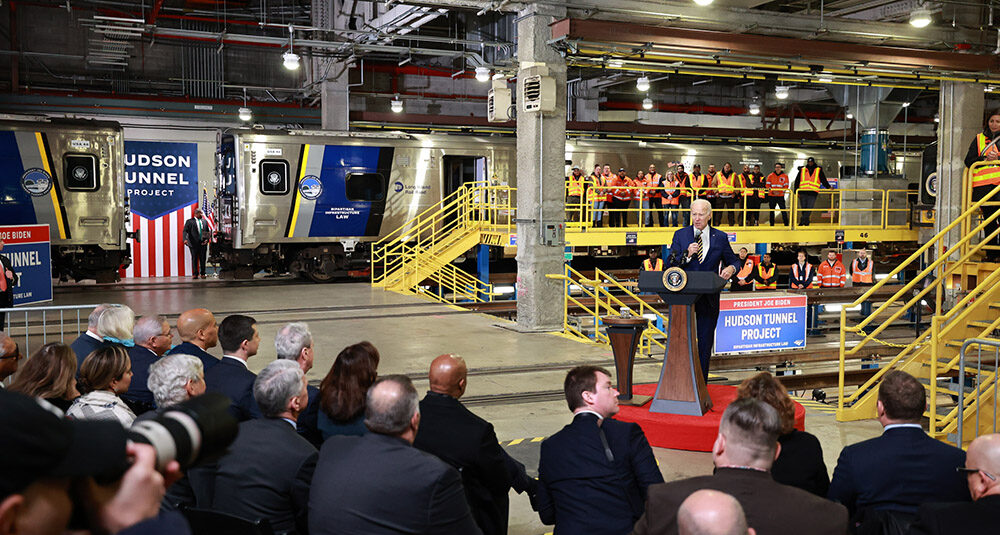
“What New York, New Jersey, and Amtrak have agreed to do for the balance is to essentially split the responsibility – a third, a third, a third, and to split any potential overruns – a third, a third, a third,” said Daleo. “And they have agreed to that between the three of them and the Gateway Development Commission – called a project development agreement. And what the PDA also specifies, is that if any party delays any element of the project, it’s that partner’s responsibility for those costs.”
“So, it’s a combination of working to secure this funding from the Federal Transit Administration and the Federal Railroad Administration. And we’re not bashful, we will apply for funding everywhere,” said Daleo. “Combined with a responsible structure for how the states and Amtrak can share that risk on a moving forward basis. And that holds the right parties accountable for their actions.”
The discussion continued through some more details about the construction process – changes in methodology from the past, the rehabilitation of the current tube, the role of innovation and technology, and more – before closing out with final thoughts.
“I think the cost of not doing this just completely exceeds the cost of doing it,” said Lalevee, who noted the intangible costs, jobs, and economic impact it will provide as well as getting cars off the road, helping to fight climate change, and more. “It means the whole world to this region.”
“This is a gamechanger. We have to embrace it and move forward – and leave the world a little better place than the day we came into it,” said Plate. “And then we’ve accomplished our mission.”
“I can’t tell you how proud I am of being the New Jersey co-chair of the Gateway Project,” said Grewal-Virk as she wrapped up the discussion. “But I’m even prouder of everyone we are working with and the collaboration you see up here. We can’t do it alone. It’s a team effort.”