Sign In
 Free Newsletter

University Hospital first in the state to implant world’s smallest pacemaker
Arrhythmia Institute brings state-of-the-art heart technology to New Jersey
Anthony Vecchione//February 27, 2020//
University Hospital first in the state to implant world’s smallest pacemaker
Arrhythmia Institute brings state-of-the-art heart technology to New Jersey
Anthony Vecchione//February 27, 2020//


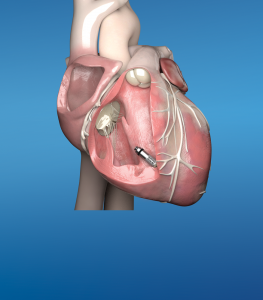
University Hospital in Newark said Wednesday that its newly established Arrhythmia Institute became the first facility in the state to implant the Micra AV device, the world’s smallest pacemaker with atrioventricular (AV) synchrony from Dublin Ireland-based Medtronic.
The Arrhythmia Institute is also in the final stages of approval to be the only center in New Jersey to offer the WiSE-CRT System from California-based EBR Systems, Inc, which is designed to overcome the limitations of the existing CRT systems that deliver pacing stimulation outside the heart.
The WiSE CRT System was developed to address the persistent limitations of current CRT systems and to provide a more customized, patient-specific solution.
“I am incredibly grateful to work alongside such a hardworking and talented team here at the Arrhythmia Institute as we look towards implementing more leading-edge cardiac technology to better treat our patients,” said Dr. Emad Aziz, director of the Arrhythmia Institute. “Given the success we have seen with the Optimizer and Micra AV device implants, coupled with our progress toward final approval to begin offering the WiSE-CRT System, University Hospital is poised to lead the way in modern arrhythmia health care, not only in New Jersey but in the field at large,” said Aziz.
“When Dr. Aziz joined University Hospital, we had complete faith that he would create a state of the art electrophysiology program, but we could not have foreseen how quickly he and his team would be able to achieve so much in such a short time,” said Dr. Shereef Elnahal, president and chief executive officer of University Hospital. “Our Arrhythmia Institute has quickly established itself as a provider for first-rate cardiac care to patients in Newark and now, throughout New Jersey. We are excited to see how Dr. Aziz and the team will continue to drive the arrhythmia healthcare field forward into the future,” said Elnahal.
Heart failure is a condition in which the heart isn’t able to meet the body’s needs, by either not filling up with enough blood, or being unable to produce enough force to pump blood throughout the body. Heart failure is a very common condition that over 5 million people in the United States have been diagnosed with. While there is no cure, innovative treatments help improve the quality of life for those living with heart failure.
Over the last seven months, the Arrhythmia Institute has established a number of unprecedented milestones for University Hospital. In addition to introducing brand new procedures in the state and reestablishing the Electrophysiology (EP) Laboratory as a leader in health care technology and services, they have also performed more than 440 procedures with no complications.
The Optimizer Impulse Dynamic device delivers timed electrical pulses called CCM (Cardiac Contractility Modulation) directly to the heart. CCMs trigger a host of physiological benefits such as an increase in calcium uptake and improving cell metabolism and gene expression and decreasing common heart failure symptoms such as shortness of breath and fatigue.
The Micra AV device, which is implanted through a minimally invasive procedure, is used to treat patients with an atrioventricular block, in which the electrical signals between the atria and ventricle chambers of the heart are impaired. The Micra AV device, at one-tenth the size of a traditional pacemaker, has several additional internal atrial sensing algorithms to improve detection of cardiac movements. This allows the device to better adjust the electrical activity of the atrial and ventricle chambers providing “AV synchronous” pacing therapy, leading to increased blood flow from the left ventricle and improved quality of life for patients.
The WiSE-CRT System, unlike other pacemakers, uses proprietary wireless technology to deliver endocardial stimulation or pacing from inside the heart, to more accurately synchronize the pace of the left and right side of the heart. This approach gives the system more flexibility to be customized to best support each individual patient.
The Arrhythmia Institute’s success has extended the work of Electrophysiology service to other hospital services such as the ICU, sleep medicine, emergency medicine and stroke. Additionally, multiple practices from around the region, including Jersey City, Bayonne, Union, and Paterson are now sending their patients to University Hospital for EP services.