Sign In
Upcoming Event
 Free Newsletter

Bringing the doctor to the house
At-home health care gains traction in New Jersey
Martin Daks//July 8, 2019//
Bringing the doctor to the house
At-home health care gains traction in New Jersey
Martin Daks//July 8, 2019//


Driven by demographics – graying baby boomers, mainly – home-based health care is a growth industry in New Jersey. Consider the hiring statistics: the state’s share of home health care employment is “meaningfully greater” than the national rate, according to a late 2018 report by the Department of Labor & Workforce Development; and more than half of all the job postings for licensed practical nurses in New Jersey were tied to a single employer – Bayada Home Health Care – according to a 2017 study by the New Jersey Collaborating Center for Nursing.
Since 1975, Bayada “has had a special purpose to help people have a safe home life with comfort, independence, and dignity,” the company said in a statement. It operates in 23 states, including New Jersey, and in six countries.
A growing market
“The market is close to $2 billion a year today [in New Jersey] and we anticipate that will rise to about $17 billion in 15 to 20 years,” said Dan Powell, chief executive officer of Visiting Nurse Association (VNA) of Somerset Hills. “The elderly make up a larger share of the population, and people are living longer. More people want to stay in their residence and home care can often deliver the same high-quality outcome at less expense.”

In the past, hospital services were mainly confined to the hospital itself. But today, thanks in part to medical advances and in part to reimbursement restrictions by payors like Medicare, Medicaid and insurers, “[h]ospital stays are getting shorter, and people are being discharged earlier,” Powell noted. “That’s OK, because they don’t need acute care at that point, but they still often require skilled care. Thanks to at-home services like ours, they can get that – from a variety of specialists – in the comfort of their own home. Besides the benefit of being surrounded by family members, they’re also not around ill people, so they’re not as likely to pick up a bug from other individuals. Studies have shown that the outcome from at-home skilled care is as good as or better than a hospital stay, and we can deliver that care at a lower cost. So everyone’s happy.”
VNA of Somerset Hills and other home health services companies can do this “because we don’t have the brick-and-mortar, and acute-care facility costs that hospitals do,” he added. “We deliver high-quality results, but we’re mainly covering personnel costs. So we can pass these savings on.”
Powell isn’t just blowing his own horn. In a 2018 study published in the Journal of General Internal Medicine – involving Brigham and Women’s Hospital, and believed to be the first randomized controlled trial of home hospital patients performed in the U.S. – the direct cost for home patients was 52 percent lower than for the control group of hospital patients.
During the study, “[h]ome patients were more physically active, with a trend toward more sleep,” according to the report. “No adverse events occurred [among the] in home patients, one occurred in control patients.”
Virtually all VNA of Somerset Hills home-based caregivers are employees, according to Powell. “Sometimes a handful may be from skilled nursing facilities that we’ve teamed with; but these are people who we’ve trained and supervised,” he said. “We are able to realize more efficiencies with employees – who enjoy a robust set of benefits and a pleasant working environment – and we want to ensure that caregivers meet our standards and understand our processes.”
His agency and others can bring in a variety of skilled caregivers, including physical therapists, occupational therapists, speech therapists and others.
Caseworkers and other professionals also keep in touch with the discharging hospital, physicians and others to coordinate care, Powell noted. His organization can also provide end-of-life hospice care, bringing together social, spiritual and other professionals and counselors “to develop and coordinate a personalized care plan that focuses on the patient’s physical, emotional and spiritual needs,” according to a VNA of Somerset Hills statement.
An expanding provider base
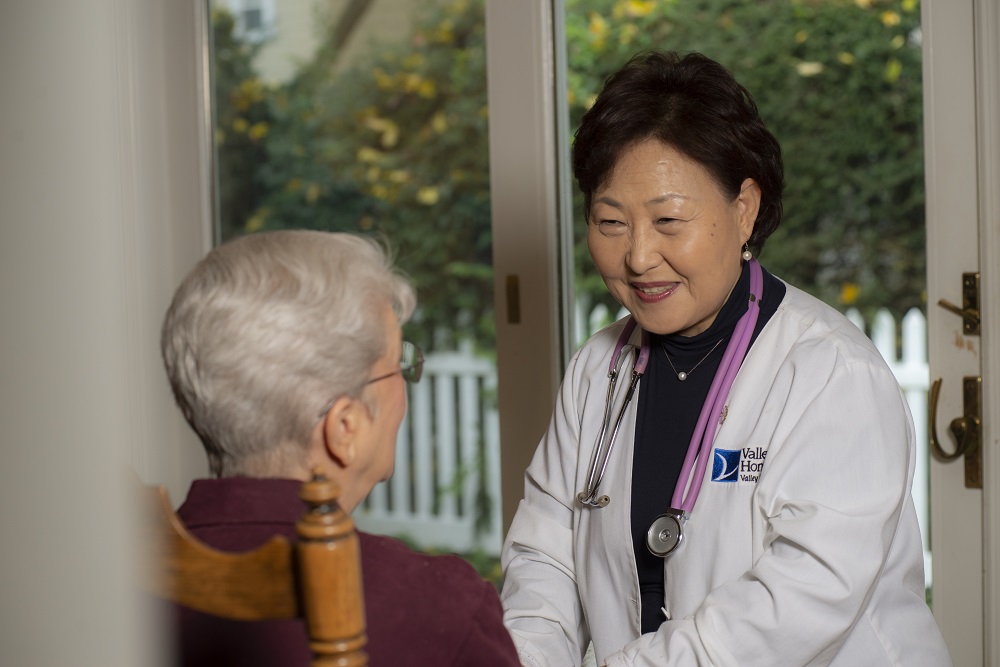
Hospitals and affiliated institutions are also stepping up their at-home game. Since 1987, Valley Home Care – one of the entities that makes up Valley Health System, which also includes The Valley Hospital and Valley Medical Group – has been delivering home-based health care services.
“Like the other entities in the Health System, we have high patient satisfaction scores and quality outcomes, including the overall rating of our home care services and likelihood of recommending our agency when compared to our peers,” said Donna Fry, vice president of Valley Home Care. “We have a number of initiatives underway at Valley to ensure multiple convenient ways for our patients to access care from our organization. Home care and hospice services in the home enable patients and families to be together in the comfort of their home, and helps to avoid the need for emergency care, rehospitalization, or the need for a skilled nursing facility.”

Patients are “less prone to infections or contagions,” she noted, adding that “recovering in your own home with your comfortable surroundings is most desirable and therapeutic.” The cost of care is less in the home, Fry added.
Her organization can provide a spectrum of at-home services, with providers that include RNs; advanced practical nurses; physical, occupational and speech therapists; social workers; dieticians; end-of-life doulas; art and music therapists; bereavement counselors and others, she noted. Utilizing the organization’s Telemanagement remote monitoring system, “we can monitor vital signs, and assess the patient’s status remotely, including heart rate, blood pressure, weight and the level of oxygen content in their blood,” Fry added.
Despite the opportunities and benefits associated with at-home health care, however, there are some challenges. One issue is “reimbursement for the amount of care patients and families need or want,” she noted. “Another is the availability of 24 hour staff and home health aides.”
Home care and hospice services in the home enable patients and families to be together in the comfort of their home, and helps to avoid the need for emergency care, rehospitalization, or the need for a skilled nursing facility.
– Donna Fry, vice president of Valley Home Care
Other organizations see similar issues. With some 10,000 baby boomers turning 65 every day, “it can be a challenge to hire all the staff we need,” said Michelle Mendelson, senior vice president of Hackensack Meridian Health’s homecare division. Still, for more than 35 years, “We’ve been involved offering convenient access to people. Now, for example, right after hip surgery, you can go home and get care in your residence. We can also offer home-based infusion [administering medications directly into a vein through a needle or catheter] and other services. There’s a tremendous amount of patient interest in at-home care. Baby boomers have helped to shape these expectations.”
Home-care services are generally less-expensive than those delivered in hospitals, “because we don’t have the huge infrastructure associated with a hospital setting,” Mendelson said. “Our main cost is labor, and we can bring in specialists as needed.”
Even when it comes to hospice care, “we can offer pain management and other services” without carrying the overhead of a complete hospital infrastructure. “Of course it’s important to be cost-efficient, but it’s also vital to pair that with quality and outcomes,” she noted.
She sees continued growth for the at-home segment, as “insurers, regulators and the CMS [the federal Centers for Medicare & Medicaid Services] support these efforts, when appropriate. Technology is also driving the trend, with smartphones and apps that make it easier to receive and manage medical information.”