Sign In
 Free Newsletter

Seeking stability
Business leaders, progressives hope for return to normalcy under Biden
Daniel J. Munoz//January 25, 2021//
Seeking stability
Business leaders, progressives hope for return to normalcy under Biden
Daniel J. Munoz//January 25, 2021//


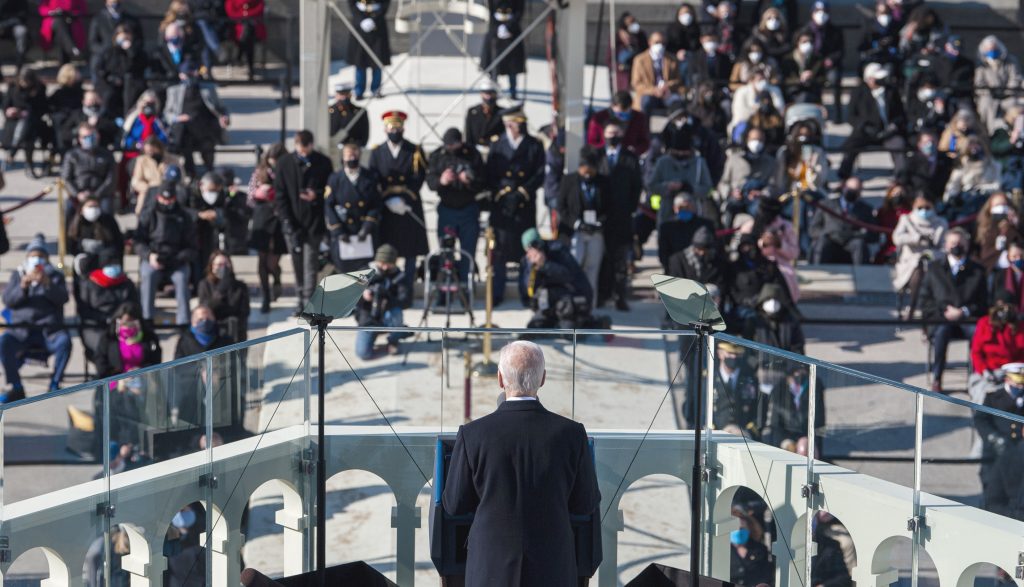
While many business executives, progressives and labor leaders disagree on issues related to taxes and regulations, most expressed at least some confidence in what could be in store for New Jersey under the administration of President Joe Biden. “The tone will be calmer,” said Tom Bracken, president and chief executive officer of the New Jersey Chamber of Commerce. “That’ll allow the ability to focus on the real areas of need as opposed to getting sidetracked every five minutes by some other issue that pops up. It kind of gives a more normal atmosphere.”

That stability is crucial for businesses, according to Ben Dworkin, a political analyst who heads the Rowan University Institute for Public Policy and Citizenship. “If you’re running a major corporation, a multinational corporation, if you had factories and offices around the world, around the country, or even around the state, you were worried over the last few years about where the president might go tomorrow, what’s going to be the new priority, who’s going to be attacked because you said something or didn’t say something or did something he liked or didn’t do something,” Dworkin said in a Jan. 19 podcast interview with the New Jersey Society of CPAs.
Dworkin said businesses now have an idea of what’s ahead: a potential reversal of the 2017 21% federal tax rate for businesses, which was slashed from 35%. “But they know it’s coming,” he said. “Any good CEO and [chief financial officer] is preparing now for those higher tax rates, understanding that the break they got in the Trump administration is not going to be the same as what they get under the Biden administration.”
Many in the state’s business and political circles have pointed to three ways New Jersey will benefit: the long-awaited federal approval of the rail tunnel replacement under the Hudson River; a repeal of the $10,000 federal cap on state and local property tax deductions; and federal aid to shore up the state’s response to the COVID-19 pandemic and its vaccination efforts.
In addition, Biden’s $1.9 trillion economic recovery proposal includes $350 billion for state and local government aid. New Jersey had to borrow more than $4 billion to fill holes in its budget created by the pandemic.
“We are optimistic that the Biden administration will bring about a robust vaccination program and enhanced support for businesses struggling to survive in the short term, and, going forward, will place great emphasis on infrastructure and innovation that drives jobs and consider relief from the SALT challenges that our state faces,”

Michele Siekerka, president and CEO of the New Jersey Business and Industry Association, said in a Jan. 20 statement.
Gov. Phil Murphy agreed that the Gateway tunnel would finally leave the station with following Biden’s inauguration. And Anthony Coscia, who chairs Amtrak, which owns much of the Northeast Corridor including the Hudson River portions, cited Biden’s support for public infrastructure.
“I think there are a lot of reasons. In an effort to recover from the economic impact of COVID, that infrastructure will be front and center,” with the Gateway Development Corp. taking the lead,

Coscia said in an interview soon after Biden’s victory.
Widespread vaccinations – both in New Jersey and nationwide – will be the most important step toward resuming much of pre-pandemic life. In New Jersey, state health officials are trying to vaccinate 4.7 million adults within six months. But the rollout of the vaccinations under the Trump administration has been plagued by delays and shortages. By the time former President Donald Trump left office, fewer than 16 million people had been vaccinated, rather than 20 million Americans he promised by the end of December.
“To the degree that the pharmaceutical industry in New Jersey is involved with developing new vaccines, manufacturing new vaccines, distributing the vaccines, to the degree that our health care economy, not just the pharmaceutical companies but the entire health care infrastructure is involved with that, they should expect they’re going to be the priority,” Dworkin said.
Three of the global drugmakers working on COVID-19 vaccines are based in New Jersey: Merck, Sanofi and Johnson & Johnson.

“We hope the Biden Administration recognizes the important role of America’s biopharmaceutical industry indeveloping vaccines and treatments to combat the COVID-19 pandemic and delivering value to our health care system through life saving therapies and cures,” Debbie Hart, president and CEO of BioNJ, the trade group for thestate’s pharmaceutical industry, said in a statement.
A POST-PANDEMIC ECONOMY
Biden’s stimulus plan calls for $15 billion in small business grants, and $175 billion in low-interest loans, to help businesses through the worst of the second wave and hold them over until the summer and the end of the pandemic. And Biden proposed a nationwide $15 minimum wage. The current rate has remained at $7.25 for over a decade. New Jersey minimum wage went up to $12 an hour on Jan. 1, and will reach $15 an hour in 2024
“You look at a lot of the folks hired into the Biden administration … that is an economy that centers on growing the economy from the bottom to the middle out, it is not trickle-down economics,” said Brandon McKoy, president of the left-leaning think tank New Jersey Policy Perspective.

McKoy suggested that the economic recovery priorities in a Biden White House are centered on the notion that higher wages and more “spendable income” drives “people’s ability to take part in the economy,” which he said is vital to triggering a broader rebound.
“If unemployment is low but poverty is high, we’re not doing our jobs. Focusing on poverty and hunger, homelessness … metrics that demonstrate basic needs and welfare, that is going to be the priority.”
But Anthony Russo, president of the Commerce and Industry Association of New Jersey, took a more cautious view, citing the prospect of higher taxes. “If [Biden] starts rolling out all these taxes on businesses, businesses are going to constrict, they’re going to have to adapt, they’re going to have to make cuts,” he said in an interview.
“Maybe that means a loss of jobs, a scale-back of production.”
Bracken and Siekerka agreed. New Jersey did, after all, finally enact a millionaire’s tax, and extended the increased corporate business tax for the highest-earning businesses, Bracken pointed out. “We also hope there is recognition by the Biden administration that a tax-and-spend platform will create further challenges for New Jersey, as a national outlier for taxes and business climate,” Siekerka said.
Bracken contended that Trump strengthened the economy. “It was booming before COVID and that had to do a lot with his very pro-business work, and his international work,” Bracken said. “The fact is under Trump it happened, you have to think he had some impact.”

John Kennedy, who heads the nonprofit New Jersey Manufacturing Extension Program, agreed that some aspects of the Trump doctrine helped the state and nation shore up manufacturing. He pointed to larger federal tax breaks that allowed companies to reshore some plants in the U.S. and the replacement of the North American Free Trade Agreement with the United States-Mexico-Canada Agreement.
But Kennedy said he hopes the Biden administration will help bolster the manufacturing supply chain, which has been devastated amidst an economic recession. In the short-term, Kennedy called for a “state-by-state national database for supply chain, so we can communicate better to know who makes” personal protective equipment or vital components for them.
“The fallacy that was driven in New Jersey and outside was that nobody made PPE during the pandemic. A lot of companies do. There’s quite a few companies in New Jersey but we don’t know of them because they maybe make a component of them.”
STRONGER JOB PROTECTIONS
Part of the $1.9 trillion stimulus proposal, and the COVID-19 response Biden outlined after his inauguration, includes a larger role for the federal Occupational Safety and Health Administration in private workplace protections against CO-VID-19. Critics argued that under Trump, OSHA largely punted the responsibility to individual states, creating a patchwork of labor protections.

Debbie Berkowitz, a former senior policy advisor under OSHA, and chief of staff at the agency during the Obama administration, said over the summer that the federal agency had largely been absent. “They have merely issued advisory guidance and posters that they are not enforcing. And the guidance is quite vague and filled with language such as ‘strive for’ or ‘consider this.’”
One order that Biden announced will direct OSHA to provide guidance for workplace safety on the virus. “If the Biden administration issues an emergency standard, employers would be required to provide certain protections for their workers during the pandemic,” Todd Vacchon, faculty director at the Labor Education Action Research Network within Rutgers University, said in a Jan. 18 statement. “Biden’s OSHA could also implement better data collection and tracing protocols, stiffer penalties for non-compliant employers, and a more aggressive naming-and-shaming approach for the worst offenders.”