Sign In
 Free Newsletter

In public comment, Murphy outlines grave congestion pricing concerns
'Enough is enough,' the governor said during call-in to MTA hearing
NJBIZ STAFF//March 5, 2024//

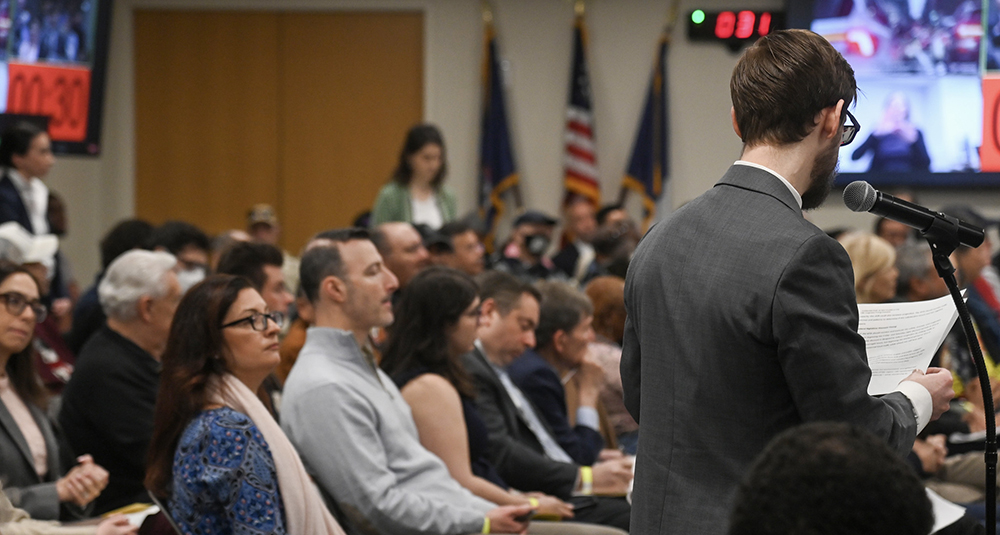
The Metropolitan Transit Authority held its final public hearing March 4, 2024, regarding its congestion pricing program. - PROVIDED BY MARC HERMANN/MTA
The Metropolitan Transit Authority held its final public hearing March 4, 2024, regarding its congestion pricing program. - PROVIDED BY MARC HERMANN/MTA
In public comment, Murphy outlines grave congestion pricing concerns
'Enough is enough,' the governor said during call-in to MTA hearing
NJBIZ STAFF//March 5, 2024//


Gov. Phil Murphy weighed in March 4 as final public hearings took place before a tolling scheme is finalized for New York’s controversial congestion pricing program. Murphy formally submitted written comments and called into the Metropolitan Transit Authority (MTA) board hearing.
“Today, I again voiced New Jersey’s concerns with MTA’s plans for congestion pricing in New York City,” said Murphy. “MTA continues to cut corners on the legal and procedural requirements to establish congestion pricing in an effort to ignore the chorus of voices rising up in opposition to MTA’s plans. Enough is enough. It’s time for the MTA to abandon its proposal and rethink congestion pricing in a way that makes sense.”
The current proposed structure recommends a $15 toll for passenger vehicles to enter the area south of 60th Street in Manhattan. You can read more about the proposed pricing structure here.
The MTA held the third and fourth public hearings Monday. Murphy called into the first session, a recording is available here.
“On behalf of the 9.3 million residents in New Jersey, let me just say that this an incredibly ill-conceived plan,” Murphy said at the start of his nearly two-minute call into the public hearing. “And it is, frankly, not about congestion or the environment. It is a means to solve the deficit at the Metropolitan Transit Authority. That’s what that is – and you’re asking New Jersey commuters to weigh in and help that. And $15 may not seem like much with a couple billion-dollar deficit – but that’s backbreaking for our commuters. And not only that, it will displace the pollution and the challenges to the environment simply from the Central Business District in Manhattan to Hudson and Bergen Counties in New Jersey.”
Murphy cautioned this will lead to toll shopping. Additionally, it will result in not just a financial disaster for New Jersey commuters but an environmental disaster for North Jersey.
“We’re reasonable people. We have probably the strongest pro-environmental track record of any American state over the past six-plus years,” Murphy continued. “We want to be reasonable – I promise you. We are good partners. We do an enormous amount with New York – but this is completely unacceptable on behalf of our commuters. We are willing to sit at the table with the MTA and its leadership, other community representatives, and try to see if we can find some common ground.”
The governor stressed he is personally willing to do that.
“But if this is the plan – as it is constructed, it is completely and utterly unacceptable to the commuters from New Jersey into Manhattan,” Murphy closed the call.
Governor’s recommendations
In his eight-page letter, Murphy laid out the concerns in further detail as well as offered recommendations:
- Revise and shorten the period during which drivers are subject to peak-hour tolling
- Clarify that the low-income toll credit and crossing credits apply jointly
- Provide crossing credits for those who use the George Washington Bridge
- Increase the crossing credits for all New Jersey crossings
- Do not toll during off-peak hours
- Provide additional credits or refunds to all low-income drivers so that they have parity with low-income drivers in the Central Business District
Murphy said that New Jersey will use every tool at its disposal to fight “the unfair and unjust plan,” including continuing to pursue legal challenges – noting the lawsuit already pending, which was expanded in January to include the MTA and Triborough Bridge and Tunnel Authority (TBTA) – in addition to the U.S. Department of Transportation and the Federal Highway Administration, with the lawsuit alleging that the federal government violated the National Environmental Policy Act and the Clean Air Act by approving plans for congestion pricing without adequate environmental review.
Pushing back
In a statement to NJBIZ, the MTA pushed back against the criticism and defended its process.
“A 4,000-page yearslong environmental review studied traffic impacts with intersection-level granularity nearly all the way to Philadelphia and found no significant environmental impact,” John McCarthy, MTA chief, policy and external relations, told NJBIZ. “Today we are hearing from those who are interested in offering their comments as part of the ratemaking process for Central Business District toll, in accordance with New York State law. Those comments will be reviewed and considered before the MTA Board votes this spring on a toll rate structure.”
Over four hearings, the MTA says nearly 400 speakers addressed MTA leaders and board members about congestion pricing.
The public comment remains open through March 11. More details on how to weigh in can be found here.