Sign In
 Free Newsletter

IT leaders discuss population health, data security at health tech conference
Anthony Vecchione//May 8, 2019//

IT leaders discuss population health, data security at health tech conference
Anthony Vecchione//May 8, 2019//


 Listen to this article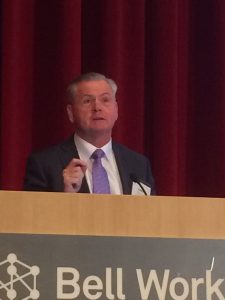
Experts in health care information technology from hospitals, medical device manufacturers, pharmaceutical and health insurance companies shared their ideas and discussed best practices on Tuesday at the NJ Tech Council Future Forum 2019 at Bell Works, the landmark former Bell Labs headquarters in Holmdel.
Technology and innovation were the dominant themes and panel members addressed topics including population health, data security, cloud computing and strategies on how to make health care easier for patients.
“The goal of the health tech conference is to share best practices, latest trends, and insights about how technology is transforming health care,” James Barrood, president and chief executive officer of NJ Tech Council told NJBIZ.
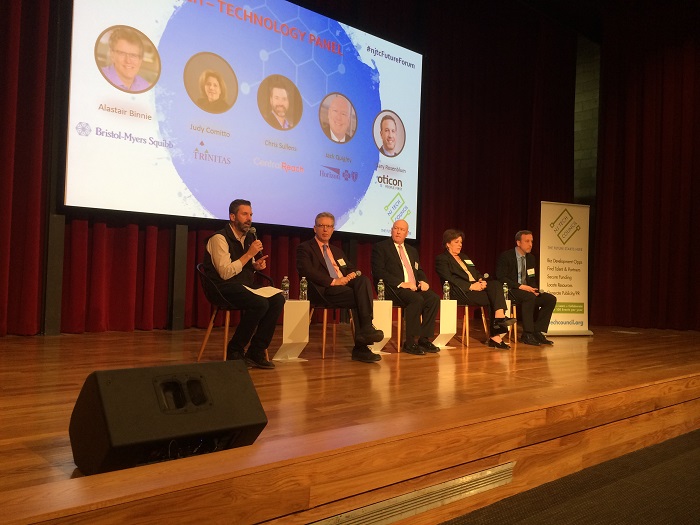
The forum was comprised of two panels: a technology panel featuring: Alastair Binnie, head of Information Technology for Research & Development at Bristol-Myers Squibb; Judy Comitto, vice president IT and chief information officer at Trinitas Medical Center; Chris Sullens, CEO of CentralReach; Jack Quigley, chief architect at Horizon Blue Cross Blue Shield of New Jersey; and Gary Rosenblum, president of Oticon Inc.
The innovation panel included: Robert Zambon, director, Real World Innovation Janssen; Colleen Riley, vice president, Science and Technology for the Joint Replacement Division of Stryker Orthopaedics; Tiffany McLaud, head of the Consumer Health Accelerator for Bayer; Cathy Bennett, president and CEO of the New Jersey Hospital Association and Dr. Michael Kirchhoff, chief innovation officer at Cooper University Health Care.
Keynote speaker Joseph Scott, executive vice president for Health Care Transformation for RWJBarnabas, presented a high-level overview of what his health system is focusing on in order to create and sustain healthy communities.
Scott said that social impact is a key strategic asset.
“We believe that as we move to value the key strategic asset will be the social determinants of health, making sure that patients have the basic things that they need to access health care.”
Scott stressed that as New Jersey moves from a fee for service payment model to a model where hospitals will be at risk for outcomes and cost, there will be a need to redesign how care is delivered and how to make it more standardized.
“We know that CMS has a goal that 95 percent of their payment will be in some type of alternative payment model by 2025. We have an aging and complex population in New Jersey and thousands of people are now eligible for Medicare,” Scott said.
He added that RWJBarnabas is moving from the hospital to the medical neighborhood strategy.
“We are trying to figure out how to make health care easier and accessible for people within a particular neighborhood. Our goal is to have the primary care physician in our service area within a 15-minute drive of every person who we serve.”
Physician burnout, said Scott is a major issue in part because physicians spend too much time staring at that screen.
“We find that’s a big issue within the health care system. We work with a company that has been able to streamline the medical record and save physicians 35 percent of their time in searching the medical record for information that they need.”
Scott said that RWJBarnabas is using more apps designed to make health care easier for patients. For example, an app for appointment scheduling that also allows direct access to a patient portal; a texting app that asks a patient who was admitted to the hospital if someone explained their plan of care and asked their satisfaction level.
Panel members asserted that data security, privacy and cloud computing are integral parts of today’s health care IT landscape.
Quigley, chief architect at Horizon Blue Cross Blue Shield of New Jersey, said that Horizon moved to the cloud two years ago. “It gives a chance to rethink how we build not just our infrastructure, but truly our whole model of delivering capabilities to our consumers.”
Quigley added that security and privacy are paramount issues.
“We built in security in everything we did, it is in our delivery pipeline. The cloud has given use much richer capabilities faster and much more automated resources.”
Comitto, vice president IT and CIO at Trinitas Medical Center, told attendees that cloud computing has worked extremely well. “There are reasons for that, one is financial. Companies that are specific to health care were able to process multiple hospitals on the same server and maintain our security and allow us access to host devices as needed. It has been an extremely positive experience and clinicians have no idea the equipment is not on site,” Comitto said.
Bennett, president and CEO of the New Jersey Hospital Association, said that among the innovations that the association is keeping an eye on several emerging trends including 3-D printing.
“We’ve seen the emergence of 3-D printing. I’ve seen a great uptick. That’s one of the things that are going to be really important in the future. 3-D printing is something where the health care sector has become the second largest sector in that industry.”
“As a hospital association, we realize that we have the ability to be the tip of the spear for where the industry is going to be going. We’ve been making a lot of investments and the most specific in health analytics,” said Bennett.