Sign In
Upcoming Event
 Free Newsletter

Legislators weigh change in law over ‘magic mushroom’ compound
Evidence mounts on therapeutic value of psychedelics
Kimberly Redmond//November 4, 2024//

Psilocybin is the psychoactive compound in so-called “magic mushrooms.” - DEPOSIT PHOTOS
Psilocybin is the psychoactive compound in so-called “magic mushrooms.” - DEPOSIT PHOTOS
Legislators weigh change in law over ‘magic mushroom’ compound
Evidence mounts on therapeutic value of psychedelics
Kimberly Redmond//November 4, 2024//


The basics:
- New Jersey is considering a bill that would legalize the use of psilocybin, the psychoactive compound in “magic mushrooms,” as a mental health treatment.
- Psilocybin is currently classified as a Schedule I drug at the federal level, but research has shown its potential therapeutic benefits for treating conditions such as depression, anxiety, post-traumatic stress disorder and addiction.
- If passed, the psilocybin program – to be overseen by the Department of Health – would have strict regulations, including license documentation requirements, medical supervision, data collection, production restrictions and more.
Lawmakers in Trenton are considering a bill that would legalize production and use of psilocybin – the psychoactive compound in so-called “magic mushrooms” – as a mental health treatment in New Jersey.
Under Senate Bill 2283, the state would allow the establishment of licensed psilocybin production facilities, treatment centers and testing operations. After that, individuals suffering from certain conditions would have access to the non-addictive psychedelic drug in regulated settings.
Similar to marijuana, psilocybin has been categorized as a Schedule I drug under the Federal Controlled Substances Act for the last 54 years. Since the government considers it a drug with a high potential for abuse that serves no legitimate medical purpose, it is illegal to possess, obtain, distribute or produce psilocybin under federal law.
However, research interest in the use of psilocybin under professional supervision – or psilocybin-assisted therapy – to treat mental health conditions, like depression, anxiety, post-traumatic stress disorder and addiction, has been growing. In fact, the U.S. Food and Drug Administration granted “breakthrough therapy” designation to psilocybin-assisted psychotherapy for both major depressive disorder in 2019 and treatment-resistant depression in 2018.
Despite its status as a Schedule I controlled substance at the federal level, possession of psilocybin has been either decriminalized or deprioritized in some states. Others have proposed or enacted legislation to regulate production, sale or supervised administration.
If the state Legislature approves the bill and it is signed into law, New Jersey would become the third state in the U.S. to regulate the use of psilocybin for health care treatment. Oregon and Colorado have already legalized it for therapeutic uses, as well as research.

Senate President Nick Scutari, D-22nd District, primary sponsor of S2283, said, “Scientific research is showing that psilocybin can be a safe and effective treatment for severe depression, anxiety and other mental health disorders.”
He added, “This bill will create a framework for a program that offers professionally supervised services to qualified patients who would benefit from psilocybin treatment. This has the potential to make a real difference in the lives of those who suffer adverse behavioral health conditions.”
After clearing the state Senate Budget and Appropriations Committee Oct. 7, the bill was sent to the full Senate for further consideration.
State Sen. Joseph Vitale, D-19th District, said, “We are only just beginning to grasp the true breadth of the number of New Jerseyans facing daily struggles with debilitating issues such as severe depression, chronic pain and addiction, as well as other health disorders. We also know that finding effective treatment for such ailments can be difficult.”

“Mental health disorders are not a one-size fits all category – psilocybin might be the one treatment that works for thousands of people in our state,” said Vitale, chair of the Senate Health, Human Services and Senior Citizens Committee and primary sponsor of the bill.
Co-sponsors include state Sens. Holly Schepisi, R-39th District; Andrew Zwicker, D-16th District; Nilsa Cruz-Perez, D-5th District; and Declan O’Scanlon, R-13th District.
Since the proposal’s introduction in 2022, it has undergone a few revisions. The bill that advanced last month in the Senate focuses largely on therapeutic access for adults over 21. A previous version included provisions that would have made it legal for adults to “possess, store, use, ingest, inhale, process, transport, deliver without consideration, or distribute without consideration, four grams or less of psilocybin.”
Fast fact
If the proposed bill is signed into law, New Jersey would become the third state in the U.S. to regulate the use of psilocybin for health care treatment.
That aspect of the proposal aimed to significantly expand on reforms signed into law in 2021 by Gov. Phil Murphy that made possession of 1 ounce or less of psilocybin a disorderly persons offense instead of a third-degree crime.
In June, when lawmakers revised the proposal to only allow its use for therapeutic purposes and in preventative behavioral health treatment, Vitale said, “This is a public health initiative and a medical initiative for those who need to potentially have this medicine to address any number of conditions … It would seem to me that those who were penalized in the past for possession or use were likely not using it for medical purposes.”
Companion legislation introduced last session by Assembly members Herb Conaway, D-7th District; Clinton Calabrese, D-36th District; and Anthony Verrelli, D-15th District, has yet to advance out of the Health Committee.
A spokesperson for New Jersey Assembly Democrats told NJBIZ there are no updates on the bill as of Oct. 29.
What would it look like?
The Senate bill would task the Department of Health with licensing and regulating the manufacture, testing, transport, delivery, sale and purchase of psilocybin. Before any such program is operational, the DOH would establish a 15-member advisory board to develop recommendations on implementation. During an 18-month period, the panel would develop requirements for the licensing process, including qualifications, cost and exam, as well as guidelines for providing psilocybin to eligible individuals, tracking products and access. It would also come up with a defined list of qualifying health conditions.
Licenses for manufacturers, service center operators, testing laboratories, facilitators and workers would not be issued until after the board finishes its process. However, that cannot happen later than 24 months after the effective date of the bill.
Applicants for a psilocybin service-facilitator license must submit documentation to the state Department of Health proving that they are 21 or older, have a high school diploma or its equivalent, completed the training requirements for licensure and any necessary exams, according to the bill.
Going forward, the DOH would be required to oversee the program. In order to evaluate overall success, the state would collect data annually from providers on patient experiences, as well as treatment outcomes.
According to the bill, qualifying patients would have to be at least 21 years old with a referral from a physician, psychiatrist, psychologist or clinical social worker.
The legislation also mandates a three-step treatment process that includes preparation session — where information and treatment plans are discussed with patients, as well as safety and consent disclosures; an administration session, during which the patient consumes psilocybin under the supervision of a qualified service administrator at a service facility; and an after-treatment therapy session to discuss the experiences of the session, assess its outcome and determine follow-up care.
The bill does not legalize the sale of psilocybin to be taken home — anything sold must be consumed on the premises under supervision.
Additionally, local officials would have to approve any production facility or service center in their community. The proposal notes that treatment centers would not be allowed within 500 feet of an elementary or secondary school.

The bill would also prohibit delivery to patients and public advertising. But service centers could advertise to other health care professionals.
With a goal of creating a long-term strategic plan for safe, accessible and affordable access to psilocybin for all adults 21 and up, the DOH would also develop a social equity program. Along with establishing financial assistance to help low-income people cover costs of psilocybin services, DOH would also develop programs for technical assistance, reduced fees and other support services.
It also would include a social opportunity program for license applicants, which individuals must have had a primary residence in a “distressed area” for five of the last 10 years, hire a workforce of whom half reside in a distressed area or demonstrate an economic need.
Do you believe in magic?
A poll by the William J. Hughes Center for Public Policy at Stockton University found that a slim majority of residents (55%) in New Jersey support legalizing magic mushrooms for medical purposes.
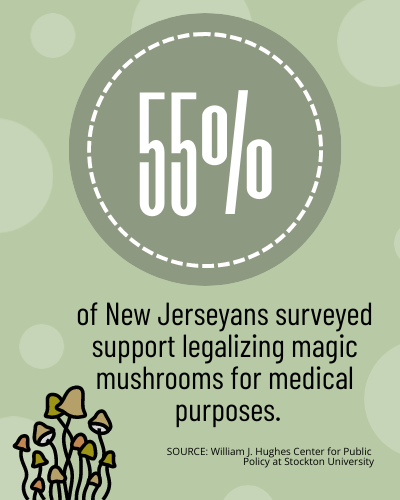 Conducted between February and March of this year, the survey of 606 adults found that most respondents (57%) were at least somewhat aware of the medicinal use of psychedelics to treat mental health disorders. In addition, 47% had no opinion regarding psychedelic drugs, while 19% viewed them positively and 32% had a negative view.
The survey noted that people who were more aware of this type of treatment, have used psychedelics in the past or know someone who has or have felt the need to seek treatment for their own mental health issues were more likely to support legalizing psilocybin-assisted therapy.
Levels of support also varied by demographics, like age and political affiliation, with younger cohorts aged 18-49 and Democrats demonstrating higher rates, the poll found.
Prompted by New Jersey lawmakers’ consideration of the bill, researchers at Stockton University examined existing clinical studies to evaluate the safety of using psilocybin to treat mental health disorders.
Among the findings in the May 2024 report are that the effects of psilocybin are comparable to the effects of more traditional pharmaceutical drugs used to treat depression, like selective serotonin reuptake inhibitor (SSRI) medications. And one to two doses of psilocybin are sufficient to produce anti-depressant effects lasting months, are generally not associated with long-lasting side-effects and have immediate effect.
The team also found that professionally supervised use of psilocybin in a well-controlled environment seems to pose minimal risks for physical and psychological harm. Additionally, clinical researchers have established safety guidelines for psilocybin-assisted therapy, which includes a set of criteria that should be used to determine who is a good candidate for this type of treatment, standards for the minimum number of supervisors, proper training and more, the report noted.

Guillermo Artiles, chair of the government affairs practice at Newark-based McCarter & English, believes the bill under consideration by lawmakers “marks a significant step toward progressive mental health care.”
“By embracing the therapeutic potential of psychedelics, the state recognizes the growing body of evidence suggesting that substances like psilocybin can offer relief for conditions such as depression, anxiety and PTSD, especially for patients who have not responded well to traditional treatments,” he told NJBIZ. “Like any new medical approach, adequate oversight and regulation will be key to ensuring that psilocybin is used effectively in clinical settings under the guidance of trained professionals.”
While Artiles thinks it could be a “heavy lift” for Scutari to convince legislators of the need for such a program in New Jersey, the lawyer went on to say, “He’s committed to the cause and just as he did with cannabis, will eventually get it done. He’s a great educator and will happily teach his colleagues the importance and impact of this legislation.”