Sign In
Upcoming Event
 Free Newsletter

First 100 days: Sherrill targets affordability, permitting reform, energy
Matthew Fazelpoor//May 11, 2026//
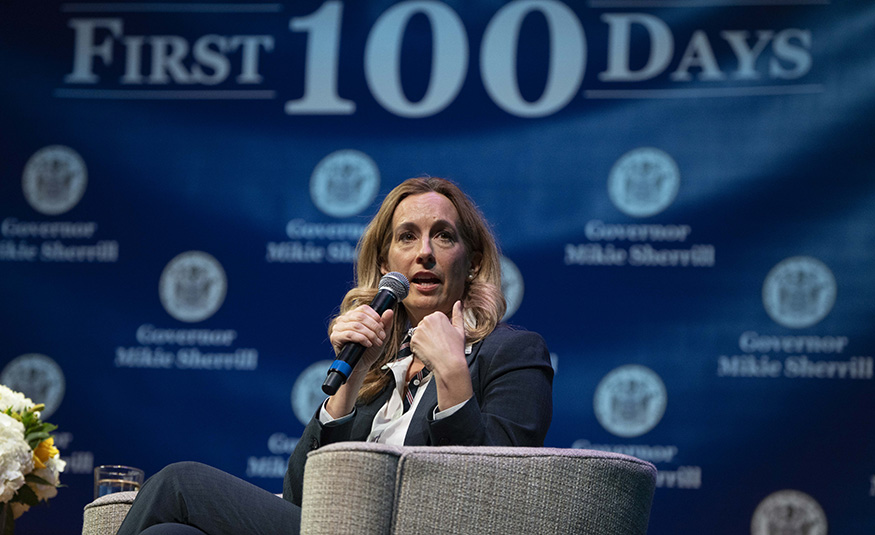
On April 29, 2026, at New Jersey Performing Arts Center in Newark, Gov. Mikie Sherrill joined moderator Brent Johnson for a fireside chat about her first 100 days in office. - PROVIDED BY NJ GOVERNOR'S OFFICE/TIM LARSEN
On April 29, 2026, at New Jersey Performing Arts Center in Newark, Gov. Mikie Sherrill joined moderator Brent Johnson for a fireside chat about her first 100 days in office. - PROVIDED BY NJ GOVERNOR'S OFFICE/TIM LARSEN
First 100 days: Sherrill targets affordability, permitting reform, energy
Matthew Fazelpoor//May 11, 2026//


 Listen to this article
The basics:
- Gov. Sherrill marks 100 days in office
- Highlights administration’s emphasis on reducing costs, improving predictability
- Permitting reform, energy affordability remain major priorities
- Governor previews plans tied to healthcare, education and the World Cup
At the 100-day mark of her administration, Gov. Mikie Sherrill used a wide-ranging public conversation to reflect on early priorities – and preview what comes next – with a focus on affordability, permitting reform, energy policy and economic opportunity.
Speaking April 29 during the “100 Days with Governor Mikie Sherrill” fireside chat at New Jersey Performing Arts Center, where she was sworn in as New Jersey’s 57th governor Jan. 20, Sherrill outlined a governing approach centered on what she described as solving practical challenges facing residents and businesses. NJ Advance Media hosted the event moderated by reporter Brent Johnson, who pens the “Mikie’s World” newsletter for NJ Advance Media tracking the new administration.
“It feels like 100 years, but it’s been great,” Sherrill said when asked about the pace of her first months in office.
Speeding things up
For the business community, one of the clearest throughlines is the administration’s emphasis on reducing costs and improving predictability — particularly through changes to the state’s permitting processes. Sherrill said feedback from companies across New Jersey pointed to delays and uncertainty as a major barrier to growth.
“We were hearing from businesses all over the state that the No. 1 thing that they were facing and the reason they weren’t expanding in the state was because it was taking them too much time to get through permitting, and that it was costing them tons of money — and that it was a black hole,” she said.
She described a system that, in some cases, lacked clarity and consistency. “Well, they tell me, you know, that I need to do these five things, and I get through it, and then I come to submit my permit, and then they tell me, I need five more things,” Sherrill explained. “And I said, why? And they said, well, I just hadn’t thought of this, I guess. Just this really random type of experience that was making it hard for them to have predictability.”
Not wasting any time
That feedback helped shape early actions, including executive orders and the broader push to streamline approvals. The administration has framed the as central to its agenda focused on affordability and streamlining processes.
“So that’s why I hired the state’s first ever chief operating officer, so that we could really make sure we were very mission focused, driving down costs, holding government accountable, taking care of our kids, and that each department in my office was doing the same thing with this mission focus on driving affordability for families,” she said.

A formal policy rollout that same day underscored that focus on permitting reform. The New Jersey Department of Environmental Protection announced “Operation FAST” (Facilitated Approvals for Sustainable Transformation), a department-wide initiative aimed at streamlining reviews, reducing backlogs and improving coordination across permitting programs.
The administration said the effort is designed to accelerate approvals, particularly for energy and infrastructure projects, while maintaining environmental standards. It includes hiring nearly 50 additional staff, modernizing IT systems and expanding early-stage project coordination to reduce delays — steps intended to make the process more predictable for businesses.
“Throughout the first 100 days of my administration, I’ve been laser-focused on saving New Jerseyans time and money by making government accountable to our residents and businesses,” Sherrill said in announcing the initiative. “DEP’s Operation FAST delivers by removing unnecessary hurdles that hurt our businesses, our environment, our economy and our wallets.”
Cost pressures
Energy costs – a recurring concern for businesses and residents alike – were another major focus. Sherrill pointed to early moves to freeze rates and accelerate generation, while acknowledging that long-term solutions depend on expanding supply and navigating external pressures.
“Yes, rates have been frozen,” she said when pressed by Johnson about her executive order that aimed to freeze rate hikes. “There were a couple rate cases that were done before I got into office, and so we’ve had to subsidize those to make sure those rates stayed flat.”
Throughout the first 100 days of my administration, I’ve been laser-focused on saving New Jerseyans time and money by making government accountable to our residents and businesses.
– Gov. Mikie Sherrill
She added that controlling costs over time will require additional generation capacity. “And then we’ve worked with the power companies to keep the rates frozen right now as we move quickly on new power generation,” she explained. “Because if we’re going to really get the cost down over time, we’re going to need to come up with more power generation.”
Her administration has also moved to lift the state’s long-standing nuclear moratorium, part of a broader energy strategy NJBIZ has previously reported on, while pursuing solar, battery storage, gas plant modernization and emerging technologies, such as virtual power plants.

Crunching the numbers
Looking ahead, Sherrill made clear that fiscal constraints will shape policy decisions in the months to come. She described the current budget environment as unusually challenging, citing the end of federal pandemic aid and ongoing structural issues.

In March, she proposed her first budget. NJBIZ reported extensively on the $60.7 billion spending plan, which is currently under consideration by the Legislature as the budget process continues.
“So the reason I call this budget, sort of a perfect storm … is because suddenly we have this COVID money drying up, and so we don’t have that ability to sort of have a soft landing for a lot of stuff,” she said.
“We also have seen the fact that the federal government is attacking a lot of the long running programs that they’ve had,” she added. “I think the COVID money papered over some of the structural difficulties that our state was facing, long-term challenges like the state health benefits plan.”
The administration faced a roughly $3 billion structural deficit, prompting a mix of targeted cuts and policy changes. “We had a lot of hard choices in the budget,” Sherrill said.
At the same time, she emphasized a longer-term view. “We don’t look at this in just like a one-year budget,” she said. “This is how we’re growing the future of New Jersey. If we did nothing, we probably would have seen a requirement for about $5 billion to be cut out of the budget next year. That would have been a real blunt cut, instead of more of a finesse. So that’s why we started to act this year.”
As an example, she pointed to the paring down of the StayNJ senior property tax relief program, which would be reduced by about $500 million tied to income thresholds.
Schools and workers
Education is another major area of concern, particularly around the effectiveness of the state’s school funding formula. The policy has drawn the ire of lawmakers, municipalities and residents across the political spectrum.
Despite record spending, Sherrill said outcomes are not keeping pace. “It’s amazing. We spend so much money on our schools, and we traditionally have had the best schools in the nation, and that has been a real source of economic benefit,” she said. “It’s given our students such opportunities, and it’s why so many businesses are here. They tell me that again and again.
“Unfortunately, we are not seeing the schools keep up now with our great reputation in all cases.”
She pointed to disparities in performance and the need for structural changes. “So just for example, if you look at some of some of the poorer communities across the state, their third grade reading scores aren’t commensurate with Mississippi,” the governor said. “And I think that that should shock everyone here.”
Stabilizing funding and improving outcomes, she said, are central to the administration’s next phase.
World Cup opportunities
The upcoming 2026 FIFA World Cup was another topic with direct business implications, particularly around tourism, infrastructure and regional branding. The event will bring eight matches to MetLife Stadium, including the Final.
Recently, the governor has gotten into a dispute with FIFA over transportation prices. She argues that the governing body should help host cities defray the associated costs. Sherrill framed the event as an opportunity to generate economic activity, while acknowledging logistical and cost challenges, including widely discussed $100-plus roundtrip train tickets.
The administration is exploring ways to offset those costs, potentially through private sector involvement. Johnson asked about that, referencing Pennsylvania’s approach to the transportation issue for the matches that Philadelphia will host. Through a deal with Airbnb, fans heading to Lincoln Financial Field will pay normal fares ($2.90) but can ride SEPTA free on the Broad Street Line after matches.

Sherrill said her administration is looking at potential corporate sponsorships. “We’re in some discussions on how that might work and who would get the benefit,” she said. “We’re looking at how to target it for New Jerseyans.”
She also addressed the ongoing regional rivalry over branding the event. Despite the matches physically taking place in New Jersey, the local organizer is the NYNJ Host Committee; with New York often absorbing much of the attention – and credit – surrounding the festivities. “I think it’s funny how much New York is protesting,” Sherrill said. “And I think [Gov.] Kathy Hochul better be careful, or people are going to show up in Buffalo for the World Cup – if she keeps telling everyone it’s in New York.”
Federal tensions
Sherrill also spoke at length about her relationship with the federal government under President Donald Trump. She framed it as both adversarial and, at times, necessary. “I’ll work with anybody to help the people of New Jersey, but I’ll also stand up to anybody if they are attacking the people of New Jersey,” she stressed.
She pointed to legal battles over funding, including the Gateway Tunnel project, as an example of that approach. “And that was illegal,” Sherrill said of the withholding of federal funding. “So, I took him to court, and then I won. And then I took him to court again, and then I won. And the money’s flowing. And now we’re in court again because we want damages.”
I’ll work with anybody to help the people of New Jersey, but I’ll also stand up to anybody if they are attacking the people of New Jersey.
– Gov. Mikie Sherrill
At the same time, she acknowledged areas where collaboration could benefit the state, particularly on energy. “We’re working with the White House, because we think that they could put the financing together really well for nuclear,” said Sherrill. “I really think that the federal government’s key if we’re going to build this out at a reasonable cost and in a reasonable timetable.
“So, that could be an area, but we’re not going to name Newark Airport after him to get this nuclear site done.”
The next 100 days
Looking forward, Sherrill said the next phase of her administration will focus on several core areas, including healthcare, education, energy and continued operational reforms. Over the next 100 days, she identified healthcare and education as “the two critical things for the next budget.”
Additionally, Sherrill cited getting through the World Cup and continued work on energy infrastructure and innovation. “And then we’ll also be working to make sure that we are continuing to move forward on the nuclear generation and working on some of our other plans on solar,” said Sherrill. “As well as we’ll have a plan forward on these virtual power plants, which are really exciting.”
So grateful for the hard work of this incredible team over the past 100 days.
We’re on a mission to deliver for you – and we’re just getting started. pic.twitter.com/gHAKQwbQHc
— Governor Mikie Sherrill (@GovSherrillNJ) May 1, 2026
Operational transparency, particularly around permitting, will also remain a priority. “We’ll be rolling out in June, the first pilot program for the permitting dashboard,” said Sherrill. “This is where you can see where your permit is going.”
Taken together, the conversation paired with early policy moves and Executive Orders offer a snapshot of an administration still defining its long-term trajectory, but focused on affordability, efficiency and economic competitiveness. For New Jersey’s business community, the coming months will test how those priorities translate into measurable changes on costs, timelines and growth opportunities.