Sign In
Upcoming Event
 Free Newsletter

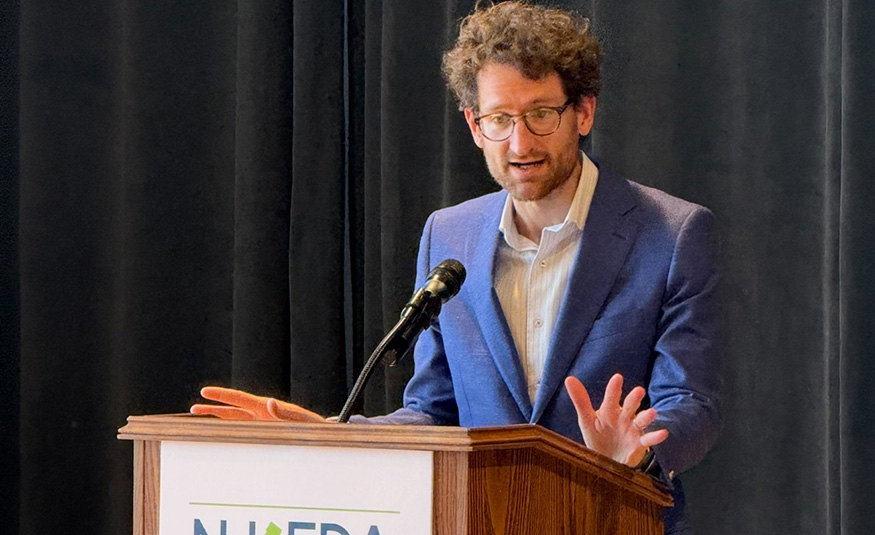
New Jersey Economic Development Authority CEO Evan Weiss addresses the audience gathered March 30, 2026, for the NJEDA's Women's History Month event in Red Bank. - MATTHEW FAZELPOOR/NJBIZ
New Jersey Economic Development Authority CEO Evan Weiss addresses the audience gathered March 30, 2026, for the NJEDA's Women's History Month event in Red Bank. - MATTHEW FAZELPOOR/NJBIZ
Weiss outlines NJ strategy on film growth, World Cup, budget
Matthew Fazelpoor//April 20, 2026//


The basics:
- NJEDA CEO Evan Weiss details plans to strengthen New Jersey’s long-term economic growth
- Focus includes FIFA World Cup 2026, innovation hubs, AI initiatives, film industry expansion
- Weiss highlights need for deliberate budgeting amid macroeconomic, global pressures
- Emphasis on supporting startups, scale-ups & small businesses through targeted investment programs
In the second part of a wide-ranging conversation with NJBIZ, New Jersey Economic Development Authority CEO Evan Weiss discusses his approach to the state’s broader economic landscape – from the state budget to major global events and long-term industry growth — as he continues to settle into the role.
The discussion moved beyond operational priorities to focus on how New Jersey can position itself for sustained opportunity across businesses of all sizes, touching on the 2026 FIFA World Cup and the continued buildout of sectors like innovation and film and television.
Against that backdrop, Weiss offered his perspective on how these pieces fit together within a broader economic strategy.
Sherrill’s budget debut
He spoke about the governor’s first budget proposal.
“The budget proposal continues investments in things that I’m happy we’re continuing investment on – like our Main Street Program,” Weiss told NJBIZ. He reflected on his time in the Murphy administration when the program was set up during the pandemic. “The budget is much less important for EDA than most agencies because so much of what we do by design is meant to come from our balance sheet or our tax credits.
“What I’m most interested in is more of how the budget speaks to the broader macroeconomic environment,” Weiss continued. “And, most importantly, really wrestling with the structural deficit and the things that the budget has to swim against, especially the changes in Washington about how funding is working — big deal.
“When I speak to the business community, there’s grumbling – there’s always going to be grumbling. But they understand why these things have to be happening. It’s tough out there and I think, unfortunately, she [Gov. Mikie Sherrill] and the budget team are getting proven right – where I’m concerned about watching the economy and watching what’s going on in the Middle East, and inflationary pressure ticking back up again,” said Weiss.
“I think we do need to have a pretty deliberate mentality around how we’re dealing with the budget.”
Supporting soccer success
Part I
In the first part of our discussion with NJEDA CEO Evan Weiss, the leader talks about the first months on the job, his listening tour, his goals and more. Catch up here.
The NJEDA is playing a huge role in the upcoming 2026 FIFA World Cup, recently approving $20 million to support the New York New Jersey Host Committee during the tournament. That includes $5 million for the World Cup Community Initiative. The program aims to provide grants for local organizations and municipalities to hold events like watch parties – boosting foot traffic and supporting small businesses.
When asked how he thinks about the once-in-a-generation tournament and how New Jersey businesses can best capitalize, Weiss reflected on his recent trip to Salem County for a bill signing pertaining to nuclear energy – and how an area like that is very far away from the games.
“But it should still matter for people in Salem, or people in far Sussex that something special is happening in New Jersey,” said Weiss. “I definitely believe the Meadowlands area needs to be the epicenter of it – because that is the epicenter of it. But at the same time, I think where I’m at, where the governor’s at, and it’s just the idea that people need to feel that they have a good memory of this; that there was something fun they got to do; that it wasn’t this thing that made it hard to get to work.
[I]t should still matter for people in Salem, or people in far Sussex that something special is happening in New Jersey.
“Obviously there’s going to be disruptions,” he continued. “There’s no way around that. But that their kids maybe got to meet someone who’s playing in it; that they got to go to a watch party – and that, very importantly, whenever they do that, it’s not a national chain that’s selling you hot dogs. It’s a New Jersey business. And there’s New Jersey vendors selling New Jersey clothes.”

Building with intention
Weiss believes when you have one of these major events, you need to be really intentional about capitalizing on it.
“It’s very easy for them to come in with a kind of standard playbook – and we can’t do that,” Weiss stressed. “I have a lot of faith in [NJ Transit President and CEO] Kris Kolluri and the challenge he has ahead of him. I have a newborn and he probably sleeps less than I do.”
He emphasized the governor’s and the administration’s belief that people across New Jersey should get a good experience.
“And this should be a net positive as best we can. These things are expensive – and we’re getting less aid than we thought from our national friends,” said Weiss. He noted some interesting ideas with short-term rentals and a grant program being stood up by Choose New Jersey. “So, lots of opportunity.”
The discussion then turned to a key element of the Murphy administration, which NJBIZ has reported extensively on, strategic innovation centers. Some SICs are up and running while others are in varying phases of planning or construction.
SICs next steps
“How are you thinking about that initiative and taking the groundwork that was laid there and moving that forward?” NJBIZ asked.
“It’s one I care a lot about,” said Weiss. “That was part of the work I did in the Murphy administration, was to set up that initial appropriation and program for it. I’m so pleased to see how it’s evolved. I think there might be room for some additional ones, but what we’re really talking about, as well, is trying to figure out where we double down on our investment.
I think there’s just a lot of cool stories with innovation, where things you thought were a dinosaur office park could have some new life, maybe some innovation companies, maybe some housing.
“Some I know well from my time in Newark like HAX. Their whole point is that they’re creating all these companies,” said Weiss. “Where do we put the companies? There’s some answers in the building – and there’s some answers in other parts of Newark or the area.
HAX Newark drives deep tech, VC investment

HAX, the SOSV development program for deep tech startups, operates a 35,000-square-foot hub in Newark that opened in May 2024.
A year in, HAX celebrated its success establishing a global hub for startups – with more than 50 enterprises invested in and relocated to Newark. Those startups have employed more than 160 people and raised over $60 million in VC funding. Keep reading.
“It’s amazing to have the opportunity with some of these SICs – but where do they go?
“I also think there’s some interesting plays relative to – we have a lot of 70s, 80s vintage, big, sprawling office or lab complexes. That my hope is we can reposition with some of the SIC companies,” he continued. “I think there’s just a lot of cool stories with innovation, where things you thought were a dinosaur office park could have some new life, maybe some innovation companies, maybe some housing.
“That kind of thing is exciting to me. I also think we really are at the forefront of things like the AI Hub [a partnership between NJEDA, Princeton, Microsoft and CoreWeave],” said Weiss. “We have HAX like I said. We are doing amazing things with aviation and the FAA in Atlantic County and the Atlantic City area.”
All hands on deck
Weiss said he gets mad when he hears of companies leaving New Jersey.
He recounted a speech at the recent launch of the NJ AI Hub Accelerator (powered by Plug and Play). “I was serious when I said this. We have you here – hooray. Too many of you are leaving. But be honest with us. Why is that happening? What can we do to change it? Real estate, talent – tell us – taxes. That is a really big deal.”

The NJEDA CEO also believes that the innovation space needs to put a greater focus on telling its stories — particularly in areas where, maybe the company is solving a complex problem that is not easily explainable. He used a recent nuclear fusion company he met. Weiss said he understands nuclear fusion but joked that if you went two layers deeper, not as much. So, it’s important to tell the benefits these innovative companies offer.
“It’s could generate an enormous amount of jobs, all kinds of jobs,” said Weiss. “When we were at the nuclear plant, the governor was talking about someone who’s been a welder there for 40 years. Physicists, welders in the same place. I think New Jersey has always done a really good job of – any part of the job spectrum – having something and whether its pharma, film, innovation, there’s sectors where there’s so many different ways to participate.”
Close-up on: The long play
Things then shifted to the state’s booming film and television sector – which has seen a huge jump in production spend as projects utilize the film and television tax credit program. And as three major studio development projects advance, including Netflix in Monmouth County, LionsGate in Newark and 1888 Studios in Bayonne.
The NJEDA oversees the New Jersey Motion Picture and Television Commission (NJMPTVC).
“That’s my thought – taking it to the next chapter,” said Weiss when asked about how he is thinking about this sector, especially with all of these positive developments and groundwork in place. “It’s basically seeing these things – Netflix is under construction, 1888 is starting to do work, Lionsgate is under construction. They will be done with construction in the not-too-distant future.
“And that’s what I think is most exciting. We’re going to start actually having the brick-and-mortar part. Even as they’re on the ground working, the production companies that are part of these are still shooting in New Jersey. Others are as well. I think we can always do better, whether it’s film or any industry,” Weiss explained. “Just making sure they’re more tied to local vendors. I think these things also – they’re long plays.”

He noted that Hollywood took decades to build up the whole infrastructure of workforce such as carpenters, make-up, post-production, etc.
“There’s so many different parts of this,” he said. “I think we’d love to speed that up.”
It helps them [production studios] to have an ecosystem here, so they’re very cognizant of trying to build it up. And we want to help.
Weiss credited the studios that are under construction for their efforts and focus in this area. He believes they think about that a lot.
“And to their benefit,” said Weiss. “It helps them to have an ecosystem here, so they’re very cognizant of trying to build it up. And we want to help.”
Stuck in the middle
As for other areas of focus and potential opportunities, Weiss said: “It’s not a sector, per se. But I’m really interested in growing companies in the sense of – innovation is a good example. You have two people, you have five people, you have 15 people – how do I get you to 50? I saw that over and over again in Newark, where you get to this point where there’s like a valley of death; where there’s a lot of people who want to help you right at the beginning.
“You can be an innovation. You get seed money, angel investors, all that stuff. Then someone will give you $10 million, some giant fund. But it’s hard to find funding in the middle sometimes – where you’re ready to go to the next level, but you’re not big enough to get these giant checks from big asset managers,” Weiss continued.

“So that’s a really interesting area to play in, where businesses that are growing, they’re successful – but they need some specialized equipment. They need to be able to afford hiring more people,” said Weiss. He highlighted entrepreneur Adenah Bayoh, who he worked with during his time in Newark, who founded Brick City Vegan (among numerous other ventures). “She’s been able to figure out where you have the customer, you have the big vendor. But how do you scale up to meet that demand?
“I see that’s often where a lot of businesses get into some trouble. So that is an area where I’d like to be very attentive to going forward.”
Two small business tracts
Weiss then spoke about his approach to small businesses and mom-and-pop shops.
“There’s two kinds of businesses – some mom-and-pops, they just want to stay mom-and-pops, maybe pass it to their kids,” he explained. “But even if they’re a really successful pizzeria, they don’t want a second one. They just want to do this. And I get that. For that group, we have loan products, we have technical assistance, we have ways of hopefully making it a little easier and a little more profitable for them.
“I think a lot of the residential development we do is also meant to drive more foot traffic to those kinds of businesses.”
He continued, “In the other category, if that pizzeria wants a second or they have two kids and each kid wants their own – we want to be able to help expansion at a stable level. And one thing I think, particularly in a higher interest rate environment like we’re in now, you can be stuck — because going to a bank can be harder than it was. I want to work with more banks.”
Getting real
He stressed a focus on expansion and stability.
“I want to know what they are looking for – and that can change rapidly, especially in this international environment,” said Weiss. “I can’t imagine what so many of these business owners have been through since COVID, for example. What a nightmare. And then there’s all these different things, there’s tariffs, there’s war.”
“So is it fair to say that your message to the business community is that you want to hear from them? What they need, their concerns, and the solutions they are looking for?” NJBIZ asked.
“Oh yeah, I never want to stop that,” he stressed. “Because I know our solutions will then need solutions to the solutions. I have a good sense, just from being around a lot of small businesses. But I just want to listen. My other message is we will try to be realistic. We had a lot of programs that the federal government was funding that don’t exist anymore.
“How do we figure out how we pick up the slack most efficiently? I also want them to tell me – if you’re annoyed by your bank, what can we do with your bank to maybe with some of our extra muscle make them better? What can do we with your accounting firm and so on?”
Covering the gamut
The conversation closed with a question on how Weiss would describe his overall vision for the NJEDA and his excitement in taking on the leadership role during this important and complex moment.
“I want EDA to feel accessible to everyone,” he explained, stressing how he wants to be honest with businesses he deals with about whether something can or cannot work. “I never want to feel like we’re leading someone on – that’s not acceptable. Business people or our employees don’t have time for that.
“We can deliver so much growth to the state – we have been,” said Weiss, noting he has worked in other states that are very jealous of NJEDA. “What we have here is a really special asset. So, we want to keep up that reputation – and also, just be nimble. I didn’t use the word AI the last time I worked with the NJEDA. I not only use the word, but we use it.”
Weiss reiterated being quick with these changes.
“We can’t get left behind by another state, another country. Everyone’s always been trying to stay up to date, but it matters a lot more now,” he said. “Those are the big things. I’m very moved that I’ve been able to go to two different senior housing and a veterans housing groundbreaking alongside an event for nuclear.
“I really want to continue being able to cover that gamut.”