Sign In
Upcoming Event
 Free Newsletter

Rutgers offers New Jersey’s only forensic nurse examiner course
Program is a crucial component in treating sexual assault survivors
Kimberly Redmond//June 1, 2026//
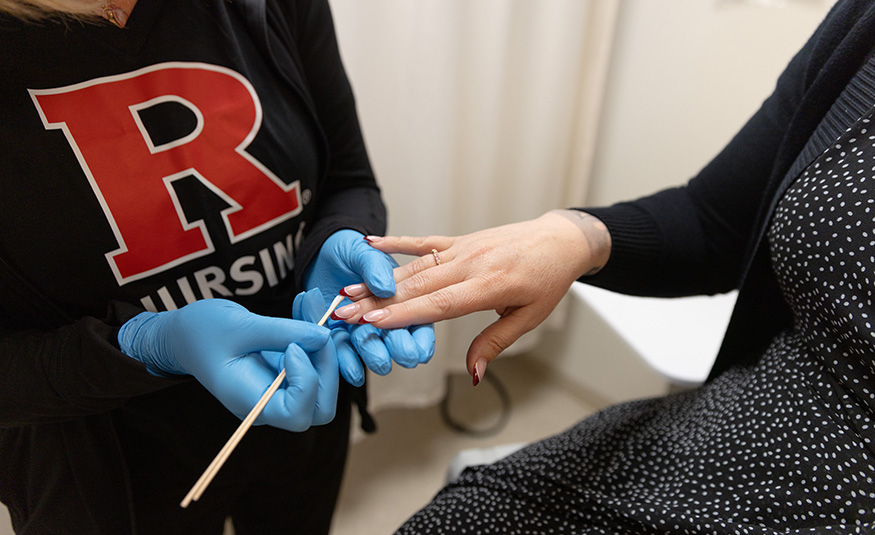
Rutgers School of Nursing faculty members Nicole Fusco and Tristan Wristen demonstrate the proper way to swab a site for evidence collection. - PROVIDED BY LUCA MOSTELLO
Rutgers School of Nursing faculty members Nicole Fusco and Tristan Wristen demonstrate the proper way to swab a site for evidence collection. - PROVIDED BY LUCA MOSTELLO
Rutgers offers New Jersey’s only forensic nurse examiner course
Program is a crucial component in treating sexual assault survivors
Kimberly Redmond//June 1, 2026//


The basics:
- Rutgers’ forensic nurse examiner course is only one in NJ
- Program has graduated 80 students since launching in 2024
- Forensic nurses provide sexual assault and domestic violence care
- Nursing shortages continue to challenge statewide staffing needs
From HBO Max’s “The Pitt” to NBC’s “Law & Order: Special Victims Unit,” television often gives the impression that specialized care for sexual assault survivors is waiting the moment they arrive at a hospital. But that’s not always the case in the real world.
According to the Emergency Nurses Association, only about 25% of U.S. hospitals have any form of forensic nursing program. The lack of certified forensic nurses – individuals trained to care for victims and properly collect evidence – is a nationwide issue, but most severe in rural parts of the country, the organization says.
Along with limited training pipelines, the emotionally demanding nature of the work can lead to high rates of burnout and compassion fatigue. The shortage is compounded by the fact that many hospitals employ on-call forensic nurses rather than full-time teams, making it harder to recruit and retain specialized staff.
According to the National Council of State Boards of Nursing, approximately 100,000 registered nurses left the workforce during the COVID-19 pandemic due to stress, burnout and retirement. The number of forensic nurses also has fallen. After growing from 4,500 in 2018 to almost 6,100 over the next two years, the population fell to 5,600 in 2022, data shows.
Every 74 seconds, someone in the U.S. is sexually assaulted. Every nine minutes, that person is a child, according to the Rape, Abuse & Incest National Network (RAINN). For survivors, the care provided immediately after an assault can profoundly affect both healing and justice. When that’s unavailable, crucial evidence may not be collected properly – or at all – and potentially undermine criminal cases.
In hospitals and healthcare settings, victims of sexual violence and domestic abuse are cared for by specialized sexual assault response teams of medical professionals, forensic specialists, social workers, attorneys, law enforcement, the courts and clergy.
A different skillset
For years, emergency room doctors were largely responsible for treating sexual assault survivors in hospitals. But as ERs grew busier and physicians had less time to spend with each patient, it became increasingly difficult to provide the specialized, trauma-informed care these patients need.
Sexual assault:
A look at the numbers
- Every 74 seconds, someone in the U.S. is sexually assaulted.
- Every 9 minutes, that person is a child.
- 6,100: Number of forensic nurses in 2020
- 5,600: Number of forensic nurses in 2022
– SOURCES: RAINN and National Council of State Boards of Nursing
Forensic nursing emerged to fill that void, combining medical treatment with evidence collection and support tailored specifically to survivors of violence. In hospital settings, forensic nurses are often brought in through emergency departments to provide specialized care once a patient presents after an incident.
Rather than every hospital in New Jersey maintaining its own Sexual Assault Response Team (SART), each of the 21 counties coordinate a shared pool of on-call forensic nurses across multiple facilities to ensure coverage despite limited personnel.
Teams are led by a coordinator typically based in the county prosecutor’s office who manages training, staffing and hospital coverage.
Under the certification process overseen by the New Jersey Attorney General’s Office and New Jersey Board of Nursing, forensic nurses must first become licensed RNs, have at least two years of nursing experience and then complete specialized forensic training through programs approved by the state and International Association of Forensic Nurses.
Many hospitals in the state offer forensic nursing preceptorships so applicants can complete the supervised clinical training required to become competent in sexual assault examinations as part of the certification process.
Healthcare, law enforcement and more
In a bid to help standardize training, create a reliable pipeline of nurses and reduce the burden on county coordinators to train people from scratch, the Rutgers School of Nursing started a forensic nurse examiner course that teaches students how to care for patients of sexual assault and domestic violence.
Launched in late 2024, it’s currently the only course its kind in New Jersey. That makes it the state’s main training program for forensic nurses. The offering meets standards set by the New Jersey Board of Nursing and International Association of Forensic Nurses.

Certified forensic nurse examiners Kristen Crespo and Nicole Fusco lead the class. The three-month program combines online coursework with in-person clinical training in areas such as evidence collection, forensic photography, trauma-informed care, courtroom testimony and sexual assault exams.
Most of the class takes place virtually. Students also spend one weekend onsite doing clinical work, like practicing exam skills on medical manikins and patient-actors trained to mimic victims.
According to Rutgers, 80 students have completed the program since inception. Now, it’s gearing up to welcome the course’s sixth cohort, Rutgers Center for Educational Innovation and Quality at Rutgers University School of Nursing Associate Dean Jeannette Manchester said.
[Forensic nursing] doesn’t fit into any one area – it’s a little bit of healthcare, a little bit of law enforcement and a little bit of victim services.
– Jeannette Manchester, Rutgers, associate dean
“I think it’s easy to say, ‘I’m an emergency room nurse,’ ‘I work in the ICU [intensive care unit]’ or ‘I’m a home health nurse.’ This doesn’t fit into any one area – it’s a little bit of healthcare, a little bit of law enforcement and a little bit of victim services,” Manchester said.
“It’s kind of an interesting skillset that you need to have. And it’s not always an easy one for a school to be able to fit into their programming … it took me quite some time to get our program going because of the different requirements and how things have to be laid out and done. And it’s a significant amount of faculty and staff that need to make it work,” she said.
‘Very much needed’
“On top of that, we’ve been in a nursing shortage for so many years that it makes it even harder to get forensic nurses trained and hired because they’re already spread thin working wherever they are and we’re not graduating enough nurses to cover that basic need,” she said, noting, “Most forensic nurses work in one place and then this is a second, per diem position … Often times you’ll need multiple people to cover all the shifts around.”
According to Manchester, a major part of the role involves helping assault survivors navigate both the immediate medical response and the long-term emotional impact of returning to everyday life after the trauma.

Given how crucial the work is, Manchester said it was “really important” to develop a “true, laid out, proper educational course.”
“It’s an area that’s really needed. Every hospital has access to forensic nurses, but they’re not based in the hospital. And so, when someone comes in and has some type of event or an assault that has happened, the hospital calls for a forensic nurse. And with the way New Jersey has been growing, it’s everywhere, right? We have seen an increase in cases across the state, and so forensic nurses are very much needed,” she said.
Take two
Rutgers previously had a forensic nursing program that fell by the wayside in the early 2000s. After Essex County’s Sexual Assault Nurse Examiner (SANE) program coordinator reached out to the school about reviving it, Manchester set to work.
“It’s been really fantastic – with the last three groups that we’ve had have been full with wait lists. So, now I’m trying to get creative in terms of our space and how we are able to run the course to see how many students we can get into the course. I am very focused on maintaining the right faculty to student ratio of two faculty members for eight students,” Manchester said.
“They’re learning so many different things. It’s not just the assessment of the patient — it’s working through the different types of advocacy that a forensic nurse is going to need to know. So, talking through that during that simulation, learning and knowing and understanding what follow-up looks like in New Jersey, along with collecting evidence that is typically used in legal cases,” she said.

“All of that is included in our simulation scenario. And so because this is the first time that these nurses in the course will actually be putting their hands on all of these things, we think it’s really important that they have not only that actor who is well versed in the simulation and they’re trained themselves, but are faculty very close by monitoring exactly how they’re doing it and giving them real-time feedback,” Manchester explained.
Students with two years of professional nursing experience are eligible to apply, according to the program’s rules. Many students come with little or no experience working with genital anatomy, which heightens student anxiety, according to instructors. There also is a greater likelihood that forensic nurses will testify in court, which adds to the pressure and the stakes.
Not what you see on TV
Participants seek training for different reasons, Crespo and Fusco said. Some aim to add a skillset to their nursing toolkit while others may have personal experiences and want to help others in their time of need, they said.
Whatever the motivation, Crespo said the job is rarely as glamorous – or as scary – as depicted on television. “Nurses might get nervous because of the things they see on TV, but the job ends up being 10 times worse in their head,” she said.
“We all become attached to our patients and want to see a good outcome, but we also must remain neutral,” Crespo went on. “We’re not working for the prosecution or the defense. Our job is to treat the patient – who is our main focus.”
We’re not working for the prosecution or the defense. Our job is to treat the patient – who is our main focus.
– Kristen Crespo, certified forensic nurse examiner, Rutgers instructor
Manchester believes the demand for forensic nurses stems from increased emphasis on supporting victims as part of a greater push for advocacy. She thinks some of the growing awareness may be tied to some of those popular television shows.
“People may be kind of learning that there is support for them after something like this and are maybe more willing to come forward,” Manchester said. “It also does seem like it’s a little bit more out there and people are talking about it more rather than before when people didn’t talk about it, you didn’t hear about it and you didn’t really want to come forward.”
Manchester said, “To me, it’s one of those things that I wish we didn’t need. I wish we didn’t need things like another cancer center. But this is the reality.”
“I am happy and pleased to be able to really offer a course to people who are interested in becoming forensic nurses that is solid, evidence-based and really gives them a good foundation for practice. And I’m glad I’m also happy to be able to grow that and create more programs and give those nurses who are either already in forensic nursing or just starting out more resources and more opportunities to be able to learn their craft better,” she said.