Sign In
Upcoming Event
 Free Newsletter

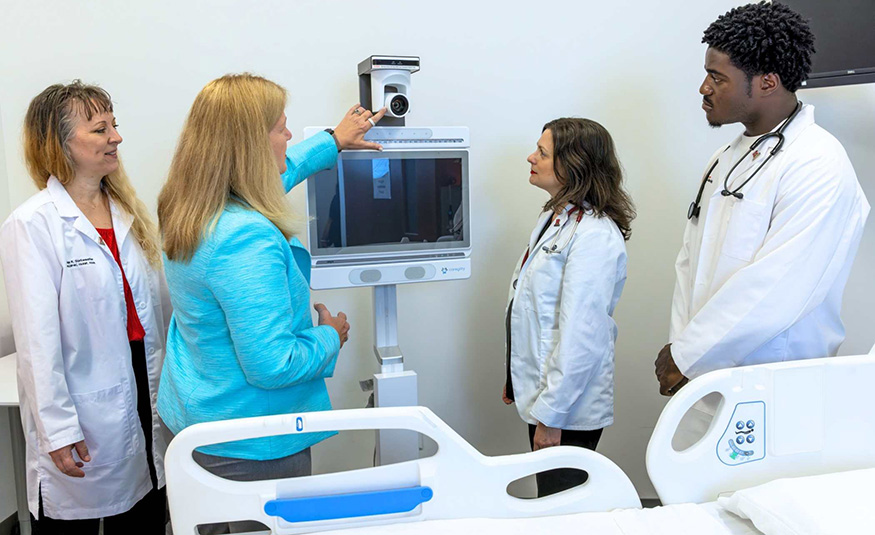
Susan Kristiniak, Caregility's chief nursing officer, demonstrates the company’s Connected Care Platform to Angela Starkweather (left), dean and professor at Rutgers School of Nursing, and undergraduate nursing students Julie Cornell and Triumphant Aydodele. - PROVIDED BY JEFF ARBAN
Susan Kristiniak, Caregility's chief nursing officer, demonstrates the company’s Connected Care Platform to Angela Starkweather (left), dean and professor at Rutgers School of Nursing, and undergraduate nursing students Julie Cornell and Triumphant Aydodele. - PROVIDED BY JEFF ARBAN
Rutgers, Caregility launch virtual nursing program (updated)
Kimberly Redmond//July 27, 2026//


)

The basics:
- Rutgers, Caregility collaborate on virtual care component for undergraduate nursing education
- Caregility will provide technology for nursing education labs in Newark, New Brunswick
- Coursework will cover telehealth, AI, data privacy and digital care
- Virtual nursing certificate for practicing nurses is planned for fall
Virtual nursing is gaining traction nationwide, with hospitals increasingly incorporating remote care into patient rooms, command centers and home-based care programs. By using such technology in areas like admissions, discharges, education, remote monitoring, care coordination and other clinical functions, care teams can streamline workloads, improve efficiency and spend more time providing direct patient care.
According to healthcare market research firm Black Book Research, as of 2025, 88% of U.S. hospitals are piloting or have fully implemented inpatient virtual care. Roughly three-quarters expect to expand virtual care services by the end of 2026, Black Book said.
Despite the growing adoption, more than half of the nation’s nursing schools still don’t offer a telehealth curriculum for undergraduates, the Journal of Professional Nursing found. The 2022 national study cited factors such as limited funding, lack of faculty expertise and already crowded course requirements as reasons why many schools had not yet incorporated virtual nursing skills into student education.
‘No longer a future concept’

To help bridge that gap, Rutgers School of Nursing is teaming up with Wall Township-based Caregility to introduce a virtual care component into undergraduate nursing education.
“Virtual care is no longer a future concept in healthcare,” said Caregility Chief Nursing Officer Susan Kristiniak. “It is part of how care is delivered every day. By working with the Rutgers School of Nursing to bring virtual nursing education into the learning environment, we have an opportunity to help prepare future nurses for the realities of connected care and support the evolution of nursing practice.”
To support the state’s first virtual nursing program, Caregility will provide access to its platform, smart room endpoints and clinical care applications to support virtual care simulation and training experiences within Rutgers’ nursing education program.
That includes donating seven wall-mounted technology systems equipped with high-zoom cameras, speakers, microphones, infrared lights, and video monitors for the university’s nursing labs in Newark and New Brunswick. Additionally, the agreement includes software, 24/7 support, and technical and clinical application training, the partners said.

Meanwhile, Rutgers is developing coursework designed to help students build the knowledge, confidence and practical skills required to work effectively in digitally enabled care environments. The curriculum will cover key areas of modern practice, including virtual communication, patient engagement, data privacy and ethics. Students will also receive training in technology operations, AI-assisted clinical tools, healthcare leadership, mentoring and quality improvement, the partners said.
Improving outcomes
Formed in 2019 as a spinout of Wall Township-based Yorktel’s healthcare practice, Caregility provides a virtual care platform that enables telehealth, virtual nursing and remote patient monitoring across hospital, outpatient and home-based settings. The company says hundreds of healthcare networks worldwide use its artificial intelligence-enabled connected care services to improve clinical workflows, patient safety, workforce efficiency and access to care. On an annual basis, the platform supports more than 9 million virtual care sessions, it added.

Caregility President and Chief Operating Officer Mike Brandofino noted that the telehealth appointments that became so popular during the pandemic “are really only a small portion of virtual care.”
“Technology can help improve access, strengthen care coordination and support better patient outcomes. When used thoughtfully, virtual care can help healthcare organizations reach more patients, support care teams and improve the overall quality of care,” he said.
For example, when a stroke specialist is not physically available at a hospital, telehealth technology allows the doctor to see and evaluate the patient remotely so treatment decisions can be made quickly, he said.
“There are literally dozens of workflows now across the health system that require that connected care within the hospital,” he said. “So, we basically provide a platform that gets a lot of information from the room and allows clinicians to be able to get into the room remotely.”
“Right now, we have about 20,000 rooms connected to the service, so we’re truly a global solution in many health systems,” he said.
Getting ahead of the curve
Kristiniak added that Caregility has also “been very involved in all the rural health initiatives at remote urgent care centers or remote hospitals that don’t have the level of expertise.”
Partnering institutions include Penn Medicine, Penn State, Inspira Health, Mercy Virtual and the Mayo Clinic. Internationally, Caregility works with health ministries in Saudi Arabia and Jordan, as well as Nagoya University Hospital in Japan and Alberta Health Services in Canada.
Less than a year ago, the company announced it was working with Drexel University in Philadelphia to bring the latest smart room technology and best practices into the school’s nursing programs. Besides serving as Caregility’s CNO, Kristiniak is an adjunct professor at Drexel. Based on her experiences working with students, Kristiniak said she knew that new nurses hitting the hospitals are “overwhelmed with all of the technology and all of the changes.”
“So, Mike and I sat down and I said, ‘We have to be ahead of the curve. We’re a company that does great at managing nurses in place and facilities in place and thinking about offloading that physical and cognitive burden on that bedside nurse. But how are we readying the next generation?’”
Working on workflows
That led to the creation of a program at Drexel aimed at better preparing nurses for the growing use of digital health and AI in healthcare.
Kristiniak said, “Just think about how many pieces of technology are out in the arena already. This is an opportunity for those students to put their hands on it and to practice within that framework of care delivery, which is uniquely different than what they’re doing right now.
“In nursing simulation labs, they attempt to replicate a patient-nurse experience. So, they’re fully set up with beds, oxygen, all of the pieces, and they’re in a two-way kind of mirror experience. The faculty sits in a booth … and gives feedback on students,” Kristiniak explained.
Caregility’s technology uses cameras and virtual connections to let nurses, students and other caregivers interact with remote experts who can provide guidance, training and support. The system helps frontline staff know when to bring in additional resources, such as a virtual physician or specialist, she said.
Brandofino emphasized the importance of allowing students to “experience that virtual care workflow.”
“So, how do you talk to a patient’s family when you’re in the room with the patient and they’re remote? How do you talk with an interpreter, maybe a sign language interpreter, and the patient in a video session … it’s more about the workflows within that environment than it is the actual technology,” he said.
Extra layers
After learning about Caregility’s success at Drexel, Rutgers reached out to inquire about rolling out a similar program. Angela Starkweather, dean and professor at the Rutgers School of Nursing, said Caregility’s global leadership in virtual care made them “an ideal partner for this initiative.”

“As one of the nation’s leading schools of nursing, we are committed to building innovative collaborations that advance nursing education, clinical practice and health outcomes,” she said, adding, “Educating students for contemporary nursing practice means helping them develop fluency not only in bedside care, but also in the digital tools, communication models and collaborative workflows that increasingly support patient care.”
Besides being “an internationally known New Jersey company that has really risen to the occasion of making the right decisions in their equipment,” Caregility’s team has been helpful in “being able to see what the landscape is,” Starkweather said.
“Susan is really at the level of all the CNOs across the United States in knowing what the needs are of the nurses who are in practice. Then, we stepped back to say, ‘Well, what do we need our students to be able to know about this technology?’” she said.
We want to focus on using [the technology] as a tool to augment communication rather than have it be something that distracts them from the patient in front of them. Because that is the center of our care, is the patient.
– Angela Starkweather, dean and professor, Rutgers School of Nursing
“We want to focus on using it as a tool to augment communication rather than have it be something that distracts them from the patient in front of them. Because that is the center of our care, is the patient,” Starkweather explained.
“We want our nurses to be at the cutting edge and being able to step out of our programs into the clinical setting and transition smoothly. And this is just adding some additional skills that they’ll be able to use within different healthcare settings, whether it’s the hospital, community setting or otherwise, because it is really being used across different settings of inpatient care,” she said.
Return on investments
In hospitals and psychiatric settings, virtual care tools can provide “that extra pair of eyes for safety, quality care and being able to get expertise in the room at the time that you need it,” she said.

On the road
A Hackensack Meridian Health nurse is helping her fellow healthcare workers adopt the network’s generative AI agent that aims to reduce burnout and speed clinical note summaries. And she’s tapping into her creativity to spread the word. Find out more here.
Meanwhile, in a home care environment, the technology can help loop in additional expertise and family members when needed to support decision-making, according to Starkweather.
“I think they’re working on the aspects of being able to use some of those elements in the charting as well, which is really exciting because then it makes the workflow of the nurse all that more efficient so they can really spend the time that they need with the patient rather than on all of the documentation,” she added.
“It’s already taken off in our inpatient settings … and I think it’s adding to help support the work that nurses do. So, the return on investments in safety, quality and burnout are things that we’re looking forward to,” she said.
“But also expanding across rural settings and looking at how do we use this technology in maybe home settings for helping to monitor patients or older adults who are living alone and need to have some extra eyes on them? Care doesn’t just happen in the hospitals. In outpatient settings and community settings, how can we use this to augment care and provide expertise at the moment that the patient is in front of you? I think those are great opportunities,” she said.
“When you think of how we provide care for the people who have challenges with transportation or challenges with waiting in a waiting room … this could really alleviate things like that,” she said.
Not a replacement
Despite all the ways in which technology can be applied in healthcare, Starkweather believes virtual care tools are not meant “to reduce the amount of nurses out there.”
“It’s really to provide that extra layer of safety and quality care,” she said. “It allows them to be able to do things more efficiently and in a way that is also patient-centric. That’s a main theme of what we’re trying to do in our curriculum — really highlighting the patient centricity of this technology, really arming our students with these strong skills because they’re so essential to that nurse-patient relationship.”
“The relationships that we have with our patients, their families and their caregivers so important and … you cannot replace that with any type of technology,” she said. “But in terms of the communication, this augments being able to have the whole team knowledgeable about what’s going on, monitoring and really being able to provide the best care that we can to our patients.”
The NJ connection
Besides being a first-of-a-kind program in New Jersey, the collaboration with Rutgers also represents Caregility’s first academic partnership in its home state. Brandofino described the collaboration as “extra special because we’re from New Jersey.”
“We’re very familiar with Rutgers and all it does in the state and how attractive it is for students from around the country and the world. So, it’s definitely prestigious to have a partnership with them. And for us, it allows us to help get the next generation prepared for what they’re going to experience when they get into the marketplace.”
We’re very familiar with Rutgers and all it does in the state and how attractive it is for students from around the country and the world. So, it’s definitely prestigious to have a partnership with them.
– Mike Brandofino, president and CEO, Caregility
Besides continuing to grow its academic partners in the U.S. and beyond, Brandofino hopes relationships with educational organizations “will open the door for potential research down the road and studies around new technologies that we’re thinking about introducing.”
“And potentially work with them and their connections to various hospitals to try and work through some of those things together,” Brandofino said. “We’re really excited about these relationships and think that there’s a lot of things that we can do together.”
Starkweather added, “With Caregility, it has just been so seamless because they are a New Jersey company and they’re really dedicated to our residents and being able to offer this technology. Being able to work with industry leaders who have the main focus of improving patient care, that’s been something great as a nursing entity and being able to link in with what they’re doing and provide the skills to our students.”
“That is a real strength of the partnership; their interest in really preparing our students for how to use this technology and augment their care, improve workflows and provide other opportunities for nurses across the board, whatever stage they’re at in their career,” she said.
Staying involved
The undergraduate program is being integrated into the curriculum now. Rutgers will then follow that with a certificate program in virtual nursing for practicing nurses that will launch this fall through the Center for Professional Development, according to Starkweather.
“We really want to be a resource for nurses who are either just getting the technology at their institution or interested in learning more about the opportunity. The certificate will really give them a skillset to both implement and evaluate the technology once it’s in place,” she said.
“When you think about the number of nurses who are retiring, this is a great way for them to stay involved, use their career wisdom at the bedside still and really have a purpose within this space of being a mentor and being able to provide their expertise even though they’re not at the bedside per se,” Starkweather said.
Brandofino said Caregility is excited to help new nurses prepare to enter emerging healthcare delivery environments and assist experienced nurses in getting used to technologies so they “can get into virtual care programs around the country.”
“We’ve seen that happen where a nurse has a bad back or bad knees and can no longer actually be on the floor. So, instead of retiring, they get put in these virtual nursing programs. And that knowledge gets to stay in the health system, whether it’s for mentoring or it’s for specialist capability, but it really is going to extend the nurses that can stay in healthcare and we desperately need that because there aren’t enough nurses coming in and we have nurses kind of aging out,” he said.
After Rutgers, Caregility expects to unveil an academic partnership with Fairleigh Dickinson University’s nursing program, according to Kristiniak. “I’m really proud that Caregility is getting the technology into the hands of healthcare delivery but also really being proactive in thinking about those next generation of students. And, it’s not going to be limited to nursing. Fairleigh Dickison is already talking about pharmacists and social workers because the shift of virtual care delivery,” she said.
Editor’s note: This story was updated at 3:49 p.m. July 27, 2026, to update Mike Brandofino’s title.