Sign In
Upcoming Event
 Free Newsletter

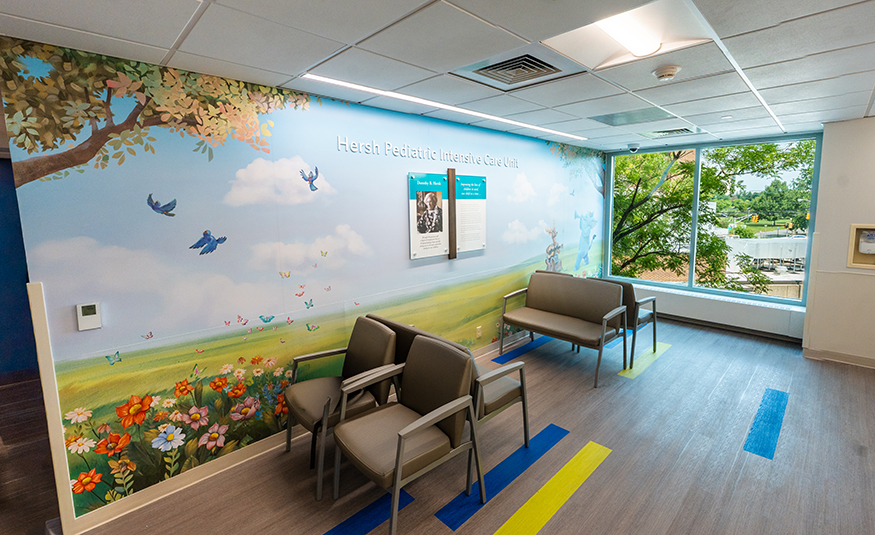
In summer 2026, Saint Peter’s University Hospital completed its $11 million Hersh Pediatric Intensive Care Unit. The name recognizes The Hersh Foundation, which contributed $1 million to help kickstart the project. - PROVIDED BY SAINT PETER'S
In summer 2026, Saint Peter’s University Hospital completed its $11 million Hersh Pediatric Intensive Care Unit. The name recognizes The Hersh Foundation, which contributed $1 million to help kickstart the project. - PROVIDED BY SAINT PETER'S
Saint Peter’s invests $36M in New Brunswick ICUs (updated)
Jessica Perry//July 27, 2026//


)

The basics:
- Saint Peter’s University Hospital is investing $36M in new ICU facilities
- New PICU will expand from eight to 14 beds
- New adult ICU will include 24 beds
- AI and virtual nursing technology will support patient care
As services shift out of hospitals and closer to the communities they serve, intensive care units are commanding more space on campus. ICUs at hospitals across the U.S. admit more than 5 million patients each year. Representing about 20% of all acute care admissions, the figure is substantial. And rising.
In New Brunswick, Saint Peter’s University Hospital has taken proactive steps to accommodate the rising patient census. The Roman Catholic-sponsored facility is investing $36 million to build new Pediatric and Adult Intensive Care Units on campus.
Discussing the capital investments in 2024, Saint Peter’s President and CEO Leslie Hirsch told NJBIZ, “This is probably the most substantial project that we’ve done in many, many years.”
Meeting demand
Driven by sicker, older, more medically complex patients and lessons learned during COVID, hospitals are expanding ICUs to meet demand. From 2025 to 2035, Vizient Intelligence projects ICU days will increase by 14%, compared to just 5% growth in overall inpatient utilization during the same period.
Within the department, Vizient said a growing 57% of usage came from critical care cases, versus surgical. For hospitals already operating at or near capacity limits – not unheard of – the trend exacerbates capacity issues. And the increase in the average length of stay in the ICU has also adversely affected vacancy, according to Vizient.
The state-designated children’s hospital and regional perinatal center located on Easton Avenue is also a major clinical affiliate of Rutgers Biomedical and Health Sciences. Its accolades include the Beacon Award for Excellence, presented by the American Association of Critical-Care Nurses. As of 2025, Saint Peter’s has earned seven Beacon Awards for its Adult ICU and two for the PICU.
The system’s flagship recently completed its $11 million Hersh Pediatric Intensive Care Unit. The name recognizes The Hersh Foundation, which contributed $1 million to help kickstart the project. Saint Peter’s also secured additional funding by way of an appropriation in the Fiscal Year 2024 state budget.
After celebrating the space in June with a blessing event, the new PICU is currently awaiting inspection by the state Department of Health to begin occupancy. Vice President Of Patient Care Services and Chief Nursing Officer Linda Carroll says the hope is to activate sometime in August.
Already one of the larger pediatric intensive care units in the state, the recently completed work relocated the department, increased capacity from eight to 14 beds, and sought to center families and the patient experience.

Lessons learned
The updates offer more space, increasing patient rooms from about 150 square feet to as much as 270 square feet, Carroll said. Having that area – along with full, private bathrooms – is important to accommodate families and overnight visits.
The overall PICU follows a kind of circular format. Carroll explained the layout provides visuals of all rooms from the nurse’s station. The environment is also now more reflective of its impressionable patient base. Columns are painted to look like trees, adding some whimsey, while circus animals perform across picturesque murals that dress up the walls.
Along with adding design elements to create a more kid-friendly environment, the updated PICU also takes care to remove things from view, “so that, for a child, it doesn’t look like a hospital room.” Beyond the aesthetic and pediatric-geared touches, Carroll noted that changes like using panels to conceal equipment on the head wall also positively impact infection prevention.

“[W]e don’t have privacy curtains … we use the technology, especially for our new units, where you actually turn a switch and all the glass frosts over,” Carroll explained.
“It’s a lot easier to keep clean and launder. And really eliminates cross contamination,” she added.
While the previous unit served them well, Carroll said that Saint Peter’s census started to escalate post-COVID. The executive served as the hospital’s incident commander during the pandemic. On any given day, she explained that the patient count reached as high as 22.
For Saint Peter’s it highlighted unmet need. “We felt really strongly that we wanted to expand our services,” Carroll told NJBIZ.
In its approval of the plans, the New Jersey Department of Health projected 60% occupancy on an annualized basis at the new PICU. However, it noted Saint Peter’s expects normal seasonal fluctuations would increase that figure to 80%–100% of the 14 new beds throughout the year.
According to the healthcare system, its PICU treats between 1,400 and 1,800 patients annually.

NJBIZ honoree
Saint Peter’s Healthcare System President and CEO Leslie Hirsch was the recipient of the 2026 NJBIZ Health Care Heroes Lifetime Achievement Award. Read about this honor here.
Beyond the need for increased capacity, the pandemic also helped influence other features in the new PICU.
“We wanted to be very, very mindful of when these type of health emergencies arise; making sure that we’re prepared,” Carroll explained.
“It’s making sure that we had enough negative pressure rooms, so if we get any patients coming in that any airborne type illnesses, that we have the proper way to really isolate them,” she went on.
More than half of the rooms in the PICU now feature that capability, according to Carroll.
For staff and patients, “We wanted to make sure, from a healthy work environment, that we put lifts in the ceiling,” she also detailed. “So that if there’s a child that is really difficult to move, that we’ve got other devices to assist.”
Thanks to identifying swing space, construction of the new PICU did not disrupt operations in the current pediatric intensive care unit.
The Adult ICU required a bit more maneuvering. When the work began, Hirsch said several dominos needed to fall into place to ensure success.
Trading spaces
That $25 million project will bring department’s capacity to 24 beds as it expands to cover most of the fifth floor in the Middlesex County seat. The new Elizabeth and Joseph DeMarco Adult Intensive Care Unit is supported by a $1.5 million donation from the DeMarco family. It will replace the current ICU, built in 1989. Plans for the new project will increase the critical care unit to about 25,000 square feet with delivery expected by mid-2027.
Uncovering history
Work is currently underway on the Adult ICU renovations at Saint Peter’s University Hospital, and it’s come with a few surprises.
The space on the fifth floor that will house the new unit has existed since a major expansion project in the mid 1970s, Chief Nursing Officer Linda Carroll said.
But when they broke down some of the walls on the fifth floor in the present, it revealed features much older than that, including the facility’s original facade.
“It was totally intact when they took down the walls,” Carroll said. “So, they just put the sheet rock over the face of the old hospital.”
Today, Saint Peter’s University Hospital sits on 9 acres donated by the Diocese of Trenton in 1923. It opened on Easton Avenue in New Brunswick in 1929.
The updated space is crucial. As the population grays, patients 65 years of age and older account for nearly half of all ICU patients. And they bring distinct needs along with them.
Carroll said construction of the first phase – demolition on half the floor – is wrapping up this summer. To accommodate the rearrangement, the project required reevaluating the use of existing space at Saint Peter’s. To make room, she said the hospital decided not to renew an agreement with a long-term acute care provider that rented space within the building.
In April, the Adult ICU moved to the first level to advance work on its revamped space up on the fifth. The new critical care department will span two wings with a central core of common space in the middle. “It’s all the ICU when you walk out of the elevators,” Carroll said.
The design emphasizes patient flow and practitioner awareness, which supports staff in performing their duties. For staff, Carroll noted the mood boost that coming into a new environment can have on its own, as well as the work required to get up and running.
According to Saint Peter’s, the 100-member unit is staffed by 80 registered nurses and three advanced practice nurses along with intensivists. The ICU comprises medical intensive care, cardiac intensive care and surgical intensive care. The hospital says the department treats between 900 and 1,100 patients annually.
When the Adult ICU made its move to the former LTAC space, the beds there were different from the ones utilized prior to the move. Whether it’s different physical equipment, or technology, Carroll said providers must be mindful of providing training for staff — especially in a new space.
“Making sure that everybody’s oriented, the physical plan, fire egress, where all the call lights are … You have to make sure that staff are oriented and that they do a return demonstration so that they’re deemed competent,” she explained. “The worst thing you would ever want is to have, especially in a critical care area, to have staff fumbling around not knowing how to use equipment or not knowing where to find things. So it’s a lot of prep work ahead of time.

People power
Saint Peter’s is introducing AI across both the new PICU and Adult ICU construction. Studies note artificial intelligence can offer insights to identify risk earlier, support decision-making and enhance workflows in ICU nursing – highlighting how the technology can improve the experience for caretakers as well as patients.
At Saint Peter’s, virtual nurse capabilities allow for remote monitoring of patients. “We call it HelloCare,” Carroll said of the technology, which uses a room’s TV as a communication tool. “Very similar to how we did during COVID … where you’d have an iPad in the room and you could communicate to your patients that way.”
Spotlight on hospitals:
also in this issue
Rutgers School of Nursing is teaming up with Wall Township-based Caregility to introduce a virtual care component into undergraduate nursing education. Read more.
In addition to helping isolate patients that may need it within the department, the technology can also help them connect with offsite family members and others. “[Y]ou can have the physician tie in as well as the family, the patient and the staff members,” Carroll said.
Beyond the new ICUs, Carroll said the Step Down and Medical-Surgical units also utilize HelloCare. Leaning into tech like that as it expands capacity offers Saint Peter’s a double edge as the pace of tech adoption continues to accelerate.
Humans: Mission central
However, humans are still very much central to the mission. Carroll said staff support programs and physical investments, like those in the ICUs, help with recruitment and retention of team members. Calling attention to Saint Peter’s MAGNET Award recognition and guidance, she noted the importance of empowering clinical staff nurses and making sure they have a voice.
“A lot of these ideas were really birthed through our professional practice council,” she said, highlighting that the group is 100% employee driven. “So the staff really come up with what is important for them as far as a healthy work environment. What type of recognition is meaningful for them? What can we do to promote resilience?”
That extends to both the PICU and Adult ICU projects. “Not only did the staff nurses participate in construction meetings,” Carroll said. “We also had our physicians, too.”
These healthcare professionals convened with Saint Peter’s Engineering Department and its project team partners. Bringing together nursing staff and leaders, and doctors, “It really was everybody involved to make some of these decisions,” Carroll added. “So, we feel really good about that. This is going to be state of the art.”
Carroll said, “it’s not just building things and doing things the way we’ve always done them.” But rather using that knowledge base to prepare for the future of care.
Hospitals can’t predict the future, but they can plan for it. “Having all of those experiences under our belt I think really have helped us to create the ‘state of the art,’ really,” Carroll said. “I don’t think we forgot anything. Just by having so many people involved and having those experiences … really did help us to create two beautiful units that I really think we pretty much thought of everything.”
Editor’s note: This story was updated at 3:10 p.m. ET July 28, 2026, to correct the number of beds in the Adult ICU under construction at Saint Peter’s University Hospital. The new unit will include 24 beds, while the old one had 26. The new rooms occupy larger footprints than their predecessors. Additionally, Saint Peter’s is no longer an affiliate of The Children’s Hospital of Philadelphia as previously indicated on its website.