Sign In
Upcoming Event
 Free Newsletter

NJ FY27 budget hearing highlights business tax concerns
Assembly holds first meeting on Sherrill's $60.7B spending plan
Matthew Fazelpoor//March 19, 2026//

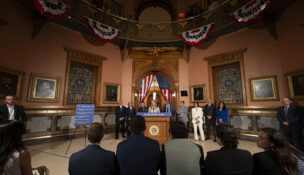
Gov. Mikie Sherrill gives her first Budget Address in the Assembly Chambers of the State House in Trenton on March 10, 2026. - PROVIDED BY THE NJ GOVERNOR'S OFFICE/RICH HUNDLEY III
Gov. Mikie Sherrill gives her first Budget Address in the Assembly Chambers of the State House in Trenton on March 10, 2026. - PROVIDED BY THE NJ GOVERNOR'S OFFICE/RICH HUNDLEY III
NJ FY27 budget hearing highlights business tax concerns
Assembly holds first meeting on Sherrill's $60.7B spending plan
Matthew Fazelpoor//March 19, 2026//


The basics:
- Assembly Budget Committee holds first hearing on $60.7B FY27 plan
- Business groups back spending cuts but warn on new taxes and fees
- Concerns raised over NOL cap, ABC deduction, Employer Health Contribution
- Budget includes full pension funding, K‑12/early education aid, property tax relief
New Jersey’s Fiscal Year 2027 budget season took its next step March 18, as the Assembly Budget Committee held the first public hearing on Gov. Mikie Sherrill’s $60.7 billion spending plan.
As NJBIZ has reported, some of the key budget toplines include fully funding the state pension system; increasing K–12 and early childhood education funding; and providing property tax relief through programs like ANCHOR, Stay NJ and Senior Freeze.
At the same time, proposals to cap net operating loss deductions, limit the alternative business calculation deduction, and establish an employer health assistance contribution have drawn some scrutiny from the business community.
The Wednesday meeting lasted more than six hours. It gave residents, business and advocacy groups, stakeholders and lawmakers their first opportunity to weigh in on both the administration’s spending plan, as well as its proposed revenue measures.

Assembly Budget Chair Eliana Pintor Marin, D-29th District, opened the hearing welcoming participants and stressing the importance of public input.
“These hearings are an opportunity for us to listen carefully and respectfully to the voices, concerns and perspectives of our residents and stakeholders,” said Pintor Marin. “I want to note that this year’s budget timeline is a bit more compressed than usual.”
Welcome dose of reality
Mike Egenton, executive vice president of government relations, New Jersey State Chamber of Commerce, highlighted both positives and concerns in the budget. He opened his testimony acknowledging the state’s business community recognizes New Jersey operates in a challenging fiscal environment.
As the governor laid out, the state is contending with a $3 billion structural deficit amid tightening conditions, reduced federal funding and geopolitical uncertainty.

“The State Chamber appreciates the administration’s efforts to confront these realities and to begin taking steps toward addressing the $3 billion structural budget imbalance,” said Egenton. “We appreciate the administration’s commitment to maintaining fiscal stability while continuing to invest in key priorities, such as infrastructure, workforce development, Pre-K and education.
“These investments are essential to supporting long term economic growth and ensuring that New Jersey remains a competitive place to live, work and do business. The business community shares the administration’s goal of building a stronger, more resilient economy that benefits all residents of the state.”
Can’t ‘cut our way to prosperity’
Egenton said the chamber commends efforts to reduce overall spending growth and to implement $2 billion in spending cuts. He also cited efforts to reduce that structural deficit to around $1.7 billion from $3 billion.
“These steps signal an important acknowledgement that New Jersey must begin bringing spending growth in line with revenues and improving the state’s long term fiscal outlook,” said Egenton. “However, we cannot cut our way to prosperity. Expense reductions must be paired with aggressive growth initiatives that generate sustainable, organic revenue from business expansion.
“The foundation for strong economic and fiscal growth can only be achieved by combining continued expense austerity with significant revenue growth.”
Expense reductions must be paired with aggressive growth initiatives that generate sustainable, organic revenue from business expansion.
—Mike Egenton, executive vice president of government relations, NJCC
Egenton noted the chamber’s support for initiatives including:
- Funding for the New Jersey Economic Development Authority and the New Jersey Innovation Authority
- Additional staffing at the New Jersey Department of Environmental Protection to expedite permitting
- Reducing business filing fees
- More resources for the New Jersey Business Action Center
- Continued funding for the Main Street Recovery
However, he noted that as the budget approaches $60 billion, the state must look for ways to rein in spending.
“We are concerned about several proposals within the budget that would increase costs for employers at a time when New Jersey already faces significant competitiveness challenges,” said Egenton. “Businesses are still adjusting to the Corporate Transit Fee, which was enacted in 2024.
“Additional taxes or fees layered on top of this, risk discouraging investment and job creation in the state.”
At an inflection point
New Jersey Business & Industry Association Chief Government Affairs Officer Chris Emigholz also testified March 18.

“Like almost any massive spending document, the proposed FY27 $60.7 billion state budget has some positive features for the business community and some that are concerning,” Emigholz said.
His testimony focused on three main themes: the inflection point on spending, concerns about new revenues and pro-business investments.
“More than anything else, the FY27 state budget now before you represents an inflection point on our state spending philosophy in New Jersey,” Emigholz said. “We recently faced a turning point with pension payments in the state budget after previous legislators and governors shirked their pension responsibilities for years.
The decision before you now is whether to begin to rein in spending increases as Gov. Sherrill called for, or continue to let the budget grow at unsustainable levels as it has in recent years.
— Chris Emigholz, chief government affairs officer, NJBIA
“Thankfully, we finally made the right decision to ramp up pension payments and maintain full funding for years now – even if that meant not being able to afford to spend as much on other programs. The decision before you now is whether to begin to rein in spending increases as Gov. Sherrill called for, or continue to let the budget grow at unsustainable levels as it has in recent years.
“The $24.1 billion/69.5% increase in Gov. [Phil] Murphy’s eight budgets has led to the currently proposed $1.7 billion structural imbalance.”
A ‘welcome change of pace’
NJBIA also commended cuts in the budgets, such as a slimmed down Stay NJ.
“It is a welcome change of pace to see the business community is not alone facing new burdens in the budget, as has been the case in recent years,” said Emigholz. “Beyond the initially proposed FY27 spending cuts, NJBIA hopes that further structural reforms, such as school consolidation and shared services, benefit reform and those proposed in the bipartisan Path to Progress report, can be explored to continue to make New Jersey more affordable.”
Emigholz noted support for no legislative or executive add-ons to the plan.
“Additionally, NJBIA hopes that choosing fiscal discipline and shared pain today will help pave the way to the statutorily scheduled sunset of the Corporate Transit Fee two years from now,” said Emigholz. “The most important thing in today’s proposed budget is to make the decision to put that sunset in motion. So New Jersey no longer is a corporate tax outlier with the highest corporate tax rate in the nation and the only state with a rate in double digits.”

Tax increases and staying competitive
Emigholz noted New Jersey has the second highest unemployment rate in the nation. Additionally, it holds distinction as the only one in the top third for each of the four major state and local taxes, he said.
“NJBIA is concerned about any tax increase that makes New Jersey less competitive,” he explained. “These include the three proposed new revenue raisers … in the FY27 state budget that totals $750 million in new state revenue for New Jersey.”
“The budget proposed a temporary $1 million cap on all NOL deduction under the corporation business tax for a three-year period, from tax year 2026 through tax year 2028, increasing state revenues by $485 million annually over those three years,” Emigholz continued. “This proposed cap impacts 600 taxpayers.
“This tax change is disappointing for several reasons, not the least of which is the fact that the increase in NOL use comes from a change to NOL policy that the business community recently negotiated with New Jersey Treasury officials just a few years ago. It is not a corporate loophole, but a common tax policy to incentivize entrepreneurship and risk-taking.”
Shared, significant concerns
Egenton shared concerns about the revenue raisers and echoed the sentiment on the NOL cap.
“The proposal to establish an Employer Health Assistance Contribution raises significant concerns,” said Egenton. “While it may be framed as a fee or contribution, it effectively functions as a new tax on employers. This policy would penalize businesses whose employees enroll in NJ FamilyCare, even when those employers offer health insurance coverage.
“In many cases, employees choose Medicaid because it is a lower cost option compared to commercial premiums or choose to work limited hours so they can continue to qualify. Beyond the policy concerns, the administrative challenges associated with tracking and verifying this information would be substantial for employers,” he continued. “The unintended consequences would discourage companies from offering part time positions.”

ABC
On the alternative business calculation adjustment, Egenton said the 2011 reform aimed to better align New Jersey’s tax system with its regional and national competitors.
“While this change is expected to generate roughly $120 million in revenue, it again raises relatively little compared to the size of the overall budget — while making New Jersey less competitive for entrepreneurs, small business owners and investors,” Egenton continued. “In the real world, businesses with $500,000 or even $1 million in gross revenue are hardly ‘large businesses.’
“These are the very individuals who start companies, create jobs and drive innovation. And it is critical that New Jersey remains a place where they choose to launch and grow their businesses rather than look to other states.”
Emigholz said that of the 240,000 taxpayers who claim the ABC deduction, only 10,000 returns will see an increase in tax liability.
“Even if it is true that it should be better focused on small businesses, a threshold of gross income over $1 million is just not focused on small businesses, but tiny businesses. There also seems to be a disconnect to limit eligibility for a net income program by using gross income. At the very least, the eligibility threshold should be examined to include small and mid-sized job creators.”
Both Egenton and Emigholz also called for restoration of the NJEDA’s NJ Manufacturing Voucher Program.
Closing comments
Egenton closed urging officials to avoid policies that increase costs for employers while providing relatively limited fiscal benefit.
“New Jersey’s long term economic growth depends on maintaining a competitive, predictable environment for businesses to invest, expand and create jobs,” he said. “We look forward to continuing to work with the Legislature and the Administration to ensure that the final budget supports both fiscal responsibility and economic growth.”
Emigholz said his organization looks forward to working “to remove or moderate the three revenue raisers,” as well as maintain Sherrill’s proposed spending cuts and avoid last minute additions.
“NJBIA will do this while trying to maintain investments in the three pro-growth spending areas of workforce development, infrastructure and innovation, especially in manufacturing,” he said.
The Assembly Budget Committee will hold its next public hearing March 25 at 9:30 a.m. The Senate Budget and Appropriations Committee will hold its first hearing, remotely, March 24 at 10 a.m. The public can register to provide testimony by phone or video through the Legislature’s website. Hearings are available to view live here.
The governor must sign the state budget into law by June 30, 2026.