Sign In
Upcoming Event
 Free Newsletter

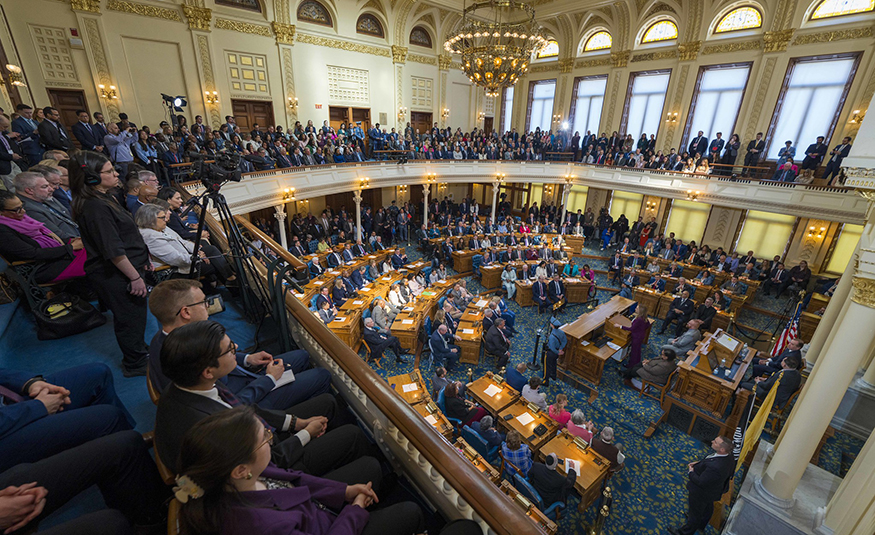
Gov. Mikie Sherrill gives her first Budget Address in the Assembly Chambers of the State House in Trenton on March 10, 2026. - PROVIDED BY THE NJ GOVERNOR'S OFFICE/TIM LARSEN
Gov. Mikie Sherrill gives her first Budget Address in the Assembly Chambers of the State House in Trenton on March 10, 2026. - PROVIDED BY THE NJ GOVERNOR'S OFFICE/TIM LARSEN
NJ lawmakers advance $60.75B budget after rare Sunday session
Matthew Fazelpoor//June 29, 2026//


The basics:
- Budget committees approve NJ’s $60.75B FY2027 state spending plan
- Final floor votes expected before June 30 constitutional deadline
- Budget includes $6B surplus, full pension payment
- Business groups criticize new taxes, budget transparency
In a rare Sunday night session, the Senate and Assembly Budget committees approved New Jersey’s $60.75 billion Fiscal Year 2027 spending plan. Clearing Senate Bill 2027/Assembly Bill 5327 keeps the state on track to meet the June 30 constitutional deadline, despite the budget process once again coming down to the final hours.
The votes – held just one day before the start of the new fiscal year – set the stage for final approval by both chambers Tuesday. After, the budget will head to Gov. Mikie Sherrill’s desk to be signed into law. The committee action follows a budget agreement announced last week between Sherrill and Democratic legislative leaders.
Having finalized the broad framework of the spending plan days earlier, they continued to negotiated several elements, including legislative spending priorities and budget language, through the weekend. Lawmakers received hundreds of pages of budget documents only shortly before Sunday’s committee meetings.
The $60.75 billion budget matches the spending level Sherrill proposed in March. Senate Budget Committee Chairman Paul Sarlo, D-36th District, said the uncommon outcome reflects weeks of negotiations between the executive branch and legislative leadership.
Delivering a balanced budget

“We’re going to present today a $60.75 billion budget. It matches the governor’s budget message (GBM). We haven’t seen that in some time,” said Sarlo. “All the years I’ve been doing it, first time I’ve seen it. I commend the Legislature, both houses, and the governor for agreeing on a spending plan that matches the governor’s budget message.
“There was a lot of give and take in this. Of course, for the new governor, there’s a learning curve of going through the process; been a lot of give-and-take.”
Sarlo thanked the key stakeholders and partners involved in the process.
“A lot of time was spent in the last week or two,” said Sarlo. “The principals had an agreed framework in place earlier this week, Monday, and as you know. There is a lot of moving parts to put a budget of this magnitude together, including some language changes, including some cuts and restorations.
“So, we are delivering today a balanced budget to the State of New Jersey.”
Sarlo said the plan includes a $6 billion surplus, a full pension payment and “a very, very strong property tax relief program” that includes funding for ANCHOR and a restructured Stay NJ program.
“There is a lot of geopolitical forces. H.R.1 [the One Big Beautiful Bill Act] is going to hit us hard next year – the impacts of H.R.1 to Medicaid,” said Sarlo. “We have a healthy surplus, a very healthy surplus heading into next year.”
FY2027 highlights
The final agreement also restored roughly $100 million above Sherrill’s original proposal for Stay NJ. That makes total funding for the senior property tax relief program approximately $742 million, while also maintaining revised eligibility standards that direct larger benefits toward lower-income seniors.
The spending plan provides record K-12 school aid, as well. However, lawmakers did not make any changes to the state’s controversial school funding formula despite bipartisan calls to revisit it.
Among the notable appropriations is $15 million for Jersey City as the city works through a fiscal crisis, which NJBIZ has reported on, in addition to a $105 million loan as part of a broader financial stabilization effort.
Beyond the budget bill itself, lawmakers advanced several key companion bills, such as:
- Increasing the Child Tax Credit for tax years 2026 through 2028 S4531/A5329
- Reducing business formation fees S4534/A5325
- Establishing a new employer assessment tied to employees receiving Medicaid coverage S4533, A5324
- Temporarily capping the use of certain corporate net operating loss deductions at $1 million S4536, A5322
- Modifying eligibility for the alternative business calculation adjustment under the Gross Income Tax S4537, A5323
While some of the included legislation earned applause, such as the Child Tax Credit and reducing business formation fees, the business community bemoaned the three measures pertaining to Medicaid and corporate taxes.
Minutes to spare
Democratic leaders praised the budget’s fiscal stability and affordability initiatives. Meanwhile, Republicans argued the process once again lacked transparency — despite promises from the new administration that this year’s budget process would be more open.

“This side of the aisle has to fault the last-minute nature of this process,” Sen. Declan O’Scanlon, R-13th District, said during the committee meeting. “It would not be hard at all – with a little bit of discipline, more professionalism across the board – to have a budget sit for a week or two weeks, so the press can dissect it, so we can, and so we could all know what we’re voting for.”
O’Scanlon, who serves as the Republican Budget Officer, added that lawmakers received the final budget documents only minutes before the committee vote.
Nobody who votes for it tonight has read it, because we just received it 15 minutes ago.
—Sen. Declan O’Scanlon, R-13th District
“Nobody who votes for it tonight has read it, because we just received it 15 minutes ago,” he said.
Cause and effect
A new report says recent corporate shifts from N.J. have cost 7,200 jobs. Keep reading.
Assembly Budget Committee member Michael Inganamort, R-24th District, echoed those concerns during the parallel meeting on the Assembly side.

“We spent four months on the budget committee, going line by line through the governor’s proposed budget; we asked tough questions, we uncovered problems, we identified areas that needed funding and fixing,” said Inganamort. “We all took this job very seriously. In return, we weren’t given one day to read the final budget before voting on it – not one day.”
He added, “Realistically, it’s going to take us days to unpack what else is actually in this budget. We can’t do it all on the fly. And I’ve had a number of people tell me that’s just the way it is – that’s the process. It’s not. This isn’t normal. This isn’t right. And what makes it even harder to justify this year is that the governor specifically promised it would be different. She promised a more transparent budget process – and I believe she failed to deliver on that process.
“I can’t vote for a $60.7 billion budget that I wasn’t given the opportunity to read in full. I am a no.”
The big picture
Another measure that has rapidly moved in recent days and weeks, including during Sunday’s Senate Budget Committee meeting, is S2338/A3735 (Polluters Pay to Make New Jersey More Affordable Act – or Climate Superfund Act). The measure would impose penalties on certain fossil fuel companies. More on to come on this on NJBIZ.
Business organizations weighed in, supporting certain aspects and investments while also offering sharp criticisms.

Hilary Chebra, vice president of government affairs for the Chamber of Commerce Southern New Jersey, warned lawmakers that the overall package could make the state less competitive.
“We know that the Legislature and the governor has put in a lot of work to address New Jersey’s fiscal challenges and maintain investments on your important priorities,” Chebra said during the Assembly Budget Committee meeting, speaking just before midnight. “However, unfortunately, these investments are overshadowed by some of the actions taken today that you’ve heard us speak on earlier.
“No business looks at one single budget provision or one single piece of legislation. They look at the climate as a whole and the cumulative impact of the policies to decide whether they’re going to invest and grow somewhere,” she continued. “And, unfortunately, a lot of the actions taken in this budget and, along with the budget, have a bad cumulative impact of making Jersey a more unfriendly and less competitive place to do business.”
Not ‘necessarily’ business friendly

Amirah Hussain, director of government relations for the New Jersey Chamber of Commerce, acknowledged several positive investments, such as in the New Jersey Manufacturing Extension Program, pensions and public broadcasting, but remained opposed to the new business taxes.
“We are very much concerned about the three punitive taxes,” she said. “We don’t feel that this budget is necessarily business friendly or sends the right signal that New Jersey is ready to attract businesses and keep the ones here. So, we remain opposed to those

New Jersey Business & Industry Association Chief Government Affairs Officer Christopher Emigholz similarly applauded lawmakers for keeping overall spending flat. He also noted the investments into NJMEP and Sherrill’s Saving Time and Money agenda, while warning that the accompanying tax package could undermine affordability.
“We are concerned that after this budget’s done, we are less affordable than we were before this budget,” said Emigholz. “This budget is still based upon new taxes, almost to a billion dollars. This budget is based upon a tax level already that was among the highest in the nation.”
The Senate Budget and Assembly Budget committees approved the spending plan on a party-line vote late Sunday evening. Assembly Budget Committee Chairwoman Eliana Pintor Marin, D-29th District, noted she would save her full comments about the bill for the floor vote Tuesday.
Seeking climate change
Following the vote, NJBIA President and CEO Michele Siekerka released a statement echoing Emigholz’s sentiments.

“NJBIA appreciates efforts with this budget to find efficiencies and to keep spending relatively flat from last year, particularly after the massive spending increases from the previous eight years of unsustainable budgets,” said Siekerka.
“There are fewer current year add-ons this year, as well, but still too many when you consider that New Jersey is still less affordable after this budget than it was before. At the end of the day, this budget still raises taxes on business – yet again – and uses some gimmicks to pay for the new spending, which inherently means a bigger structural hole in next year’s budget.
“We are pleased to see investments in Gov. Sherrill’s Saving Time and Money Agenda, and the inclusion of NJMEP funding in the budget to help our manufacturing sector. But the bottom line for the business community is we are still under attack.
The bottom line for the business community is we are still under attack.
—Michele Siekerka, president and CEO, NJBIA
“Nearly all of the revenue-raisers in this budget are on the backs of business, despite having one of the worst business tax climates in the nation.”
Siekerka added, “Rather than continuing to add the costs and burdens of our job creators, both small and large, we instead encourage our policymakers to finally embrace real reforms in New Jersey. We say it every year, but without those reforms, our affordability will continue to decline, and our large employers will continue to move, grow or invest elsewhere.
“And finally, our budget is a big spend and a big deal for our state year over year. We cannot continue to find ourselves in the dark until the last minute, so we can understand what’s included and what’s not and what the impact to our taxpayers will be. We continue to call for better transparency as we proceed forward.”
The wrong message at the wrong time
In a June 29 statement, New Jersey Chamber of Commerce President and CEO Tom Bracken said as the this cycle comes to a close, it’s time to look to the future and begin to focus on the state’s most pressing need.

“Attention should turn to advancing policies that strengthen our economy, encourage investment, and improve New Jersey’s long-term competitiveness, all of which have been virtually ignored for way too long,” said Bracken. “Supporting economic growth and the business community was not a focus of this budget. New Jersey’s employers – those who create jobs, drive investment, and fuel our state’s economy – were given minimal support.
“In fact, funding dedicated to supporting small businesses was significantly reduced, and the budget includes new taxes that disproportionately impact employers. These policies send the wrong message at a time when New Jersey should be working to attract and retain businesses, not making it more costly and cumbersome to operate here.
“The negative financial and reputational aspects will make it more difficult for us to compete, which is necessary if the economy is to grow,” Bracken continued. He stressed that these burdens on employers comes as the result of years of unsustainable spending growth.
Now it’s time to turn the page, he said.
“We encourage the administration and Legislature to work together on a pro-business agenda that supports entrepreneurs, helps existing employers grow, attracts new investment, and strengthens New Jersey’s reputation as a destination for business,” said Bracken
Next steps
Both chambers are expected to take final votes Tuesday. Sherrill must sign the budget bill ahead of the constitutional June 30 deadline.
On Monday morning, Gov. Sherrill released an update to the state’s Budget Report Card ahead of the final vote. Executive Order No. 5 created the new tool.
“New Jerseyans should be able to easily see how their tax dollars are spent and which programs they are funding – that’s why we created the Report Card. Now, we are updating the Report Card ahead of this year’s budget vote by the full legislature so New Jerseyans have a ‘one stop shop’ to more easily find a user-friendly picture of the budget.
“This budget is the most fiscally responsible in years, focused squarely on making life more affordable for New Jerseyans across our state, and I look forward to signing it in the coming days,” said Sherrill.
The budget bill is available here; and the Score Sheet here.