Sign In
Upcoming Event
 Free Newsletter

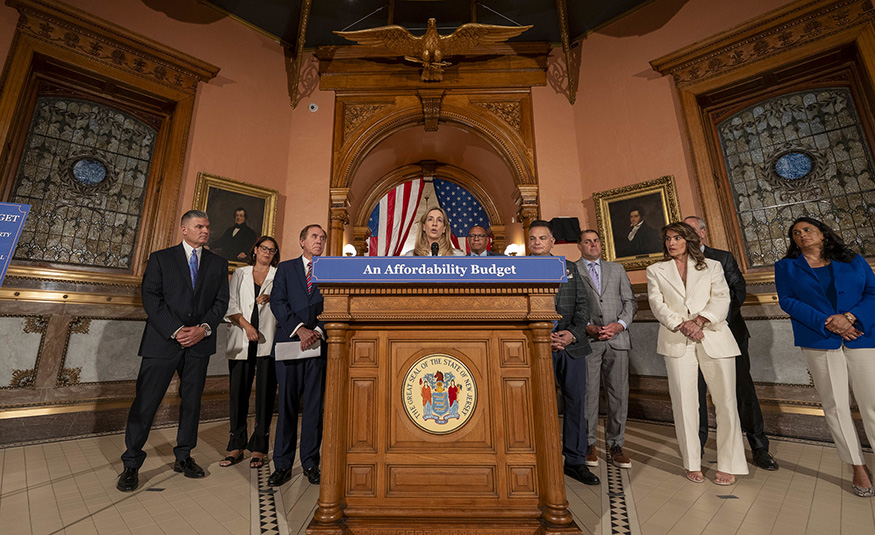
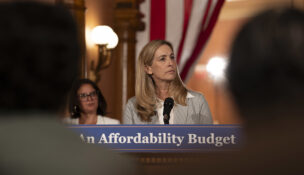
Gov. Mikie Sherrill holds a news conference in the rotunda at the State House in Trenton on June 30, 2026, after the Fiscal Year 2027 budget was passed by the legislature. - PROVIDED BY NJ GOVERNOR'S OFFICE/TIM LARSEN
Gov. Mikie Sherrill holds a news conference in the rotunda at the State House in Trenton on June 30, 2026, after the Fiscal Year 2027 budget was passed by the legislature. - PROVIDED BY NJ GOVERNOR'S OFFICE/TIM LARSEN
Reaction pours in after Sherrill signs $60.7B NJ budget
Matthew Fazelpoor//July 1, 2026//


 Listen to this article
The basics:
- Business groups criticize new employer costs in FY2027 NJ state budget
- Democrats tout affordability and fiscal discipline
- Republicans fault spending and transparency
- Advocates praise relief measures while seeking budget reforms
Gov. Mikie Sherrill on Tuesday signed New Jersey’s $60.7 billion fiscal year 2027 budget into law, pairing record investments in property tax relief and K-12 education with a full pension payment and an expanded child tax credit, while several elements drew sharp criticism from Republicans and business groups.
The budget (Assembly Bill 5327/Senate Bill 2027), the first of Sherrill’s administration, maintains spending at the level she first proposed in February – the highest in state history – while preserving New Jersey’s sixth consecutive full pension payment; cutting the structural deficit from more than $3 billion to $1.35 billion; and ending the fiscal year with a projected $6.05 billion surplus, down from roughly $7.7 billion at the start of the budget process.
Alongside the spending plan, lawmakers approved a series of companion bills that implement key fiscal policies, including temporary business tax changes, a new employer Medicaid assessment, expanded child tax credits, reduced business formation fees and a separate $358.8 million supplemental appropriations bill that became one of the most contentious pieces of the budget package.
While Democrats hailed the spending plan as fiscally responsible amid federal uncertainty, Republicans blasted it as another tax-and-spend budget that relied on last-minute negotiations and hidden spending. Business organizations similarly criticized new costs imposed on employers, while advocacy organizations largely praised the affordability measures but echoed concerns about the lack of transparency.
Top budget highlights
- $4.1 billion in property tax relief through ANCHOR, Senior Freeze and a redesigned Stay NJ program, which focus benefits on households earning $200,000 or less
- $7.3 billion full pension payment
- $6.05 billion projected surplus at the close of FY2027
- Structural deficit reduced to approximately $1.35 billion, roughly half of what the administration inherited
- $12.4 billion in K-12 education funding, another record level
- $1.4 billion for preschool education
- Temporary 25% increase in the Child Tax Credit for tax years 2026–2028
- Nearly $1.1 billion in operating support for NJ Transit
- Approximately $2.1 billion for transportation capital projects
Even with the record education investment, school funding remained one of the most contentious issues throughout negotiations.
Republicans argued districts across New Jersey continue to experience significant reductions under the state’s school funding formula, forcing school closures, staff and athletic cuts, and other difficult decisions despite overall state spending reaching record levels.
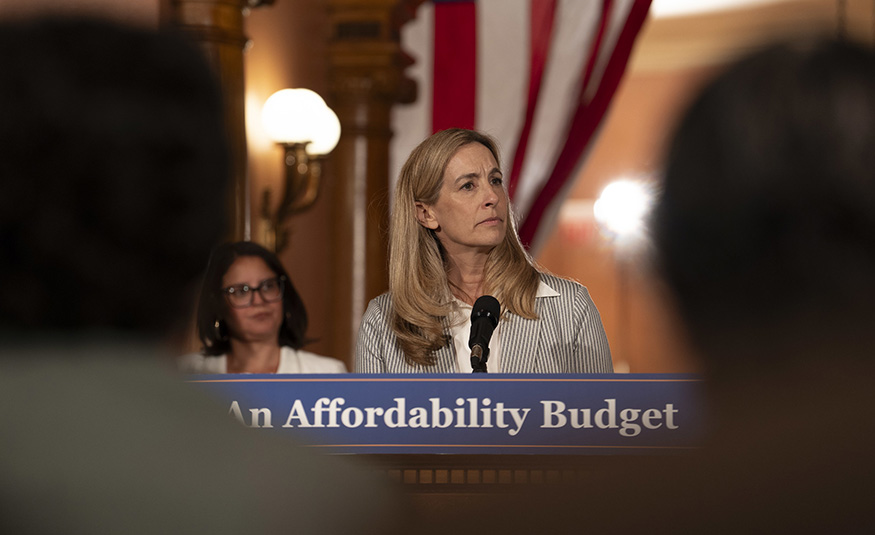
Sherrill acknowledged the situation during a news conference after the budget passed.
“We spent more money on school funding than we’ve ever spent, and yet we still see many towns struggling. So, we are going to work to address the school funding formula going forward,” said Sherrill.
Companion legislation
Several companion bills approved alongside the budget provide the policy framework supporting the spending plan.
Among the most significant:
- S4538/A5326 – FY2026 supplemental appropriations bill providing $358.8 million in additional spending
- A5322/S4536 – Temporarily caps certain corporate net operating loss deductions (expected to raise approximately $485 million in FY2027)
- A5323/S4537 – Modifies the Alternative Business Calculation deduction under the Gross Income Tax (expected to raise approximately $120 million annually)
- A5324/S4533 – Establishes an employer healthcare assistance assessment on certain employers with workers enrolled in Medicaid (expected to raise approximately $145 million annually)
- A5325/S4534 – Reduces business formation fees by $25
- S4531/A5329 – Increases the Child Tax Credit by 25% for three tax years
- A5330/S4507 – Allows temporary transfers within the pension system under certain circumstances
The FY2026 supplemental appropriations bill became a flashpoint during final negotiations.
The legislation assigns $358.8 million in additional spending before the close of the current fiscal year, allowing lawmakers to fund projects outside the FY2027 budget itself.
The largest item was a $120 million stabilization package for Jersey City, including a $105 million state loan contained in the supplemental bill and $15 million in direct aid included within the FY2027 budget. The package was designed to help the city address a projected $255 million deficit and avoid far steeper tax increases and layoffs while it works through a long-term fiscal recovery plan.
The supplemental bill also includes funding for World Cup-related expenses ($40 million), municipal transitional aid, capital projects and various local initiatives.
Republicans argued the supplemental measure effectively became a vehicle for “Christmas tree” or “pork” spending that avoided adding those items directly into the FY2027 budget. Meanwhile outside watchdog groups also criticized lawmakers for approving hundreds of millions of dollars in spending with little public review.
What leaders are saying
Gov. Mikie Sherrill

“When I took office, I promised New Jersey families that affordability would be the north star of every decision we made. With the passage of our first budget, we are delivering on that promise. It is an affordability budget that takes on the rising costs of housing, health care and property taxes while standing up to Trump’s chaos and cuts,” Sherrill said, continuing, “It is the most fiscally responsible budget in years. It cuts our structural deficit in half and puts us in a stronger position for the future without raising taxes on individual New Jerseyans. This budget reflects our values, protects our future, and ensures doors to opportunity remain open in New Jersey.”
State Treasurer Aaron Binder

“This budget demonstrates a steadfast commitment to fiscal discipline, maintaining a full pension payment, responsible surplus, and support for shared priorities like property tax relief and school funding.”
Senate President Nick Scutari, D-22nd District

“While our residents are forced to contend with cost increases due to economic policies in Washington, we made affordability our top priority by delivering record property tax relief, expanding the Child Tax Credit for working families and strengthening support for children’s mental health services. Even with difficult fiscal choices, we remained focused on preserving the investments that improve quality of life, strengthen our communities, and create greater opportunity for residents across the state.”
Assembly Speaker Craig Coughlin, D-19th District

“The Fiscal Year 2027 budget delivers for New Jersey families and carries forward the progress we’ve made in the Legislature to make New Jersey a more affordable place to call home while being responsible stewards of the people’s money. I’m especially pleased to pass a budget that includes another year of record property tax relief for New Jerseyans, including our decision to make StayNJ sustainable for retirees, so that homeowners can count on that benefit being there for them.”
Republican response
Republicans argued the budget falls short of delivering the affordability and transparency promised by the new administration.

“This budget fails in the categories the governor herself rightly laid out: affordability, transparency, pork, taxes, general gross unfairness,” said Sen. Declan O’Scanlon, R-13th District, and Senate Republican budget officer. “It fails by any objective measure of success. It fails the people of New Jersey who are starving for someone to hear their pleas for relief and honesty, and it’s not a good sign of things to come.”
Assembly Republicans similarly criticized the process, tax increases and spending.

“We have a new governor who came in with the promise of affordability. And what we have this year in New Jersey is anything but affordability,” said Assemblyman Brian Rumpf, R-9th District, Assembly Republican budget officer.

“The governor said she wouldn’t raise taxes. This budget does,” said Assemblyman Michael Inganamort, R-24th District, a member of the Assembly Budget Committee.
Republicans also continued their criticism of the school funding formula, arguing districts throughout the state remain under financial strain despite record statewide education spending.
Business groups
Business organizations acknowledged efforts to slow spending growth and other key investments made in the budget but argued employers once again bore the burden of balancing the budget.
NJBIA

“Nearly all of the revenue-raisers in this budget are on the backs of business, despite having one of the worst business tax climates in the nation,” said Michele Siekerka, president and CEO of New Jersey Business & Industry Association. “Rather than continuing to add the costs and burdens on our job creators, both small and large, we instead encourage our policymakers to finally embrace real reforms in New Jersey. We say it every year, but without those reforms, our affordability will continue to decline and our large employers will continue to move, grow, or invest elsewhere.
“And finally, our budget is a big spend and a big deal for our state year over year. We cannot continue to find ourselves in the dark until the last minute, so we can understand what’s included and what’s not and what the impact to our taxpayers will be. We continue to call for better transparency as we proceed forward.”
New Jersey Chamber of Commerce

“Supporting economic growth and the business community was not a central focus of this budget,” said Tom Bracken, president and CEO, NJCC. “New Jersey’s employers – those who create jobs, drive investment, and fuel our state’s economy – were given minimal support. In fact, funding dedicated to supporting small businesses was significantly reduced, and the budget includes measures that make it more costly for employers to do business in New Jersey.
“These policies sent the wrong message at a time when New Jersey should be working hard to attract and retain businesses, not making it more costly and cumbersome to operate here. The negative financial and reputational consequences of these policies will make it more difficult for New Jersey to be competitive – and competitiveness is essential if the state economy is going to grow.”
Chamber of Commerce Southern New Jersey

“Employers aren’t reacting to one tax increase or one regulation – they’re responding to all of it at once: higher taxes, new employer assessments, more compliance requirements, and rising legal and operating costs,” said Christina Renna, president and CEO, CCSNJ. “That cumulative effect matters. It’s particularly true in South Jersey, where many of our members are small and family-owned businesses competing directly with lower-cost neighbors in Pennsylvania and Delaware for talent and investment. Every additional cost widens that gap.
“We also remained concerned about the continued growth in overall state spending, which reflects a broader, longstanding pattern in the budget process rather than any single decision.”
BioNJ
“BioNJ congratulates Gov. Sherrill and the Legislature for the passage and signing of New Jersey’s FY2027 State Budget. As the governor described in her Budget Proposal, this is a fiscally responsible budget in the context of ‘challenging and ever-changing fiscal conditions.’
“We particularly applaud both the governor and Legislature’s support for the New Jersey Commission on Science, Innovation & Technology (CSIT) — for which Debbie Hart, President & CEO of BioNJ serves as Chair — in the Budget. BioNJ further thanks Senators Paul Sarlo, Robert Singer and Andrew Zwicker and Assemblymen Chris Tully and Christopher DePhillips for their continued support of the Commission, its mission, and their broader emphasis of the importance of early-stage innovation to the long-term wellbeing and success of New Jersey and its residents.”

Advocacy groups
New Jersey Citizen Action
“At first glance this is a strong first budget from Gov. Sherrill that largely meets the moment for New Jersey’s working families, containing important supports for low- and middle-income families with policies that fairly raise the revenues needed to fund them,” said Executive Director Dena Mottola Jaborska. “Overall, the budget represents a positive step forward.
“We will say this though. While we appreciate the work that went into crafting this budget, the process remains deeply flawed.”
New Jersey Policy Institute
“Gov. Sherrill deserves credit for recognizing New Jersey’s structural deficit and promising a more transparent budget process,” said NJPI Executive Director Wells Winegar. “Unfortunately, the final product looked much like budgets of the past. Some of these appropriations may be worthwhile, but New Jerseyans had little more than a day to review the largest budget in state history and hundreds of millions of dollars in supplemental spending. Taxpayers should not be asked to simply trust that every item deserves funding. They deserve a process that explains why these investments are being made and provides enough time for meaningful public review.”
The competing reactions underscore the political challenges Sherrill faces heading into future budget cycles.
While Democratic leaders emphasized fiscal discipline, affordability and maintaining key investments amid federal uncertainty, Republicans and business groups argued the budget continues New Jersey’s pattern of high spending and increasing costs for employers. At the same time, advocates from across the ideological spectrum found common ground in calling for greater transparency as lawmakers look ahead to next year’s budget process.
Please stay with NJBIZ for continued budget coverage.