Sign In
Upcoming Event
 Free Newsletter

NJ Polluters Pay Act pulled before final legislative vote (updated)
Matthew Fazelpoor//June 30, 2026//

PHOTO: DEPOSIT PHOTOS
PHOTO: DEPOSIT PHOTOS
NJ Polluters Pay Act pulled before final legislative vote (updated)
Matthew Fazelpoor//June 30, 2026//


)

Updated at 4:07 p.m. July 1, 2025: The “Polluters Pay to Make New Jersey More Affordable Act” was pulled from the June 30 legislative voting session and did not advance.
“We thank the Senate and the Assembly, as well as leadership, for having the good sense to hold this bill today,” New Jersey Business & Industry Association President and CEO Michele Siekerka said in a statement.
Siekerka also thanked lawmakers who “put affordability first” and said the measure would have increased energy costs for New Jersey households, set a “chilling precedent” by retroactively targeting businesses with billions of dollars in penalties, and harmed the state’s business climate.
While expressing support for discussions on future climate resiliency funding, she said the bill instead “is an attack” on an essential industry and concluded, “It needs to go away permanently.”
Read more about the measure in the original story, published June 30, below:
Background:
- Bill would require up to $50B from fossil fuel companies over 20 years
- Funds would support climate resilience, adaptation projects statewide
- Business groups warn of higher energy costs, legal challenges
- Measure now heads to full Senate, Assembly votes
One of the state Legislature’s most closely watched and controversial proposals moved another step toward passage Sunday night.
The Senate Budget and Appropriations Committee advanced legislation that would require the world’s largest fossil fuel companies to pay up to $50 billion over the next two decades to help fund climate adaptation and resilience projects across New Jersey. Originally introduced as the Climate Superfund Act (S3545/A4696), Senate Bill 2338/Assembly Bill 3735 was reintroduced this session as the “Polluters Pay to Make New Jersey More Affordable Act.”
Supporters say the legislation would shift the costs of preparing for and recovering from climate change away from taxpayers and onto major fossil fuel companies that they argue contributed most to greenhouse gas emissions. Opponents contend it would impose unprecedented retroactive liability on companies that operated lawfully, discourage investment, increase energy costs and invite years of constitutional litigation.
The proposal has emerged one of the Legislature’s most divisive bills this session. It has drawn strong support from environmental organizations and Democratic sponsors while facing coordinated opposition from business groups, manufacturers, refineries, utilities, construction trades and Republican lawmakers.
Momentum behind the legislation has accelerated in recent weeks. After clearing the Assembly Appropriations Committee June 23, the bill advanced from the Senate Budget and Appropriations Committee during a special hearing Sunday night, setting up floor votes in both chambers as the next step before the measure could reach Gov. Mikie Sherrill’s desk. As of this writing, the bill is posted for a potential vote (Senate) during the Legislature’s final voting session June 30, though the situation remains very fluid. Stay with NJBIZ for the latest.
What it does
The legislation would establish a Climate Adaptation, Resiliency and Affordability Program within the state Department of Environmental Protection.
Under the bill, the NJDEP would assess certain fossil fuel extraction companies responsible for more than 1 billion metric tons of greenhouse gas emissions between 1995 and 2024, collecting up to $50 billion over 20 years. The money would go toward climate adaptation projects including:
- Flood protection
- Stormwater improvements
- Transportation and public transit upgrades
- Energy grid resilience
- Public health initiatives
- School and housing retrofits
- Workforce development
The law would direct at least 51% of funding to projects benefiting overburdened communities.
A June 23 fiscal estimate by the nonpartisan Office of Legislative Services concluded the state’s potential revenue and expenditures under the bill are indeterminate. OLS cited uncertainty over how much companies would ultimately be assessed, whether the law would survive expected legal challenges and when any payments could be collected.
The estimate also notes the state could incur legal costs defending the measure, while similar laws enacted in New York and Vermont have already faced court challenges.
Covering costs

Assemblywoman Alixon Collazos-Gill, D-27th District, is a prime bill sponsor. She called Assembly committee approval “an important step toward ensuring that the corporations responsible for environmental damage help cover the costs of climate resilience and recovery, not New Jersey taxpayers.”
“I am proud to serve as the prime sponsor of this legislation and grateful to my colleagues for advancing this critical bill,” Collazos-Gill said in a June 23 statement. “As climate-related costs continue to rise, this legislation will help protect our communities while easing the financial burden on hardworking families across our state.”
Climate change necessity
Bill sponsors and environmental advocates held a media availability June 24 urging final passage of the legislation. Sen. Patrick Diegnan, D-18th District, said worsening flooding and increasingly severe weather have made the legislation necessary.

“Beginning with Superstorm Sandy, our state has been ravaged by the effects of climate change,” Diegnan, a Senate co-sponsor of the measure and member of the Senate Budget and Appropriations Committee, said. “Towns throughout our state are facing extreme weather events including historic flooding in Middlesex and Union counties. As we prepare to finalize the state budget, we need to ensure this legislation will provide the necessary funding to help our residents cover the cost of recovery.
“It is only fair that those entities that are responsible pay their fair share.”

Sen. Linda Greenstein, D-14th District, is another co-sponsor and vice chair of the Senate Budget and Appropriations Committee. During the June 24 event, she argued the proposal would require fossil fuel companies to help pay for climate impacts instead of leaving taxpayers responsible.
“Polluters Pay will hold big fossil fuel companies accountable for their role in causing the increasingly damaging effects of climate change,” Greenstein said. “From devastating heatwaves to more severe storms, our communities need more funding to mitigate the impact of these disasters.”
“As we work to finalize the budget, polluters causing the damage should be the ones to pay for it.”
‘Let’s get this done’
Environmental organizations and advocacy groups also celebrated Sunday’s committee action.
“We applaud the bill sponsors and legislative leaders for moving the Polluters Pay Act forward,” said Matt Smith, New Jersey director of Food & Water Watch. “This campaign has received an incredible amount of support across New Jersey over the last two years, leading us to tonight’s vote.”
“Passing the Polluters Pay Act before the state budget is finalized will make sure taxpayers are no longer forced to pay 100% of the costs of increasing flooding, extreme heat, and severe storms. Now let’s get this done.”
Passing the Polluters Pay Act before the state budget is finalized will make sure taxpayers are no longer forced to pay 100% of the costs of increasing flooding, extreme heat, and severe storms.
– Matt Smith, New Jersey director, Food & Water Watch
“This bill has brought together the broadest coalition of support I’ve seen in New Jersey in years,” said Amy Goldsmith, New Jersey state director of Clean Water Action. “Faith leaders, community groups, and labor unions, along with local officials in every corner of the state support this bill.”
Back again
Although the bill advanced, Sunday’s hearing exposed divisions over both the legislation and the process.

Senate Budget and Appropriations Committee Chairman Paul Sarlo, D-36th District, repeatedly expressed frustration that the proposal had returned to his committee after the group previously heard the measure earlier this year when it was still known as the Climate Superfund Act.
After amendments were read, Sarlo continued.
“I’m not happy,” Sarlo said as the clock neared midnight. “I love to have a good process here. I’m not happy with how this whole thing has gone down with this bill, and how certain people have acted, quite frankly, including the sponsors of the bill.
“But living up to my commitment to post it twice.”
Union opposition
What’s next?
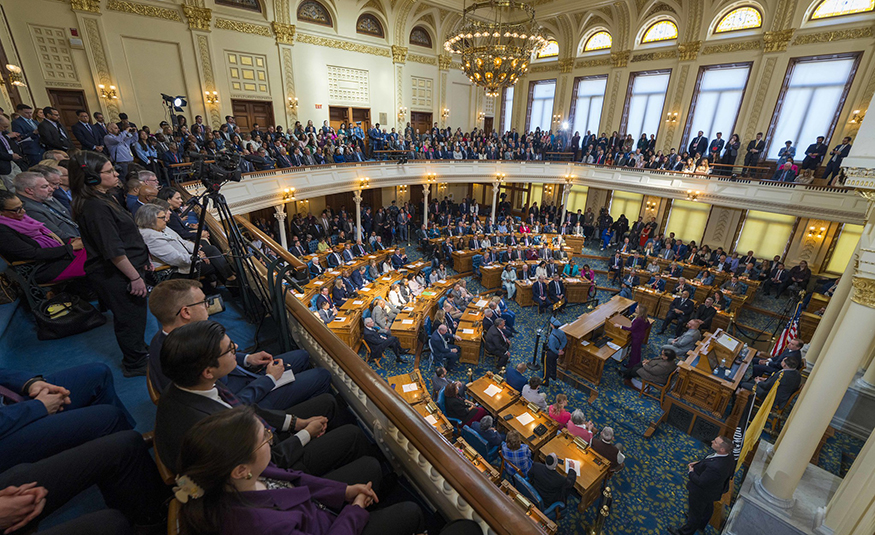
In a rare Sunday night session, state lawmakers approved New Jersey’s $60.75 billion FY2027 budget, keeping the state on track to meet the June 30 constitutional deadline. Get the latest here.
Notably, several sponsors of the Senate bill sit on Sarlo’s committee, including Greenstein and Diegnan, as well as Senate Majority Leader Teresa Ruiz, D-29th District; Sen. Gordon Johnson, D-37th District; Sen. Andrew Zwicker, D-16th District; Sen. Renee Burgess, D-28th District; and Sen. Nilsa Cruz-Perez, D-5th District.
Sarlo ultimately voted against releasing the measure, saying, “There’s a much better way of doing this.” Sen. John Burzichelli, D-3rd District, also voted no.
The remaining Democratic committee members voted to advance the bill.
Greenstein acknowledged during the hearing that she had only recently learned many building trades unions opposed the legislation.
“I’m very upset about this because I have friends on both sides of this,” she said. “I didn’t know ’til I think the day before yesterday that many of my union friends are against this. I had no idea. Maybe I missed something, but I didn’t know about it.”
“Anyway, I am going to vote to get it out of committee.”
‘One of the worst business bills’ in NJ history
The legislation has also generated an unusually broad coalition of opposition from New Jersey’s business community. Manufacturers, petroleum interests, utilities, construction trades, food retailers, chambers of commerce and national business organizations have spent months urging lawmakers to reject the proposal.
Among the most vocal opponents is the New Jersey Business & Industry Association.

Following Sunday’s committee vote, NJBIA President and CEO Michele Siekerka said the legislation “is one of the worst business bills in the history of a state that is not known for its business friendliness.”
“There is no $50 billion free lunch,” said Siekerka. “Anyone who says these costs won’t impact New Jersey consumers already mired in an affordability crisis is quite mistaken.”
She argued the bill would raise energy costs, reduce investment at New Jersey’s remaining refineries and related industries, eliminate jobs, and send “the chilling and likely unconstitutional message” that companies could face billions in retroactive liability despite complying with all applicable laws and permits.
There is no $50 billion free lunch. Anyone who says these costs won’t impact New Jersey consumers already mired in an affordability crisis is quite mistaken.
– Michele Siekerka, NJBIA president and CEO
“That’s not just being unfriendly to business. That’s business hostility,” said Siekerka. “This bill includes no economic study showing the benefit that fossil fuels have brought to our society. There are no facts on how much New Jersey has contributed to global emissions, or how much users of the products contribute to global emissions compared to those who provide the essential products.”
Call it what it is
Siekerka noted court challenges to similar laws in New York and Vermont. “And while New Jersey is in the middle of an affordability crisis, this bill all but ensures millions of dollars in legal fees for the state as the federal Clean Air Act states do not have authority to impose liability for global atmospheric conditions,”she added.
“Before it’s too late, it is time for lawmakers to understand the negative consequences of this bill and not put the state’s affordability, jobs, economy and business climate any further in harm’s way,” she closed her statement.

Days before the committee vote, NJBIA Deputy Chief Government Affairs Officer Ray Cantor similarly called the proposal “one of the most anti-business laws in state history.”
“Let’s call this bill for what it really is: An unconstitutional attempt to retroactively penalize businesses that legally provide an essential product used by everyone – including the very people supporting the bill,” said Cantor June 26. “It will raise energy costs for every New Jersey household and business over the next 20 years. It will destroy jobs and investment at our two remaining refineries and other connected businesses within the industry.
“And it will set a damning precedent for all businesses in New Jersey: That you can work within the law and live up to your permits and still be retroactively penalized.”
Cantor also questioned the bill’s legal footing. He argued states lack authority under the federal Clean Air Act to impose liability for global atmospheric conditions. Cantor also criticized lawmakers for advancing the proposal before litigation over similar laws is resolved.
What it could mean for residents
An analysis by the U.S. Chamber of Commerce’s Institute for Legal Reform finds the bill’s added energy and related costs would amount to nearly $14,000 per household over the course of 20 years.

Michael Egenton is executive vice president of the New Jersey Chamber of Commerce. NJCC has also been on the frontlines of the fight.
“I take a real big issue of calling my members polluters when they were given the legal authority, both from EPA and DEP, to produce a product and service that we all use,” Egenton testified June 23 before the Assembly Appropriations Committee. “I would bet if we did a poll in here, a majority of people drove here using that product.
“Plus, the other ancillary products that come from petroleum, whether in the agricultural business, the pharmaceutical business or the tech business,” Egenton continued. “And look, I’ve been before this committee many, many years over several budgets. Basic Economics 101. When the pressure is on my members and they’re producing a product or service, what do they ultimately do?
“They ultimately have to pass that cost on or make some modifications, don’t hire people. That is ultimately what’s going to happen.”
New name, same consequences
The Chemistry Council of New Jersey likewise warned the measure would undermine Sherrill’s economic agenda.

Executive Director Dennis Hart said the administration has emphasized improving New Jersey’s business climate, speeding permitting decisions and attracting manufacturing investment. However, he argued this legislation “moves New Jersey in the opposite direction and risks undermining those efforts.”
“The legislation would impose a $50 billion assessment on companies that the bill itself acknowledges did not violate the law, act negligently, or violate permit conditions,” Hart said in a statement released June 29. “At a time when New Jersey is competing for jobs and investment, this legislation sends the message that companies can be subjected to massive retroactive liability for lawful activities, creating uncertainty that will discourage investment and threaten good-paying manufacturing and trade jobs.”
He added, “Changing the name of the legislation does not change its consequences for New Jersey’s economy, competitiveness, or affordability.”
Hart reiterated many of those concerns during Sunday’s committee hearing. He told senators the legislation would absolutely cost jobs and discourage future business investment.
“This will put a dagger into the governor’s efforts to try and improve our economy,” Hart testified. He also urged lawmakers to wait until courts resolve those similar challenges in the region before moving forward. Hart argued there is no deadline requiring the bill’s immediate passage.
Getting worse?
Senate Republican Leader Anthony Bucco, R-25th District, also blasted the legislation.

“For more than 20 years, Democrats have talked about lowering the cost of living while simultaneously passing legislation that makes New Jersey more expensive to live and work and this is the clearest example on how it continues to get worse,” said Bucco. “The New Jersey Building and Construction Trades Council made it clear this bill will discourage investment, drive up energy and construction costs, and threaten the infrastructure projects that support thousands of good-paying union jobs across our state.”
Bucco also criticized the last-minute nature of advancing the bill just before midnight on a Sunday event. He said that when businesses decide to invest elsewhere – it’s not the politicians who feel the consequences.
“It’s the electricians, laborers, operating engineers, and countless other skilled workers who lose opportunities to earn a good living,” said Bucco.
“For a party that claims to stand with organized labor, Democrats ignored the very people who build up the Garden State every day. I’m proud to stand with our friends in the trades and the business community and oppose this terrible bill because lowering the cost of living starts with a strong economy and policies that encourage investment instead of driving it away.”
Please stay tuned to NJBIZ for the very latest on this developing story.