Sign In
 Free Newsletter

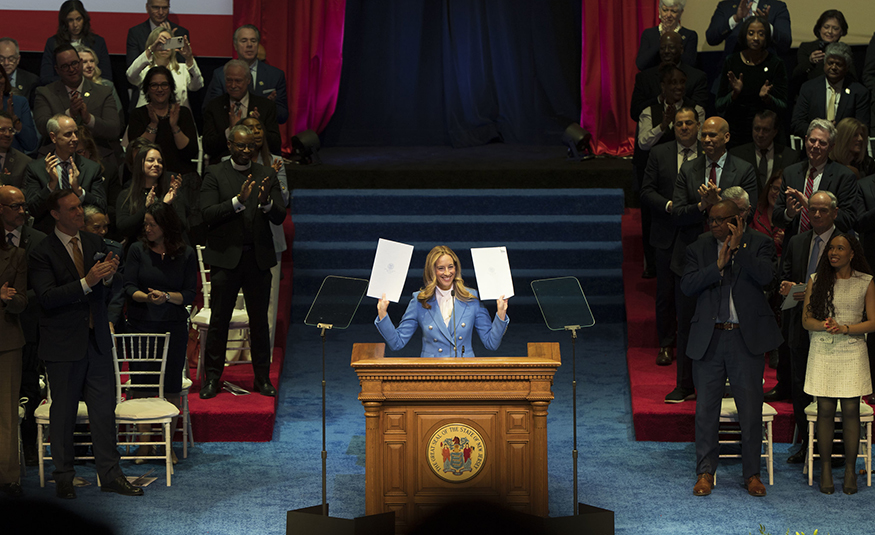
During her inaugural address Jan. 20, 2026, at the New Jersey Performing Arts Center in Newark, Gov. Mikie Sherrill signed her first two executive orders, which keeps her promise to declare a state of emergency on utility costs on day one. - PROVIDED BY NJ GOVERNOR'S OFFICE/TIM LARSEN
During her inaugural address Jan. 20, 2026, at the New Jersey Performing Arts Center in Newark, Gov. Mikie Sherrill signed her first two executive orders, which keeps her promise to declare a state of emergency on utility costs on day one. - PROVIDED BY NJ GOVERNOR'S OFFICE/TIM LARSEN
Sherrill makes early moves to cut energy costs, add supply
Matthew Fazelpoor//April 20, 2026//


 Listen to this article
The basics:
- Gov. Sherrill signs executive orders to address rising energy costs
- Order freezes or blunts electricity rate hikes for consumers
- Plan expands solar, battery storage and in-state power supply
- Includes natural gas upgrades and future nuclear development
From the moment she took the oath of office, Gov. Mikie Sherrill moved to deliver on a central campaign promise: tackling New Jersey’s rising energy costs. In a notable moment during her Jan. 20 inauguration in Newark, Sherrill paused her address to sign her first two executive orders – underscoring the urgency she has placed on the issue, with immediate actions aimed at both short-term relief and longer-term changes to the state’s energy landscape.
The dual orders reflected the core argument she made throughout her campaign: that affordability concerns tied to electricity costs required urgent intervention alongside a broader push to expand supply.
“I promised the people of New Jersey bold action to lower utility costs and, today, I’m delivering. Trenton will no longer accept the status quo and kick the can down the road while New Jersey families pay higher bills — not on my watch,” said Sherrill. “These executive orders will deliver relief to consumers and stop rate hikes, so New Jerseyans aren’t facing ever increasing electric bills. This will also create the conditions to massively expand New Jersey’s power generation, because more power in-state will help lower costs.
“I heard the people of New Jersey loud and clear – these rate hikes are unacceptable – and as your governor, I will not stop fighting to lower costs and make New Jersey a more affordable place to live, work, and raise a family.”
Executive Order No. 1 focused on near-term relief, directing the New Jersey Board of Public Utilities to take steps to freeze or blunt impending electricity rate hikes while also reviewing utility business models. Executive Order No. 2, signed moments later, took a longer view — declaring a State of Emergency under the Disaster Control Act and laying out an aggressive roadmap to bring new power generation online.
Together, the orders framed the issue in clear terms: rising demand, constrained supply, and increasing costs for residents and businesses.
Longer-term solutions
“What I was hearing from people across New Jersey was about affordability, and certainly, utility costs were at the heart of so many of the costs as I was going around the state,” Sherrill said during her April 15 “Ask Governor Sherrill” call-in show on WNYC. “They had risen by about 20% last year, and in fact, were set to rise by about another 20% this year.”
“So I said, look, I am freezing rate hikes. I’m going to declare a state of emergency and freeze rate hikes,” she added. “So, I did just that, not even in my first day – in my first few minutes.”
While the first order sought to provide immediate breathing room for ratepayers, the second made clear that the administration views increased generation as the longer-term solution.
“If we’re really going to drive down costs, we need to expand generation,” Sherrill said.
Executive Order No. 2 outlines a sweeping set of directives aimed at doing just that. It calls for the rapid expansion of solar and battery storage projects, including new solicitations under the state’s Competitive Solar Incentive program and the opening of 3,000 megawatts under the Community Solar Energy Program. It also directs the state to accelerate battery storage deployment and begin developing a “virtual power plant” program designed to aggregate distributed energy resources and reduce peak demand.
Clearing the way
The order also targets some of the structural hurdles that have slowed projects. State agencies are directed to identify permitting rules that could be waived or streamlined, while utilities are required to examine interconnection delays and grid constraints that can hold up new generation.
In addition, the order calls for steps to modernize existing natural gas-fired power plants – with an eye toward increasing output, improving efficiency and reducing emissions – reflecting the administration’s position that current infrastructure will remain a key part of the state’s energy mix in the near term.
Sherrill stressed the need to streamline project development, particularly ones already in the pipeline, pointing to early efforts there. “That’s why, through cutting red tape and permitting, I’ve actually gotten in my first two months, six solar and battery storage generation projects online. They had been languishing for months and months.”
Those early project approvals align with the broader framework laid out in EO 2, which emphasizes speed — particularly for solar and storage projects, which can be deployed more quickly than other forms of generation.

Achieving multiple goals
Sherrill has also framed the state’s approach as one that balances cost, reliability and environmental considerations.
“My goals in energy are to drive down cost, drive down carbon emissions, and expand power generation,” she continued during the radio appearance. “And I think we can achieve all of these goals.
“That’s why I started immediately with the cheapest, cleanest type of power that we could get in the ground right away with the solar and battery storage projects,” she added. “And we’re continuing to build those out. That alone won’t be enough, but it’s a great start – and a great way that we can start to expand our clean power generation.”
Check all that apply
A new Fairleigh Dickinson University poll finds New Jersey voters overwhelmingly support an “all of the above” approach to lowering energy costs. Read more here.
At the same time, she has emphasized the role of existing energy sources – particularly natural gas – as part of that transition.
“Forty percent of our mix is natural gas, and so we’re modernizing that so we can both drive-up production while driving down carbon emissions with the more modern natural gas facilities,” the governor continued. “Because if we move out of natural gas – unfortunately, what happens when we buy power on the grid is we start to purchase really dirty power from places like West Virginia, fracking from Pennsylvania, that kind of stuff.
“So, we want to make sure that we’re not moving into dirtier power as we’re trying to drive carbon emissions in the long-term.”
Those comments echo provisions in EO 2 directing the New Jersey Department of Environmental Protection to expedite permitting for upgrades at existing gas-fired plants, provided they improve efficiency and reduce emissions.
Building out nuclear
Beyond solar, storage and natural gas, Sherrill has also taken steps to position nuclear energy as part of the state’s longer-term strategy.
Earlier this month, she signed legislation at the PSEG Salem Nuclear Power Plant that removes a decades-old barrier to new nuclear development in New Jersey, while also advancing the Nuclear Power Task Force first outlined in EO 2.

The new law allows the NJDEP to approve permits for nuclear projects that meet federal safety standards, effectively clearing a longstanding regulatory hurdle while pairing that change with a broader planning effort through the task force. You can read more on that particular initiative in a companion piece in this Spotlight section.
“I’d love to build out nuclear as quickly as possible,” said Sherrill. “It’s why I lifted the moratorium. Because that’s going to be a key way in which we can produce quite a bit more power while at the same time, continuing that drive to meet our environmental goals.”
The move builds on the administration’s early emphasis on increasing in-state generation across multiple sources — a strategy Sherrill has stressed repeatedly.
“As I’ve always said, I’m interested in an all of the above model of power generation that drives down costs, drives down carbon emissions, and increases power generation,” she said. “If that makes sense in the future, New Jersey will move into it. For now, we have the initial solar, the nat gas upgrades, and then the nuclear in the future.”