Sign In
 Free Newsletter

Thirty days and counting
The governor and Legislature have until Oct. 1 to hammer out a new budget, a more compressed time frame than usual
Daniel J. Munoz//August 31, 2020//
Thirty days and counting
The governor and Legislature have until Oct. 1 to hammer out a new budget, a more compressed time frame than usual
Daniel J. Munoz//August 31, 2020//


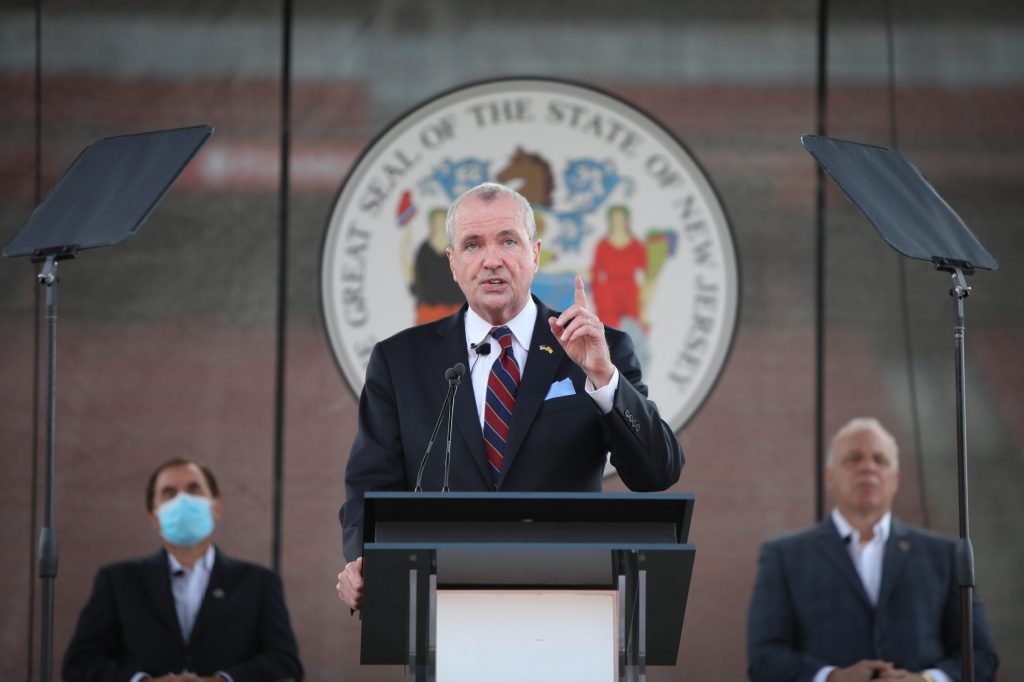
With COVID-19 upending life in New Jersey, Gov. Phil Murphy has had to completely revamp his spending plans to account for a $5.6 billion hole stemming from the pandemic and the economic shock it caused. Murphy’s original budget, presented in February, called for nearly $41 billion in expenditures. But since March, roughly 1.5 million New Jersey businesses have been shuttered or crippled, triggering steep drops in consumer buying and record-high unemployment.
Democrats in the state Legislature, typically opposed or at least skeptical of Murphy’s proposed tax increases, are now cautioning that nothing could be taken off the table. “At this point, to say anything’s off the table … where we’re at in this world right now would be very irresponsible,” Senate President Stephen Sweeney, D-3rd District, told reporters before the governor presented his revised budget in an Aug. 25 address. “I’m not excited about taxes, but you can’t pull anything out right now.”
That kind of support for new taxes has not been seen in years.
At the same time, progressives typically allied with the governor in support of his policy goals, were widely critical of how the Murphy administration and Democrat-controlled state Legislature handled a three-month stopgap budget, which will cover expenses between July 1 and Sept. 30.
“Given the scale of the COVID fiscal collapse and lessons learned in the aftermath of the Great Recession, it is imperative that decision-makers meet the moment with integrity and openness,” reads a letter signed onto by a coalition of left-leaning groups, collectively called “For the Many NJ.”

The letter is dated Aug. 19, and according to one signatory organization – New Jersey Policy Perspective – was sent to Sweeney, Murphy and Assembly Speaker Craig Coughlin, D-19th District.
Other Murphy allies, like the state’s largest teacher’s union the New Jersey Education Association, also signed onto the letter.
“As of today, 36 business days before the FY 2021 budget must be passed, there is no publicly available basic information on the budget process, like the schedule of key budget events and whether the New Jersey Legislature has plans to call upon state commissioners or fiscal experts to testify before finalizing the Appropriations Act,” the letter reads.
Both the Assembly and Senate budget committees, to that end, said in a joint statement on Aug. 26 that they are accepting public input and testimony on the proposal. Lawmakers and the Murphy administration have just 30 days to enact a new budget.
Murphy’s budget proposal includes $32.4 billion to cover expenses between Oct. 1 and June 30, 2021. It entails $1.2 billion of budget cuts, over $1 billion of new revenue – including $860 million in new taxes – and $4 billion in borrowing, which could be done without voter approval.
His proposal to extend the existing higher taxes on businesses, to increase fees on cigarettes, and impose a millionaire’s tax twice blocked by the state Legislature, are all at least being considered.
“Nothing’s off the table yet,” Coughlin said in an interview after the budget address. “We’re going to have to have ideas as well. The Legislature has it, it’s now our budget.”
But the Speaker took a more cautious approach the next day, saying in a statement to several media outlets that “we must take a hard look at the need for any taxes that could add to the burden of New Jersey’s families.”
‘Condensed’ negotiations
Senate Budget Committee Chair Paul Sarlo, D-36th District, has promised to examine the proposal closely, especially the governor’s plans to borrow $4 billion, and any potential tax increases.
“Any proposal to increase taxes or add to state debt will be scrutinized cautiously to ensure that we understand how the funds will be used, the impact on our economic recovery, the state’s ability to manage debt payments, and the multi-year consequences,” Sarlo said in an Aug. 25 statement.
Under a measure Murphy sought, the state can borrow up to $9.9 billion to make up for holes in its revenue caused by the global pandemic. Roughly half would come from a Federal Reserve program meant to offer a lifeline to states like New Jersey and would be paid back within three to five years. The other half would come from the bond market and could take decades to repay.
“While our immediate responsibility is the FY-21 budget, we have to remember that economic problems may persist and that one-year fiscal solutions may leave us short,” Sarlo added.
According to Sweeney, budget talks will be fast-paced and “condensed,” and the goal is to reach a conclusion in a matter of weeks. That timetable would represent a departure from recent years, in which weeks of relative quiet followed the governor’s budget address at the start of March, and discussions heat up only in May, before going into overdrive to meet the June 30 deadline.
But as in prior years, business groups were widely critical of the budget proposal, such as tax increases, contending that New Jersey residents and businesses are ill-equipped to handle those expenses.
“New Jersey businesses have already sacrificed their revenues and livelihoods to prevent the spread of coronavirus by shutting down their operations,” reads an Aug. 25 statement from the New Jersey Business & Industry Association. “New taxes on the very same businesses that have already given so much and are the only ones that can drive our future recovery is inconceivable considering that the state was just given $9.9 billion in borrowing authority.”

Meanwhile Tom Bracken, head of the New Jersey Chamber of Commerce, also asked why the administration is resorting to tax increases given the borrowing authority and why the governor wants to use bond revenue to fund a surplus and a pension payment.
“Why make a record pension payment and create a record surplus when reducing both would still be fiscally responsible and allow us to use more dollars to close the budget gap?” Bracken said in an Aug. 25 statement. “Cutting the cost of government, reducing the pension payments and the surplus, while creating opportunities for business growth is the foundation we need to make New Jersey more affordable and more prosperous.”
That view was shared by the state’s main trade group of accountants, the New Jersey Society of CPAs. Executive Director Ralph Albert Thomas contended that bonding is effectively a “last resort” that should be paired with deep spending cuts that reflect the dire nature of the state’s financial picture.
Murphy’s budget calls for a $2.2 billion surplus that the state would have by the end of June 2021. His budget also includes a record-high pension payment of $4.9 billion. In his address, the governor warned that the surplus was needed to cushion the impact that a widely expected second wave of COVID-19 could have on the state’s finances.

“There is no negotiating room” on the pension payments, Murphy said at an Aug. 26 press briefing, the day after he presented his budget. “If the pension payment in the budget is $4.9 billion, then the minimum amount that I’m prepared to make in the final deal is $4.9 billion, period.”
He also argued against more borrowing as opposed to taxes, warning that balancing the state’s finances requires walking a fine line amid the pandemic. “We need both recurring revenues that make sense and recurring expense reductions,” the governor said. “We have put forth a series of revenue items that will also be recurring, and we need that. I view this as a moment in time that is not back to old habits. We have no choice.”

But the governor’s budget drew praise from some allies, including some critics of the opaque drafting process. “Every dollar raised through new revenue is a dollar we don’t have to cut or borrow,” NJPP President Brandon McKoy said in an Aug. 25 statement. “These revenue streams will set a strong foundation for a stable recovery, as they provide the state with resources to keep the economy afloat and deliver critical relief to families and small businesses in need.”
The governor’s budget “calls on the wealthy and big corporations to do their part to balance a budget during an unprecedented economic crisis,” said Sue Altman, head of the activist group New Jersey Working Families, which has also typically aligned itself with many of the governor’s policies.
The budget would extend the elevated 2.5 percent corporate business surtax, which is on top of the 9 percent rate of the state’s highest-earning businesses but was set to drop to 1.5 percent for the next two years before phasing out entirely. Sweeney said he has been on board with that proposal for years.
“Millionaires who own yachts and limousines and politically powerful businesses that have taken advantage of tax loopholes can afford to contribute more so that senior citizens and working families get the services they need to recover from this devastating pandemic,” Altman said.
Financing health coverage
The governor’s proposals on health care policy, and how to fund it, were also met with mixed reactions. One plan calls for steep cuts to hospital charity care, which drew the condemnation of the New Jersey Hospital Association.

“Never before has the essential role of our hospitals and their employees been more evident,” NJHA President Cathy Bennett said in an Aug. 25 statement. “We are in the grips of the worst public health crisis in a century and tremendous federal uncertainty about future health policy. This is no time to cut charity care funding for our health care safety net and graduate medical education for tomorrow’s health care heroes.”
The spending plan calls for subsidizing health insurance purchases for those earning up to 400 percent of the federal poverty level. For individuals, it would provide a subsidy of at least $564 a year, and at least $2,256 a year for a family of four.
That, according to New Jersey Citizen Action Associate Director Dena Mottola Jaborska, is a “critical first step in making health care affordable for all New Jerseyans.”
A proposed fee on opioid manufacturers would bring in $15 million for the state.
This is no time to cut charity care funding for our health care safety net and graduate medical education for tomorrow’s health care heroes.
— Cathy Bennett, president, NJHA
“The unprecedented demands in medication caused by COVID-19 created a number of shortages, including for opioid-based treatments,” responded John Holub, executive director of the New Jersey Council of Chain Drug Stores.
“With no signs of an end to COVID-19, we cannot threaten access to critical medications with bad public policy. It is critical that Gov. Murphy remove any financial assessment on opioids from his budget proposal.”