Sign In
 Free Newsletter

NJ Legislature approves $32.7B budget Murphy supports, pledges to sign (updated)
Republican lawmakers decry pork spending
Daniel J. Munoz//September 24, 2020//
NJ Legislature approves $32.7B budget Murphy supports, pledges to sign (updated)
Republican lawmakers decry pork spending
Daniel J. Munoz//September 24, 2020//


)

Both chambers of the state Legislature approved a $32.7 billion spending plan and sent it to Gov. Phil Murphy’s desk Thursday, which he’s pledged to sign as is.
The proposal calls for $4.5 billion of new debt that will be issued without voter approval, a tax hike on millionaires, the extension of a higher business tax, and an increase to the state’s HMO assessment.
A four-person legislative borrowing committee – consisting of the Senate President, Assembly Speaker and budget chairs from both houses – will vote Monday on the borrowing, which is is likely to approve, after which the governor can enact the spending plan.
“The governor’s going to sign the budget,” assured Assembly Speaker Craig Coughlin, D-19th District, in a gathering with reporters after the Assembly voting session.
Although this budget is only nine months – running from Oct. 1, 2020, to June 30, 2021 – state spending for the 12 months that would make up the current fiscal year amounts to a record-high $40.7 billion.

That shouldn’t be surprising, argued Senate President Stephen Sweeney, D-3rd District, who told reporters during a break in the Senate voting session that most of the yearly increases were due to inflation.
Over the summer, lawmakers and the governor agreed to extend the existing budget for three months until Sept. 30, passing a $7.7 billion “bare bones” stopgap plan to keep the lights on.
Roughly $1 billion of expenses were deferred during those three months and have been reinstated in this new spending plan, such as several property tax cuts for seniors and other low-income residents, known as the Homestead rebate.
And, it includes $4.7 billion of pension payments—a record-high level of money for this one line item.
“This is a budget that we have to do to contend with the crisis this pandemic has created on the state economy and finances,” Senate Budget Chair Paul Sarlo, D-36th District, said in his opening remarks before the Senate voted on the measure Thursday. “This is a spending plan that will help address problems created directly or indirectly from the coronavirus shutdown, and will allow us to be prepared for a potential second wave.”

The budget includes a $2.5 billion surplus, meant to act as a cushion should another pandemic shatter the state economy.
Republicans panned the spending plan, arguing it does not reflect the state’s supposedly dire financial situation.
“You’d thought the sky was falling when the governor was talking about” the state’s finances, Sen. Steven Oroho, R-24th District, who sits on the Senate Budget and Appropriations Committee, said on Thursday. “We’re not nearly anywhere near what he said.”
The millionaire’s tax would hike the income tax rate from 8.97 percent to 10.75 percent for anything above $1 million, which would bring in $390 for the state through the middle of next year.
Lawmakers and Murphy agreed on a four-year extension to the 2.5 percent corporate business surtax that is tacked onto the 9 percent levied on the state’s highest-earning businesses, rather than letting the CBT sunset to 1.5 percent for two years before expiring.
That’s slated to bring in $210 million through the middle of next year, while an increase to the annual assessment on HMO premiums from 3 percent to 5 percent would bring in $100 million for the state.
The legislative budget takes out many of the tax increases that Murphy sought in his own plan, such as those on cigarettes, gun and ammunition, and yacht sales; opioids; bear hunting permits; and limousine services.
It also does not include any additional state aid under a future iteration of the federal COVID-relief bill, which Murphy argued was necessary to avoid steep cuts. Sarlo, Murphy and Sweeney maintain that the money would still be helpful to pay off this new debt.
Republicans decried what they saw as hundreds of millions of dollars in pork-spending in the proposal.
The spending plan calls for $4 million to Essex County’s First Tee golfing program, $1.5 million to the New Jersey Hall of Fame Foundation and $1 million to the Battleship New Jersey Museum in Camden.
It calls for $1 million for continued restorations to the Hinchcliffe Stadium in Paterson, $500,000 to the Newark Museum, and $150,000 toward the Thomas Alva Edison Memorial Tower and Museum. Metuchen’s shade tree management gets $100,000 and East Brunswick gets $400,000 to renovate its town hall.
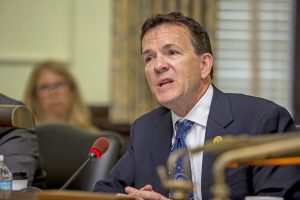
Sen. Declan O’Scanlon, R-13th District, said he wore a Christmas tie, because of apparent pork and Christmas tree items.
“I figured with the presents included in the budget, you might be starting the holidays a little earlier this year,” he quipped.
Sarlo disputed the notion of pork spending, calling it “disingenuous,” and maintaining that many of these items have “been in the budgets for the 20 years I’ve been here.”
Sweeney agreed, saying that each item had an essential reason to be there.
“This is also a budget that has certain priorities in here that really work towards [sic] some social justice impacts as well, and making sure that people that are in underserved areas are exposed to things they wouldn’t normally be doing,” Assembly Budget Chair Eliana Pintor-Marin, D-29th District, told reporters. “Especially at a time when kids are not going back to school, or seniors are stuck at home.”
And proponents of the budget argue that it has ample spending meant to finance the state’s recovery, and that cutting many of those programs would stunt New Jersey’s economic recovery.
“If we want to keep the economy going, we’re still going to have to have a certain level of spending into the economy,” Pintor-Marin said on the floor.
Sweeney and Sarlo have vowed that the state will need to adopt some form of long-term fiscal reform, like the public worker pension cuts the Senate President proposed in 2018 and school district and local government shared service agreements.
“We will be moving forward with reforms otherwise I won’t vote for borrowing,” Sweeney said.
As part of a deal brokered between Murphy and Democrat-controlled legislative leadership, the state will roll out rebates of up to $500 for hundreds of thousands of New Jersey families with income up to $150,000 sometime in summer 2021, which is when this new budget ends.
“There is no money at all” for the rebate, in this budget, said Sen. Tony Bucco, R-25th District. “All we have is a promise that the check will come out next year, just before the governor’s reelection.”
Editor’s note: This story was updated at 3:19 p.m. EST on Sept. 24, 2020, to include remarks from Assembly Speaker Craig Coughlin and Assembly Budget Chair Eliana Pintor-Marin.