Sign In
Upcoming Event
 Free Newsletter

Prayers answered
In one Jersey City project, public benefits come before private profits
Linda Lindner//March 23, 2020//
Prayers answered
In one Jersey City project, public benefits come before private profits
Linda Lindner//March 23, 2020//


One of Jersey City’s historic yet neglected properties will be getting new life as a public-private partnership after city planning officials issued approvals for the former St. Lucy’s Church property at 619 Grove St. to be converted into a unique hybrid property.
Originally founded in 1884 as a parish for immigrants living in the area, the church served as a house of worship until 1986 before closing and has not been maintained since. An adjacent school building was taken over by Catholic Charities of Newark and served as a homeless shelter, even though it was not designed for that use. There is also a rectory that Catholic Charities occupies, but that also has seen better days. Plywood covers many windows and there is serious deterioration along with structural and roof issues. The shelter’s buildings are inadequate to meet the programming needs and Catholic Charities has been actively looking for a new location for years. St. Lucy’s is the only shelter in Jersey City.
For more than 40 years the church has been in real estate purgatory. The city has received many proposals to rehab and reuse the properties, but all proved unsuccessful – until Claremont Development stepped in.
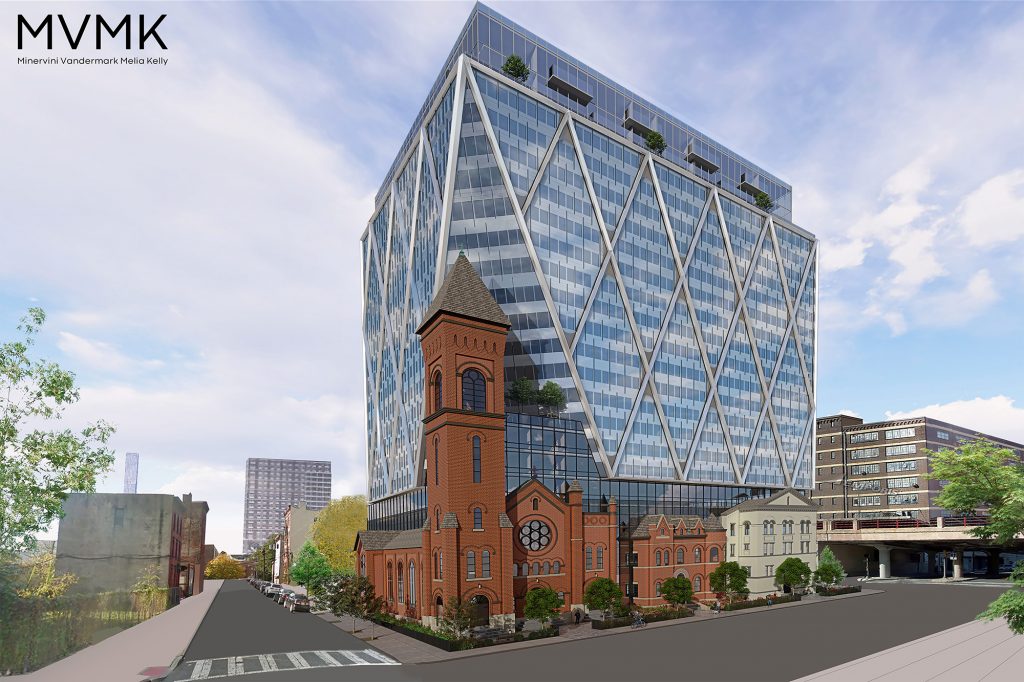
Working closely with the Jersey City Planning and Historic Preservation staff, Claremont purchased the church and adjacent buildings from the Archdiocese of Newark and agreed to preserve and rehabilitate “key historic features” on the church while constructing a glass-heavy addition rising a total of 23 stories. The church property, designed by Hoboken-based Minervini Vandermark Melia Kelly, would include 430 units of housing consisting mostly of luxury rentals.
Maximilian “Max” Dorne, partner at Claremont Development, told NJBIZ that Jersey City emphasized the importance of keeping the facade in certain places and as recently as last summer it stressed the importance of keeping the former school, which is the existing shelter, as part of the development. “Frankly it adds a lot of character to the neighborhood, to the building – especially on the pedestrian level,” Donre said. “Maintaining a lot of masonry articulation that is over a century old and clearly has significance architecturally. And any time you have these existing conditions you are creating a complexity in construction.”
Under the deal, the shelter will be built before the luxury housing portion and Claremont will not receive any tax abatement for the project. A zoning change was necessary and the planning board signed off on the modifications. Paperwork was submitted to the city council in early March and the project is now awaiting final approvals before shovels hit the ground.
“Unlike most development projects where there’s an offsite requirement or public benefit requirement that comes during construction where you have a certain set aside for affordable units occur during a lease up after construction,” Dorne said. “This is something we committed to prior to breaking ground. Part of our developer’s agreement with Jersey City is to have both projects [the shelter and the church] approved in a single application. We have to go and get a certificate of occupancy for the shelter prior to starting any vertical construction on the tower. The public benefit is coming before the developer’s benefit. We are committed to this and are so happy to be working with Catholic Charities on this project,” Dorne said.
The plans include Claremont constructing a completely new, 150-bed homeless shelter – which is more than the current 120-bed capacity – across the street that will also include 15 units of supportive housing for those living with HIV/AIDS. Claremont will also build 13 affordable units in the new tower.

Dorne said the developer partnered with a first-rate design team for structural engineering and architecture. He and his team were excited to take on the challenge of preserving and accentuating the historical facades and elements of the building.
“We’ve got units that access the bell tower for private bedrooms, common areas, some private dining and private hosting rooms in the upper floor of the bell tower it’s pretty interesting how our architecture team was able to utilize some of these existing conditions not just for aesthetics but for functional use as well,” Dorne said.
St. Lucy’s Emergency Shelter is a supervised 24-hour, 7-day-a-week, year-round facility for women and men offering housing and food for those in need. Within the first week, clients meet with staff to assess their situation. Once their needs are determined, they are referred to one or more of the following services: welfare, supplemental security income, unemployment, job training and job search, education and mental-health/addiction-treatment programs. The shelter provides two meals a day, clothing as well as a shower program and outreach services for the unsheltered homeless.
In an interview, John Westervelt, chief executive officer of Catholic Charities of the Archdiocese of Newark, said the facility does all it can to turn lives around of those that seek their help. They offer mental health assistance, job search help and reunite others with their families. They really do more than just get people off the street.
“St. Lucy’s doesn’t only give people a place to get a meal or spend a night. We offer wrap-around services — health, job search, workshops — and doing it in our current facility has been challenging,” Westervelt said. “We will be really excited once we have our new building that will allow us to have designated areas for everything and we don’t have to convert our meeting room into a bedroom.”