Sign In
 Free Newsletter

The Swift and Traumatic Firings At Applied Data Research


Date: November 21. 1988
Location: MONTGOMERY
Title: The Swift and Traumatic Firings At Applied Data Research Author: Theresa Petronico
Subject: One morning some 200 employees were given five minutes to clean up and get out
Employees at Applied Data Research entered the company headquarters in Montgomery on October 19, knowing that this was the day. A memo, circulated to the entire staff a week before, had warned them that on that day layoffs would be announced. Homer once described rumor as a many-eyed monster, and ADR was all eyes that morning. Rumors circulated madly in the building. Whose jobs were in jeopardy? Was Computer Associates really as ruthless as its reputation?
The atmosphere at ADR had been tense ever since September 13, when Computer Associates International, a Garden City, N.Y. based company, bought the software firm from Ameritech, one of the Baby Bell companies left after the break-up of AT&T. Computer Associates (1988 sales: $700 million, profits: $100 million) was known for its guillotine way of reducing staff after a takeover. While ADR people anxiously waited, many of them dusted off their resumes or started looking for new jobs.
When employees got to their offices on October 19, their former bosses were already gone. New supervisors then meticulously set about the task of informing fired employees. First the phone rang, and people were asked to come into the supervisor”s office. The call was the beginning of the end. One-by-one people went in for the behind-closed-door, five-minute sessions.
Promptly after the brief, to-the-point layoff explanation, fired employees were given five minutes to pick up their coat or purse. Then they were escorted out of the building. No good-bye parties, no gold watches. One fired employee says Computer Associates was fearful someone might try to take revenge by sabotaging files or putting a virus in a computer program.
Employees waited, hearts beating nervously, while supervisors made the final staff cuts. At around 11:30 the bosses finally announced in each department that the process had been completed. The remaining jobs were secure.
The cloud hanging over the company, however, did not disperse immediately. Surviving employees wandered through the building to find out whether long-time friends had been let go, much as a survivor of a bombing attack might go out to inspect the damage. Supervisors attempted to maintain a business-as-usual atmosphere.
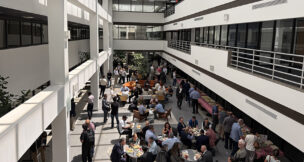
Soon after the layoffs were finished, the remaining employees, some hugging and crying, assembled in the company”s atrium. Dennis Strigl, who had been president of ADR until Computer Associates bought it, and Charles Wang, the president of Computer Associates, addressed the stunned survivors. Wang defended the brutal manner of the firings, saying that it was necessary to clear the air and would be better for the company in the long run. Said he: “The second shoe will not drop. These are the last cuts to be made.” Strigl said the layoffs were “the hardest moments in my 20 years at ADR.”
Many of the fired employees agreed with him. Some distraught staff members met first at Friendly”s Restaurant on Route 206, and then later in the day the crowd moved across the street to the Tiger”s Tale lounge. Workers tallied the number of the morning”s casualties and came up with nearly 200. As the survivors gave a shoulder to teary-eyed colleagues, the bartender offered drinks on the house to ADR employees.
“ADR was basically a family for many people instead of a job,” said Eladio Alvarez, one of those laid off. He and his wife Maria are one of the 30 working couples fired from ADR. Alvarez, who worked in the international department of the company for seven years was originally given the option of relocating overseas or taking a lower paying position within the new operation. Neither option, he says “was a satisfactory answer to my problem.”
Computer Associates offered departing employees standard severance pay, and the following week the company set up a job placement service at the Ramada Inn on Route 1. The room was equipped with phones, copy machines and typewriters for putting together resumes. Counselors were also on hand to help out-of-work employees decide where to start looking for a new job. “The company is aware of its bad reputation, so they provided severance pay and other benefits when they really didn”t have to,” says one survivor of the restructuring.
Martin Geotz, president of Syllogy, a computer software developer in Hackensack, and one of the founders of ADR, said that although he is no longer connected to ADR, he keeps in touch with key people in the administrative departments. “I was aware that certain high-level, technical people would be laid off,” says Geotz. “I don”t think it was a surprise, although maybe the extent of the cutbacks was surprising to everyone.”
Most of the ADR employees say they expected the layoffs. Cuts had to be made because of expenses and duplication of positions between ADR and Computer Associates. But employees at ADR were bewildered by the way Computer Associates handled it. “Everyone agreed something had to be done, and in my case I had almost accepted it before it happened,” said Alvarez. “But my wife was laid off from the marketing department, where practically the entire staff was let go. That was a surprise.”
Out in front of the former ADR corporate headquarters on Route 206, history has already been whitewashed away. The old ADR sign has been painted over. It remains to be seen how Computer Associates will now repaint both its sign and its reputation.
Was there a better way to do it?
The firings at ADR were a traumatic experience. But was there another way that Computer Associates could have handled it? BUSINESS put that question to Les Minsuk a founding partner of Minsuk, Macklin, Stein and Associates, a human resources firm in Princeton Junction. His response:
Termination is never easy. A comprehensive termination program ought to address two broad topics minimizing the emotional shocks of firing and being fired, and providing the tools and techniques for a job search. Whether training is conducted in-house or through out-placement services, in groups or individually employees need to feel confident that they can launch and be competitive in the search for future employment.
In these days when so many companies are highly computerized, it may be neccessary and prudent when terminations are made to have the affected employees off the premises, or at least away from computers, as soon as possible. When such measures are necessary, the availability of more extensive, positive assistance, such as outplacement, will go far toward maintaining morale for people still working and imporve the firm”s image in the industry and the community.
There are no magic wands to wave, making termination painless. A positive approach, a sound program, and a golden rule sensitivity will certainly make a difference, relieving the pressure on employer and employee alike.