Sign In
 Free Newsletter

Biz orgs: New budget could, but does nothing to, stave off July 1 tax hikes (updated)
Daniel J. Munoz//June 23, 2021//
Biz orgs: New budget could, but does nothing to, stave off July 1 tax hikes (updated)
Daniel J. Munoz//June 23, 2021//


)

Business owners can expect their taxes to increase beginning July 1, the day a record-high $46.4 billion spending bill would go into effect, in order to replenish the state’s overly-strained unemployment trust fund.
Strictly speaking, the two are not related. Business groups contend that the state can act now, but it is opting not to, to prevent the increases, given the $6.5 billion federal relief package under the American Rescue Plan and $10 billion of surplus money.
The state budget proposal passed in the Legislature on June 22 does not include money for replenishing the unemployment fund that the state used to pay out billions of dollars in jobless aid during the COVID-19 pandemic.
Republicans and several business groups suggested $2.5 billion of ARP funding over three years go toward refilling the fund, so that it would not fall on employers to cover those costs through tax increases. That would include $1.5 billion to replenish the trust fund, and $1 billion to repay loans the state took out last year to continue dolling out unemployment benefits.
In January, Gov. Phil Murphy approved a bill that would have spread out the tax increases over a three-year period in order to reload the fund.
Legislative analysts estimated that without the bill, businesses would have needed to pay close to $1 billion in taxes to make up for the spent cash. A clean-up bill extended the spaced-out tax increases to nonprofits as well.

“It’s going to be spread out, but still the business community is going to repay the whole thing,” said Tom Bracken, who heads the New Jersey Chamber of Commerce.
Using the funds, he suggested, would “take the burden off of the business community” as it embarks on a post-COVID economic recovery.
“It is concerning that this budget does not address the Unemployment Insurance Trust Fund taxes that are slated to increase greatly on July 1,” reads a statement from Christopher Emigholz, vice president of government affairs at the New Jersey Business & Industry Association.
“It is critical that the enormous debt in our UI fund be addressed with federal [ARP] funding. Without it, businesses will be looking at higher and continued taxes on the jobs they provide – which is not good for the state’s economic recovery,” Emigholz said.

Bracken noted that the budget calls for the state to set aside $3.7 billion to lower its tab, but even in this case it’s not certain just what debt the state would try to retire first. Lawmakers and the governor said they’re keeping an eye on using that money to knock down older debt.
Under the plan moving through the Legislature, the state will spend $700 million on a variety of expenses, plus $450 million to prepare the state’s three Level One trauma centers for future public health crises, and another $200 million that Murphy could spend at his discretion. The remaining funds could only be spent with the approval of the state Legislature.
“The Administration and Legislature continue to assess how to best distribute ARP funds to meet the state’s needs,” reads a statement from Alyana Alfaro, the governor’s press secretary.
Murphy, when asked during his regular COVID-19 press briefing on June 23, highlighted the bill he signed months ago to draw out the employer contributions, as a means of relief for businesses. “When you look at the broad tapestry, our small businesses need the help … and we are going to stay at it,” Murphy said, pointing to $235 million of COVID-19 business relief that he approved on June 22.
The office for the Senate Democrats, which hold a sizable majority in the state Senate, did not return requests for comment on this story.
“Most of the ARP funding will be available to determine priorities once the final federal guidance is released,” reads an email from Kevin McArdle, a spokesperson for the Assembly Democrats, who control the state Assembly.
Murphy’s office did not return requests for comment, nor did representatives for the Senate and Assembly Democrat offices, which hold sizable majorities in both chambers.
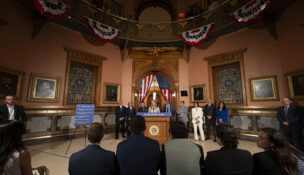
The spending bill was fast-tracked through both chambers’ budget committees on June 22, despite the public having just about 11 minutes to review the bills before they were voted on. Both chambers are expected to meet on June 24 for a full floor vote on the proposal, after which it would be sent to Murphy’s desk. He’d have to sign it by June 30.
The state would allocate $10 million toward New Jersey’s aging unemployment computer systems, which buckled last year under the weight of hundreds of thousands of sudden claims.
Republicans proposed half a billion dollars for computer and IT upgrades for both the unemployment system and Motor Vehicle Commission. The bill requires the Murphy administration to put together a report on the state’s “most critical information technology needs,” and how those fixes could be paid for with ARP funding.
Editor’s note: This story was updated at 3:38 p.m. EST on June 23, 2021 to include additional details about the 2022 Fiscal Year budget working its way through the state Legislature, and comments from the governor’s office and the Assembly Democrats.