Sign In
Upcoming Event
 Free Newsletter

Future in focus Paterson’s Crown Roll Leaf printing was able to adjust to changing market
Daria Meoli//September 7, 2015//
Future in focus Paterson’s Crown Roll Leaf printing was able to adjust to changing market
Daria Meoli//September 7, 2015//


 Listen to this article
For a hologram manufacturer from Paterson, the decline of the printing industry is not just an illusion.
As the offset printing business declined in the face of faster and less expensive digital printing options, Crown Roll Leaf has had to refocus to find new revenue streams in unexpected industries.
Crown Roll Leaf was incorporated in 1972 and originally produced the metallic coating used in the hot stamping process. Its products were used to create a shiny, embossed effect on greeting cards, book covers and packaging, such as labels and folders.
By 1984, founder Robert Waitts saw an opportunity to manufacture materials for holograms and diffractive images. By investing in the equipment and consulting with holographers around the world, Waitts began to develop processes to produce rainbow metallics that reflect light like a prism.
“We were an innovator of holographic materials processes,” said George Waitts, Robert’s son and current company chief operating officer. “My father would invest the time and money in trial and error to innovate products using this grating, or rainbow effect.”
According to Waitts, customers did not immediately see the benefits of working with holograms.
“A lot of designers said, ‘Hey, this looks great, but what am I going to use it for?’” Waits said. “It wasn’t until we started working with Marvel Comics that people started to see the potential. That opened up the industry and designers began to look at our products as a way to brighten up their packaging and make it stand out on the shelves.”
In the mid-1980s, Crown Roll Leaf was one of the only companies working with holographic materials. And one particular job made it an industry leader.
In 1985, Crown Roll Leaf created a commercial hologram for the cover of National Geographic magazine. It was a three-dimensional image of the oldest skull fossil to be unearthed at that time.
According to Waitts, that was the first commercially successful holographic job done in the country.
Because of this success and the momentum the business gained behind its graphics division, Crown Roll Leaf focused on creating the holographic and rainbow materials, as well as its other metallic, pearl tones and tints used to create a shiny, embossed effect in printing or overprinting. Its customers used its products for everything from “The Matrix” DVD cover to the Visa dove hologram that appeared on all their credit cards.
The business expanded from 4,400 square feet to 150,000 square feet at its current Illinois Avenue location. Crown Roll Leaf set up its own holographic lab, which remains the only privately-owned holographic lab on the East Coast.
Array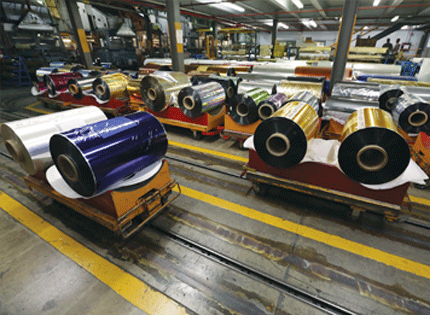
Robert Waitts, who died in 1998, had bigger plans for the holographic technology his company had developed, his son said.
“My father believed holograms and gratings were mediums that could be used for so much more than tchotchkes,” Waitts said.
The rise of digital printing put a large dent into Crown Roll Leaf’s business.
According to IBIS World, the U.S. printing industry revenue is expected to decrease at an annualized rate of 3 percent in 2010 to 2015. Many of Crown Roll Leaf’s customers who had used large commercial printers and local print shops began to favor digital alternatives, which do not utilize embossing or holographic effects.
Since 2008, Crown Roll Leaf has condensed to half the size it once was. Because of the rise in digital printing, the overall graphic end of the business shrunk by nearly 45 percent and the business has gone from nearly 300 employees to about 100.
“Unfortunately, the company’s main investment was in the graphics end of the business,” Waitts said. “You have to know your market and have the ability to see what’s going to happen.
“We didn’t switch gears right away and it took us a while before we could grasp what was happening in the industry. We’ve since switched back to the premier thing that made our company viable in the industry — our ability work with customers to be as inventive as they need us to be and to go as far as they want us to go in developing new products.”
Crown Roll Leaf, still a family-owned business, put its focus back into the lab. Rather than categorizing itself as part of the graphics industry, Crown Roll Leaf now considers itself a custom manufacturing company.
Setting the standards for IDs
The New Jersey fake ID industry has suffered a blow in recent years, thanks in part to Crown Roll Leaf.
That’s because the Paterson-based firm developed the hologram used for the New Jersey state driver’s license.
The image contains 27 hidden security details and, according to George Waitts, COO of Crown Roll Leaf, is the model for similar security features on other states’ licenses.
“New Jersey probably has the most secure card on the market today,” Waitts said. “There are security officials in other states that don’t know half of the details we’ve got hidden in there.”
The range of proprietary products it has developed in its lab include decorative coatings for glass and plastics, UV polycoatings to create fade and scratch resistant surfaces and coatings that protect against everything from gasoline to fingerprints. The company has worked with the aerospace industry to develop coatings for aircrafts and new flame retardants to be incorporated into insulation.
“We are reinventing ourselves to target specific customer bases,” Waitts said. “We are getting back to innovating to spur on new markets.”
One area of growth for Crown Roll Leaf is in working with the security industry. The firm has created unique hologram-like details for the Department of Homeland Security and several different state motor vehicle agencies. The company also works with hospitals to create security details for employee badges.
“We can produce images that take a tremendous amount of magnification to see,” Waitts said. “The human eye can’t see the details at all. We can create images that require specific wavelengths of light or a backlight to reveal particular details that are otherwise hidden. There is a whole host of things that can be done as a way to create ID security that is nearly impossible to replicate.”
The manufacturer also produces peel-and-stick adhesives that tamper-proof medical and pharmaceutical products. When the adhesive is removed or tampered with, it breaks apart or damages the product packaging.
Keeping a watchful eye on the future of the company, Crown Roll Leaf works with the chemistry and computer internship programs at William Paterson University and Passaic County College to involve the next generation in the innovations being created at the company’s holographic lab.
After hitting a few bumps in the road, it turns out Robert Waitts was right. That same technology he developed to create cool holograms for comic books could be, and now is, used for so much more than tchotchkes.
E-mail to: [email protected]
On Twitter: @dariameoli