Sign In
 Free Newsletter


PHOTO: DEPOSIT PHOTOS
PHOTO: DEPOSIT PHOTOS
HR experts share recruitment and retention trends
Matthew Fazelpoor//November 24, 2025//


 Listen to this article
The basics:
- NJBIZ panelists explore shifting recruitment and retention challenges
- HR leaders discuss hybrid work expectations and compensation pressures
- New graduates increasingly seek in-office experiences for development
- Panel examined AI‘s evolving role in recruiting and hiring strategies
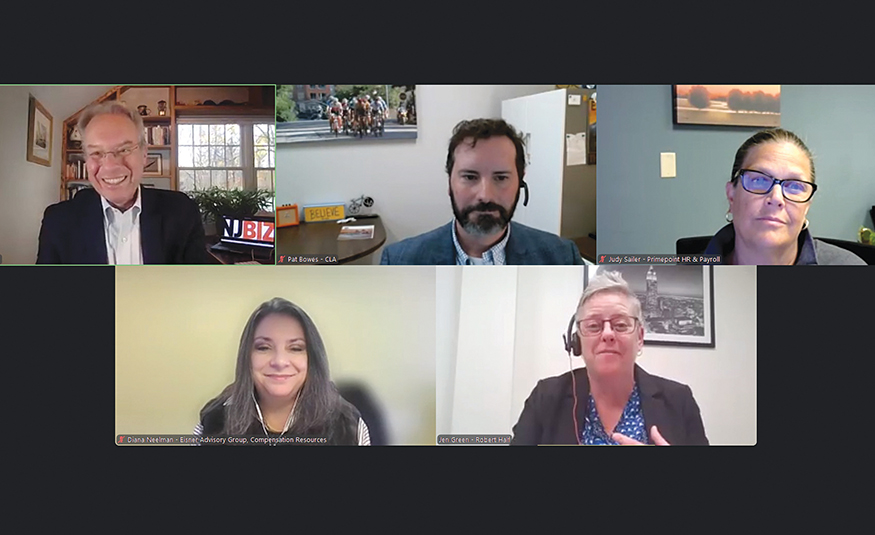
The most recent NJBIZ panel discussion featured human resources professionals sharing their insights and expertise on recruitment and retention. The topic is one that all businesses are tackling at a challenging time in several respects, including shortages and skills gaps.
The Nov. 18 panel, moderated by NJBIZ Editor Jeff Kanige, included:
- Pat Bowes, managing director of People Solutions, CLA Milwaukee (Wauwatosa)
- Jen Green, senior vice president, Robert Half
- Diana Neelman, senior director, Eisner Advisory Group, Compensation Resources
- Judy Sailer, director of learning and development, Primepoint HR & Payroll
After a discussion of recent trends, the panel dug further into post-pandemic realities, particularly around hybrid and remote work as well as work-life balance.
“We saw it before the pandemic, but it really came to the fore during, when nobody was in an office anymore – or most places – and then it sort of held over. And that became the expectation. Is that still the expectation now?” Kanige asked. “Is that the most common expectation – that I’m not going to be in the office five days a week, maybe two – maybe three at the most?”
Sailer said, “I think it really does depend on the organization and what they do. During 2020, half of our staff was still in the building because we were considered essential. So, folks got paid. That has changed over time. Now you can come in — you can be in here one day a week. You could be here two days a week. You could be here the whole week. It’s up to you – what you choose.
“But I do think there are organizations that people have to be in their office to do their job. Whatever that might be. You’re not going to go to a retail place and not have someone wait on you, for example. Where the difficulty comes in is, as Pat said, with experiences. As people are jumping or changing to other experiences – they’re finding that, to do this job, you have to be there every day; whatever that might mean to you.”
Let’s talk compensation
“Diana, I wanted to ask you about something Pat said: That to get people into the office five days a week, they’ve been having to offer more money. Are you seeing that sort of thing?” Kanige asked. “And how big an issue is compensation at this point.”
“We do see it in some situations,” said Neelman. “And again, that is where employers want them in the office full-time. So, they may give a premium to get them back into the office. A lot of it revolves around having balance and flexibility, but also providing opportunities for collaboration, for professional development. Because some of that can’t happen in a remote setting like it does when you’re in the office.
“And you have a question, and you go down the hall, and you ask your supervisor. Or you collaborate with a colleague on a particular issue. So, I think that we have to look at it from both standpoints. That yes, compensation is something that we can leverage to get people back in the office. But I think it goes beyond that from a career development standpoint.”
Replay: Recruitment & Retention
Click through to register to watch the full panel discussion!
New grad in-office trend
“I’d love to add to that,” said Bowes. “There’s something really interesting that we’re seeing. We are seeing that a lot of people who are new graduates are wanting to be in the office. And they’re coming into an office – and they’d like to know where everybody else is. These are people who, at this point, maybe had high school graduations that were all remote. Their first couple years of college were all remote.
“They are craving an in-person type of experience. So, it’s presenting this new challenge for us. How do we deliver that – depending on your culture, maybe without mandates or that kind of thing? What’s happening is there’s almost this peer pressure that’s kind of driving people back in. Because the people who are there, whether we like it or not, as you guys have said, they’re getting a different type of experience.
“They’re getting different exposure. They’re getting different opportunities. And what we’re starting to see is they are progressing faster than their peers who do not have that. Because they’re maybe making the choice not to be in the office. And so, it’s a different kind of pressure that’s bringing people into the office.”

Neelman added, “Agreed Pat. And that’s where the distinction comes in compensation. Because if you are in the office versus remote, you may be more open, available for promotional opportunities. Or you’re more visible to your manager. And then, that’s where we then start to see some of that pay change.”
Out of sight, out of mind?
“And that was an issue even back during the pandemic,” said Kanige. “Where people were afraid that out of sight means out of mind – and out of mind means I’m not going to be considered for the next promotion. Jen, is that still the case? Are you still getting that sort of fear from some people about not being in the office?”
“Yes, definitely with the junior folks,” said Green. “They want it. I agree, absolutely, with Pat – they want to be in the office. I think a lot of it is they are looking for the attention. They’re looking for the praise. They’re looking to learn. I think the bigger challenge is then you have more of the senior folks that have been there for a while who don’t want to be in the office.
“They want flexibility. They’re tired. So, it’s kind of like finding that balance. The companies that seem to be very successful when we are sending people out on interviews that tend to want to work there – is if there is absolutely some type of hybrid or flexibility. But it’s got to be pretty consistent across the board. Or that’s a whole other issue. I also think, to Diana’s point, is the collaboration meaningful when they are together – is very, very important.
“Otherwise, if you’re sitting in an office with three people – for what – you’re not learning anything.”
AI’s role in recruiting
The conversation continued on topics such as addressing the skills gap, building talent pipelines and the role of artificial intelligence in the future.
Kanige noted how a number of audience questions pertained to AI.
“We have a few questions about artificial intelligence and its role in recruiting,” said Kanige. “First one is, how do you plan to use AI to improve your recruitment processes in 2026 and how is AI impacting hiring efforts from the employee standpoint? And then, how can employees stand out?”

“There is definitely a place for AI when it comes to recruiting,” said Green. “I think that if you are using it the right way to maybe get out to the masses – and maybe if you have a smaller recruiting team that just doesn’t have the time to go through all the resumes, you might be able to get some out with the AI kind of doing that. It can help you write job descriptions. It can help you take notes when you’re taking in recruiting calls – and spit out a job description.
“So, I think that if people use AI as like an assistant to what you actually do, it’ll just help you get through things quicker.”
‘A people sport’
“We’ve taken steps not to use AI in our recruiting system, specifically because we want the authentic people – so to speak,” said Sailer. “As a college professor, I always put in there in the background – like tell me something about Beyonce. So, when they start turning in their papers, I’ll get a whole paragraph on Beyonce, which means AI made whatever they sent me.
“You can do those kinds of things now and get around them – or figure out which young people are using AI, a lot. The difficulty becomes in hiring, it’s a people sport. So, probably, like Jen, myself – we’re bringing people in the building. We want to look at the whites of their eyes. We want to talk to them. Our executive director will walk people around. He does this for every single applicant because he wants to keep the culture as healthy as it can be.
“So, he’s paying attention to those things and being engaged in it. You can’t just trust the HR module you’re using. You have to also still have your hands on the pulse of it and make sure you’re getting the right people in your organization.”
Keys to success
As the discussion closed out, Kanige offered the panelists their final takeaways and closing thoughts.
Bowes led off. “As I was thinking about how I would summarize this conversation – there’s a couple of things that stand out to me. One is that organizations, whatever industry we’re a part of, succeed when their people feel valued, supported, empowered and are engaged.
“I think another thing that we’ve talked about here is leadership sets the tone. In all of the decisions that are made – the way that we communicate with people and interact with people – reinforce, really, what do we value? And what is our culture? Those two things stand out to me – and they are just industry or service-agnostic, and things all of us can work with.”
“Since this was all about recruiting and retention, if you think more about looking internally for people, succession plan, keep going,” said Green. “I think that if you network very well, I think that if you embrace the technology – not replace with the technology – I think that that will help. And the main thing is, from a recruiting and retention standpoint, you’ve got to get your leaders on board that it is about the people now.
“It’s a candidate market. They’re running the show, so they’re either going to help you get there – or they’re not going to want to be there with you.”
Going beyond the pay
Neelman echoed those sentiments from Bowes and Green.
“What’s your value proposition as an employer? We always want to think about – it’s only about the pay,” said Neelman. “But it really goes beyond that. What do you provide as far as total rewards? How do you impart your values to employees? How do you develop them professionally. And I think that’s really where you can shine as a company from a recruitment and retention standpoint.”
“All of us, as we were coming up – we would have not left a toxic manager. And now, people are doing that,” said Sailer. “So, we’re changing this landscape. And we really need to have look at good managers, training managers, making sure that they are uplifting their folks. We talked about everybody rowing in the same direction.
“It’s going to continue at this rate – knowing what’s going on economically and numbers-wise with people. And we’re all going to have to work together to make it the strongest that it can be. And that’s having allies like all of yourselves.”