Sign In
 Free Newsletter

Murphy: NJ could still need up to $20B of federal aid through end of 2021
Daniel J. Munoz//September 16, 2020//
Murphy: NJ could still need up to $20B of federal aid through end of 2021
Daniel J. Munoz//September 16, 2020//


New Jersey could still need upward of $20 billion in federal bailout money through the end of 2021, both to make up for cratering tax revenue spurred by COVID-19 and the ensuing recession, and for ballooning expenses in response to the pandemic, according to Gov. Phil Murphy.
Still, that’s a far cry from the $2.4 billion of federal aid that the state was awarded under the landmark Coronavirus Aid, Relief and Economic Security Act, which was passed at the end of March.
Murphy, at a COVID-19 press briefing Wednesday afternoon in Trenton, lamented that the $2.4 billion came with a variety of strings attached, in that it had to be used specifically for COVID-related expenses.
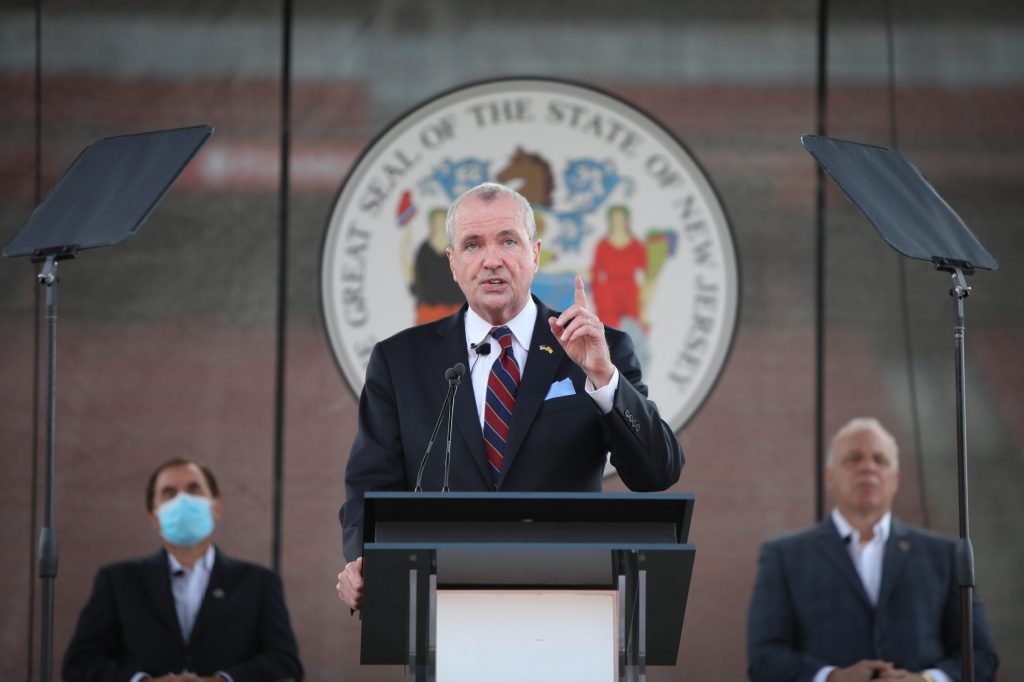
A late-August federal audit found that only 2 percent of those funds had been spent, which has drawn the scorn of both Democrats and Republicans. But the governor reiterated that the vast majority of the money has been either spent or earmarked for specific expenses to bolster New Jersey’s response: Going toward business relief, testing capacity, personal protective equipment and rent relief.
“The challenges we’ve had on early rounds of coronavirus funds … were in fact restrictions or methodologies on how that money can be spent,” the governor said on Wednesday.
New Jersey’s proposed $32.4 billion spending plan for Oct. 1, 2020, to June 30, 2021, does not count on any federal aid, even though Murphy has continually pounded the drum that the state desperately needs that money.
It instead relies on $4 billion of new debt, and more than $1 billion in new taxes and other revenue.
Top financial analysts from the state Treasury and the state Legislature are at odds over what kind of budget hole the state is looking at come the end of that plan in June 2021—with a difference of $1.4 billion.
That sets up a political showdown as Murphy tries to make the case for the new tax proposals, such as the millionaire’s tax.
Senate Budget Chair Paul Sarlo, D-36th District, said in a Tuesday interview that he was convinced most of that difference comes from the income tax.
The governor has until Sept. 30 to sign a budget sent to him by the state Legislature, or he would be required by New Jersey’s constitution to enact a state shutdown.
On Tuesday, the 50-member bi-partisan congressional Problem Solvers Caucus – co-chaired by U.S. Reps. Josh Gottheimer, D-NJ, and Tom Reed, R-NY – unveiled what’s been branded a middle-ground CARES Act extension.
It calls for $1.5 trillion in new spending, out of roughly $2 trillion in total, and includes components of both the Republican-backed $650 billion “skinny” stimulus, which failed to pass the U.S. Senate and does not include any state or local aid, and the Democrat-backed $2.2 trillion “HEROS Act,” approved in the U.S. House of Representatives, which calls for $1 trillion of federal relief.

Tuesday’s Problem Solvers proposal calls for $500 billion to cash-strapped state and local governments, like New Jersey. It’s broken down to $130 billion for “past state and local COVID expenses” and $130 billion for future virus expenses for 2021.
Another $120 billion would fill budget holes for local governments, with $250 billion to help state governments plug their budget holes, both through 2021.
“Americans simply can’t afford inaction,” Gottheimer said in his Tuesday remarks. “Our families and children can’t wait until February for the relief that can help put food on their tables, for more testing, to help for our schools, or to pay cops, firefighters, EMS, and teachers.”