Sign In
Upcoming Event
 Free Newsletter

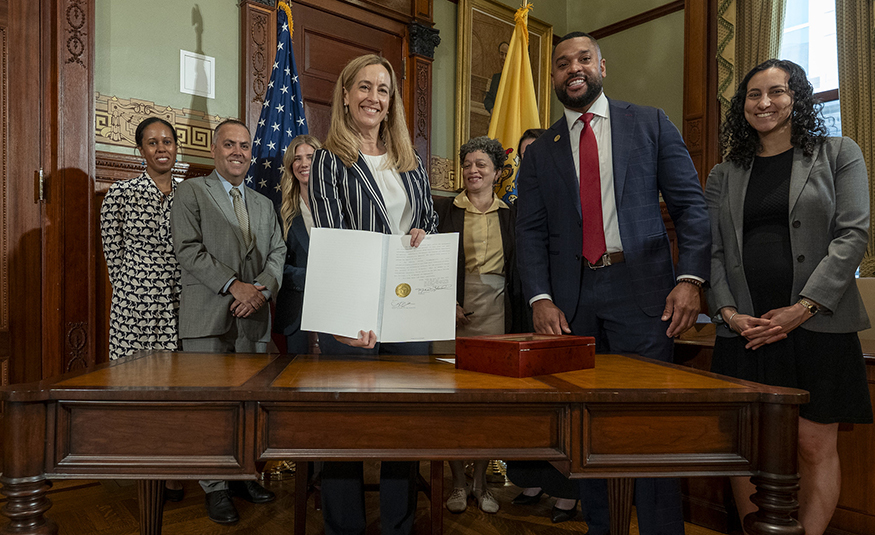
On June 15, 2026, Gov. Mikie Sherrill signed an Executive Order directing state agencies to identify hidden charges across industries. - PROVIDED BY NJ GOVERNOR'S OFFICE/TIM LARSEN
On June 15, 2026, Gov. Mikie Sherrill signed an Executive Order directing state agencies to identify hidden charges across industries. - PROVIDED BY NJ GOVERNOR'S OFFICE/TIM LARSEN
New Jersey launches crackdown on junk fees
Matthew Fazelpoor//June 15, 2026//


 Listen to this article
The basics:
- Gov. Sherrill signs Executive Order 19 targeting hidden junk fees.
- State agencies must review regulated industries, report findings by Sept. 14.
- Attorney General Jennifer Davenport warns of aggressive enforcement under consumer law
- Initiative targets deceptive pricing in housing, travel, financial services, ticketing
Gov. Mikie Sherrill launched a new statewide effort June 15 to crack down on so-called “junk fees,” directing state agencies to identify hidden charges across industries. Meanwhile, Attorney General Jennifer Davenport warned businesses that New Jersey will aggressively enforce consumer protection laws against deceptive pricing practices.
Sherrill signed Executive Order 19 Monday during a press conference at the State House in Trenton. The new initiative combines the EO with a sweeping enforcement statement issued by the Office of the Attorney General and the Division of Consumer Affairs.
The administration says the effort aims to reduce or eliminate hidden, unnecessary or unexpected fees that can inflate the advertised price of goods and services. The issue crosses industries, from rental housing and financial products to travel and ticket sales.
“New Jersey consumers deserve transparency and costs that aren’t loaded with hidden fees,” Sherrill said in a statement. “These ‘junk’ fees fuel the affordability crisis for families and undermine confidence in the prices they see advertised.”
These ‘junk’ fees fuel the affordability crisis for families and undermine confidence in the prices they see advertised.
– Gov. Mikie Sherrill
Speaking at the press conference, Sherrill framed the effort as central to her agenda. “I ran for governor to make life in New Jersey more affordable. It’s my top priority, and it’s been my focus every single day,” she said.
An ‘all-in’ approach
Under EO 19, all executive branch agencies must review the industries they regulate and submit recommendations to the Governor’s Office by Sept. 14.
Agencies are directed to assess prevalent junk fees, evaluate their impact on consumers, and propose regulatory or legislative actions to reduce or eliminate them.
The order also calls on agencies to recommend ways to establish “all-in” pricing and transparent fee disclosure so consumers know the full cost of a product or service before making a purchase.
“I believe in transparency. People deserve to see the full price of what they’re buying up front,” said Sherrill.

At the center of the initiative is a new enforcement statement from the Attorney General’s Office that argues junk fees are “quietly draining household budgets and deepening our state’s affordability crisis.”
The statement defines junk fees broadly as hidden, surprise or excessively overpriced charges that provide little or no value to consumers, or are not transparently disclosed.
Officials warned that advances in technology and artificial intelligence have made the problem worse. They alleged that some businesses increasingly use “dark patterns,” or website and app designs that obscure fees through fine print, manipulated text placement and complex click-through processes.
The state also raised concerns about “drip pricing.” Sometimes referred to as bait-and-switch pricing, under the practice businesses advertise a low initial price only to add mandatory fees later in the purchasing process.
‘Anything but convenient’
Under New Jersey’s Consumer Fraud Act, the Attorney General’s Office argues such practices may constitute deceptive, unconscionable or abusive conduct.

“Hidden and worthless junk fees are increasing costs for families, and we are putting New Jersey businesses on notice that we won’t hesitate to act when we see them,” said Davenport in a statement.
During the press conference, the attorney general said consumers often encounter fees only after reaching checkout.
“You see a good deal, think you found a bargain, but by the time you’ve clicked through the website and gotten to checkout, the price has jumped, thanks to the fees that were hidden from the start,” said Davenport. “The reality is that convenience fees are anything but convenient.”
Hidden and worthless junk fees are increasing costs for families, and we are putting New Jersey businesses on notice that we won’t hesitate to act when we see them.
– Jennifer Davenport, attorney general
Davenport added that junk fees can quietly add hundreds or even thousands of dollars to household expenses.
“Today, that changes in New Jersey,” Davenport stressed. “We’re ending the era of junk fees that fuel the affordability crisis and take money out of the pockets of our hardworking families.”
The enforcement statement highlights several practices the state may scrutinize, including:
- Hidden mandatory fees
- Misleading descriptions of charges
- Pre-checked consent boxes
- The bundling of low-value add-on products into consumer transactions
It also cites examples ranging from rental housing application fees and auto loan add-ons to rental car charges and subscription cancellation fees.
The Attorney General’s Office noted that some fees can become even more costly when financed over the life of a loan, causing consumers to pay interest on charges that provide little value. The statement further argues that junk fees not only harm consumers but also disadvantage honest businesses that disclose prices transparently.
“Competition is only possible where businesses play by the same rules and deal with consumers honestly and transparently,” the enforcement statement says.
Watch the announcement, courtesy of the NJ Governor’s Office:
Fighting the fees
State officials also warned that arbitration clauses buried in contracts often leave consumers with limited avenues to challenge fees individually, making government enforcement particularly important.
The Attorney General’s Office said it is already investigating junk fee practices in rental housing, rental cars, ticket sales and financial services. Davenport pointed to recent actions, such as guidance on New Jersey’s cap on rental application fees and lawsuits against lenders alleging deceptive loan add-ons.
New Jersey’s Consumer Fraud Act allows for civil penalties of up to $10,000 for a first violation and up to $20,000 for subsequent violations.

“The Consumer Fraud Act is one of the strongest consumer protection laws in the nation and is uniquely equipped to protect New Jerseyans from the trickery and manipulation that often accompany junk fees,” said Jeremy Hollander, acting director of the Division of Consumer Affairs, which published new “Fight the Fees” educational materials.
“We urge businesses to review the Division’s Enforcement Statement on the Division’s website and correct any practices that violate the CFA before facing enforcement action,” Hollander said.
Taking the lead
Advocates praised the initiative.
Beverly Brown Ruggia, financial justice program director at New Jersey Citizen Action, argued that some companies have increasingly built business models around fees that provide little value.
“They exist for one reason: to extract money from people who have no real choice but to pay them,” Ruggia said. “Gov. Sherrill’s executive order does not come a moment too soon, and we applaud her for calling on her administration to investigate junk fee practices.”
Sherrill also tied the state’s actions to what she described as weakening federal consumer protections.
“States have to now take the lead,” she said. “New Jersey is leading the way.”