Sign In
 Free Newsletter


NJ hospitals boldly go where no one has gone before
Martin Daks//November 13, 2023//


On the TV series “Star Trek,” Dr. McCoy could diagnose a host of ailments by simply waving his tricorder over a patient, while diagnostic sickbay beds monitored their vital signs. We’re not quite there yet, but New Jersey hospitals are getting closer.

The concept of a tricorder-like medical device is not far-fetched, according Naveena Yanamala, director of the Center of Innovation at Robert Wood Johnson University Hospital, an RWJBarnabas Health facility. “Advances in medical technology have brought us closer to realizing this sci-fi dream,” she said. “Dr. McCoy’s tricorder could instantly capture vital signs and provide rapid diagnoses. Today, wearable devices and remote health monitoring systems have made significant progress in monitoring vital signs. Smartwatches and fitness trackers track heart rate, blood pressure, and detect irregular heart rhythms. Some can even monitor oxygen levels and ECG data, albeit not as sophisticated as Dr. McCoy’s tricorder.”
Even now, however, innovations like the Point of Care Ultrasound device are impressive. “These compact, pocket-sized ultrasound machines have become indispensable tools for physicians, particularly during their rounds and in outpatient settings,” said Yanamala. “Traditionally, physicians spend a substantial amount of time using a stethoscope to assess the quality of a heart murmur, followed by an order for an echocardiogram to gain deeper insights into the patient’s heart condition. POCUS devices have transformed this process. Physicians can now conduct quick ultrasounds at the bedside, instantly generating real-time data with detailed measurements and insights that physical examinations cannot match.”

Technology advances are also driving change at facilities like Valley Health System. “We are constructing our new state-of-the-art hospital located in Paramus,” said Eric Carey, Valley’s vice president and chief information officer. “The Valley Hospital in Paramus has been designed to optimize care delivery using state-of-the-art technologies, including artificial intelligence, smart beds, and real-time location systems.”
A smart approach
As part of the “smart hospital” design, Valley will use Inspiren’s AUGi platform, “a technology developed to prevent patient falls, in each patient room,” he added. “The AUGi platform combines a hybrid sensor, AI, computer vision, a smartphone application, an integrated smart lanyard and Bluetooth low energy into a powerful tool right in the hands of our nursing staff. AUGi observes patient behavior, and the AI technology predicts bed and chair exits. If detected, the device sends alerts directly to the staff on their Vocera Edge devices to warn them of potential falls. Nurses and patient care associates can also [select] ‘live view’ to check on their patients if an alert is sent, or to coordinate their response.”
And the real-time location system hookup means that when a Valley care team member enters a patient’s room, the professional’s information – including their name, title and ID photo – will appear on a 75-inch digital footwall monitor. “Also, the RTLS will be integrated with the electronic health record to provide clinicians with up-to-date patient locations, even when they are not in the patient room,” Carey explained. “Our teams continue to be pioneers of the latest technologies. We look forward to adopting the latest technologies to improve patient care and develop more efficient operations.”

According to Kash Patel, executive vice president and chief information and digital engagement officer at Hackensack Meridian Health, “We are not quite at a ‘Star Trek’-style tricorder stage yet, but medical technology is moving at a rapid pace. We’re doing amazing things with treatment, diagnostics and screenings.”
Advances like CyberKnife – a robotic radiosurgery system designed to deliver non-surgical radiation treatments targeting malignant and benign tumors in the brain, lungs, abdomen, prostate, head and neck – “provides an outpatient, non-invasive breakthrough approach to cancer treatment for patients, including some with tumors that are considered inoperable,” Patel noted.
Discussing the future
As part of NJBIZ’s latest virtual discussion, experts from New Jersey-based organizations, including Hackensack Meridian Health‘s Kash Patel, weighed in on how technology can be used to make health care delivery more efficient, inclusive and sustainable. Click here to read more.
CyberKnife uses image-guided robotic technology to deliver extremely accurate, precisely targeted radiation to address and remove tumor cells. “CyberKnife treatment allows delivery of high doses of radiation in as little as five sessions or less, compared to several weeks of treatments with standard radiation,” he added.
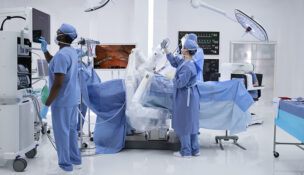
HMH also uses robotic-assisted surgery, where “the surgeon sits at a console next to the patient and controls the movement of surgical tools inserted into their body through one incision or several small incisions,” he explained. “The surgeon’s movements are translated in real time to operate with four tiny, rotating wristed instruments that perform with greater precision and range of motion than a human hand. The skilled surgeon is still in command, but the robotic assistance helps to improve outcomes.”
Patel said devices like the Apple Watch – “which stacks technology to measure heart rate and other health indicators” – further illustrate the way that medicine and technology are merging. “Additionally, sensors can now be embedded in clothing to measure blood pressure in real time,” he noted. “If you go back 20 years, these kinds of devices just did not exist. So, in another 20 years we may have tricorder-like devices.”
Artificial intelligence will play a big part in this effort, according to Patel. “AI-generated algorithms can analyze data and help to predict clinical conditions like stage 3 kidney disease, which may enable a doctor to schedule tests earlier and potentially delay the onset or mitigate the effects,” he said. “It will also enable doctors to spend more time treating patients and less time on their keyboards.”

Companies like Johnson & Johnson MedTech are also moving ahead with innovations. “We are focused on accelerating innovation to design health care solutions that are smarter, less invasive, and more personalized,” noted Ahmet Tezel, company group chairman and global head of innovation and R&D. “Today, we can help surgeons reach parts of the body that were unreachable. Guided by advanced mapping, catheter navigation and robotic-assisted solutions, we are delivering care in the hardest-to-reach territories within the human body to address complex diseases and help more patients.”
As an example, he highlighted the Monarch Platform, “the first and only multispecialty, flexible robotic solution cleared for use in both bronchoscopy and urology.” The Monarch Platform for bronchoscopy “is a first-of-its-kind robotic technology designed to enable physicians to biopsy and diagnose lung nodules with greater precision than ever before,” according to Tezel. “Given its minimally invasive approach, with the Monarch Platform, doctors can reach further into the lung than with conventional bronchoscopes, helping to enable an earlier, more definitive diagnosis.”
The platform is in clinical trials for urology procedures and has successfully completed the first robotic-assisted removal of kidney stones, he added. “When commercially available, the Monarch Platform for Urology may allow urologists to navigate through the kidney with robotic assistance designed for access, clearance and control using a handheld controller.”
And more advances are on the way, said Tezel. “The next generation of medical devices will be connected and open. Combining digitally enabled physical devices and streams of data from inside and outside the operating room, we are at the precipice of a new connected network. The potential of data to help tailor treatments and enhance real-time decision making will radically transform health outcomes, and we are excited for what’s ahead.”
Human connection
Earlier this year, the global medical technology company BD, which is based in Franklin Lakes, announced the worldwide commercial launch of FACSDuet Premium System, a new automated instrument that prepares samples for clinical diagnostics using flow cytometry. It leverages liquid-handling robotics to automate the entire sample preparation process, then automatically transfers samples to the physically integrated BD FACSLyric Clinical Flow Cytometry System – which can check and assess immune cells and identify cancer cells – without human interaction.
The model of health care is changing “as care becomes decentralized and democratized,” noted Dr. Joe Smith, BD’s chief scientific officer. “The population is aging, and more people are living with chronic diseases – which account for about 80% of all health care spend – so more people require care where they are, instead of at a central location that may not be convenient for them. At the same time, the question that health care professionals ask is no longer, ‘how do you feel,’ but rather, ‘are you actually as good as you feel.’”
Trying to answer that question when a patient is at home – instead of in a doctor’s office or other medical facility – requires bold new approaches, Smith explained. “We are working with health care organizations to identify needs like remote diagnostics and medication management, with the goal of developing solutions.”
A BD program called Smart Connected Care is exploring the ways that artificial intelligence, informatics (using digital technology to transform data and information into knowledge) and robotics are transforming health care processes, tools and treatments.
BD is also investigating ways to improve the patient experience. “One of my colleagues was diagnosed with colon cancer, and she said that the thing that sticks in her mind is, ‘the number of times they had to stick me to get blood samples,’” he noted. “We’re trying to change that paradigm to a one-stick experience, even if a person is in a hospital for a few days. As part of that effort, we recently launched a portable vascular access ultrasound device that will make it easier for clinicians to find a vessel for intravenous access on the first attempt, and then use our first-of-its-kind needle-free blood collection technology for high-quality blood draws without a needlestick. Today, the search for solutions is not limited to point of care, but it includes how to best manage care.”