Sign In
Upcoming Event
 Free Newsletter

The Mayors’ Conference Tackles Transportation


 Listen to this article
Date: May 10, 1999
Section:
Location: Newark
Title: The Mayors” Conference Tackles Transportation
Author: By Diana Lasseter Drake
Deck: Public and private-sector officials addressed the issue of Port Elizabeth-Newark and more.
This Monday, leaders of business organizations, corporations and labor unions will gather at Newark International Airport, Terminal C, to announce the formation of a new coalition that wants to protect the airport”s future prosperity. Heading into the new millennium, transportation and the infrastructure supporting it are arguably the hottest economic issues facing New Jersey.
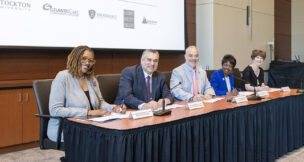
That theory was passionately embraced last Tuesday at a meeting of the New Jersey Conference of Mayors. Mayors, business people and legislators convened at Rutgers University-Newark to discuss “New Jersey: The 21st Century Transportation Gateway to the Eastern Seaboard” and to hear the praises and pleas of keynote speaker, Newark Mayor Sharpe James.
Moderated by Woodbridge Mayor James E. McGreevey, the three-hour session featured such heavy-hitting speakers as Alex DeCroce, chairman of the Assembly Transportation Committee; Ronald Shiftan, deputy executive director of the Port Authority of NY & NJ; and Jack Basso, CFO of the U.S. Department of Transportation. Guest panelists participating in a question-and-answer session included Charles Wowkanech, president of the state AFL-CIO; Robert Janiszewski, Hudson County Executive; Caren Franzini, executive director of the New Jersey Economic Development Authority; Glenn Morse of Continental Airlines; Anthony Petrizzo, vice president of Maersk; and Nicholas Taro, vice president of Sea-Land.
James, with his famous public-speaking finesse, proudly pontificated about projects that are either underway or in the planning stages for Newark. These include a new light rail system that will connect the city”s Broad Street and Pennsylvania stations and continue on to Newark International Airport.
Newark”s mayor set the more important–and necessary–tone for the day, however, when he got to “the problems that we in this room cannot and must not ignore.” Crisis No. 1, he said, is Port Elizabeth-Newark and the danger that two of its biggest container companies, Maersk and Sea-Land, may be leaving New Jersey if their requests for port improvements are not met. The final decision over the companies” lease renewals has reportedly been delayed by New York Governor George Pataki. Said James: “I can”t believe that Governor Pataki quite realizes how his holier-than-thou policy would cause irreparable harm to our cities and region.” All the speakers later echoed concern over the port issue, and despite persistent questioning from McGreevey, neither Nicholas from Sea-Land, nor Petrizzo from Maersk would comment significantly on the negotiations.
The second transportation crisis confronting the state, urged James, is the inefficiency of the region”s busiest airport, Newark International. At the heart of that discussion is Continental Airlines, which considers Newark its nationwide network hub. Continental has laid out a $1 billion Global Gateway program that will, over four years, rebuild Terminal C and support facilities. Continental is also spending $6 billion to replace its fleet. But those plans, said James, are also on hold. “The continuing bickering between Governor Pataki and Governor Whitman is delaying swift action on this vital project,” he pointed out. “If action does not come soon, the hiring of 3,200 new Continental employees and 500 construction workers will be in question.” James also touched on complaints over jet noise at Newark Airport, suggesting that “Those who wish to turn the clock back can maybe choose gliders over jets.”
Participants in the mayors” forum at Rutgers-Newark detailed big plans, both for the port and the state”s airports, highways and railways, that would ensure New Jersey”s role as the 21st century transportation gateway to the Eastern seaboard. But Sam Crane, president of the Newark-based Regional Business Partnership, made an observation–specifically about the port, but more generally about other issues–that made plans seem secondary. “It”s not a question of whether we have plans,” Crane said. “It”s a question of whether we have a will. We don”t have the will to resolve this.”
Perhaps the day”s surprise star was Myron “Mike” Shevell, who spoke in his role as vice chairman of the NJ Transit Board of Directors. Shevell is also chairman of New England Motor Freight in Elizabeth, the largest privately held motor carrier on the East Coast. Despite his humble insistence that “a truck driver doesn”t really belong talking to all these great people,” he was, to many, the voice of transportation business in New Jersey.
“New Jersey”s industrial base has changed, he said. “We are now a distribution state. If we don”t have the port, we don”t have business. If anybody who sits in this room doesn”t realize it, you”re making a grave mistake. It behooves us to to sit down like businessmen and get it resolved so we can get off the dime and get moving.”