Sign In
 Free Newsletter

Trenton sees some lame duck activity
A look at legislation making moves ahead of 2024
Matthew Fazelpoor//December 28, 2023//

New Jersey State House in Trenton - NJ GOVERNOR'S OFFICE
New Jersey State House in Trenton - NJ GOVERNOR'S OFFICE
Trenton sees some lame duck activity
A look at legislation making moves ahead of 2024
Matthew Fazelpoor//December 28, 2023//


Just before the Christmas holiday, there was a slew of activity in Trenton during the lame duck session — the post-election period before new legislators take office in January.
As NJBIZ reported, a major piece of introduced legislation was an overhaul of the state’s affordable housing system (Assembly Bill 4/Senate Bill 4251), which appears on a fast-track for a possible vote by Jan. 8 — the final day of the current legislative session. The Assembly Housing Committee advanced the measure Dec. 21 and the Senate counterpart is expected to do the same in early January.
A long-anticipated measure to ban smoking in Atlantic City casinos was expected to advance earlier in the session, but has since hit a wall amid heavy lobbying from stakeholders on both sides of the issue. That legislation remains very much in flux as of the writing of this story.
During a busy Dec. 21 voting session, several other notable pieces of legislation moved forward. Take a look at some of that activity below.
Electric buses
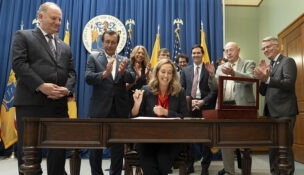
Appropriating $15 million to support the implementation of the Electric School Bus Program, S3044/A4716 received final legislative approval. The bill was also signed into law by Gov. Phil Murphy Dec. 21.
Teacher shortages
Two bills aimed at combatting statewide teacher shortages received legislative approval: S3890/A5417, which would prohibit restricting the number of semester-hour credits completed at a county college that may be accepted toward meeting requirements for teacher certification, and S3883/A5416, which would require the State Board of Education to authorize an alternate route to expedite the teacher certification of persons who are employed or have been employed by a school district as a paraprofessional, or an instructional assistant.
Family leave
The Assembly passed A5166 (S3825), which would expand New Jersey’s Family Leave Act by lowering the number of employees a business can have before it is required to offer family leave. According to estimates from the Office of Legislative Services, the measure would enable more than 700,000 people to gain job protection.
Community-anchored development
S4011/A5650, which modifies the New Jersey Community-Anchored Development Program, received final legislative approval and was signed into law Dec. 21.
Public safety
The Assembly passed A5567 (S3807), which makes it easier for counties and towns to buy public safety equipment and other vehicles by extending the length of bonds they can issue.
Waterfront leasing
The Assembly passed A5565 (S3971), which permits municipalities along the Atlantic Ocean to lease properties not located directly on the waterfront for up to 25 years instead of 10. The move is aimed at giving new life to vacant properties down the shore.
Contractors
S1890/A2138, which updates regulation of home improvement and home elevation contractors and contractors’ businesses, received final legislative approval.
Small business
“The Small Business Health Insurance Affordability Act,” S3480/A5137, which revised certain requirements for individual and small employer health benefits plans, received final legislative passage and was signed into law Dec. 21.
Sunset
Perhaps, though, the most notable aspect of this lame duck session was something that did not happen – the extension of the 2.5% corporate business tax (CBT) surcharge.
The issue, which has dominated business and political headlines in New Jersey this year, came back into the fold at the start of the session as Senate President Nick Scutari, D-22nd District, teased potentially revisiting the issue as a funding source for NJ Transit. The suggestion set the business community ablaze here in the Garden State. However, the governor quickly poured cold water on the idea.
“I am still supporting the sunsetting of the corporate business tax on Dec. 31st,” Murphy said during the 2023 New Jersey Business & Industry Association Public Policy Forum in late November. “On the one hand – a deal is a deal. We said this was a bridge until we get into a better place – and we meant it. On the other hand, it does exacerbate what is a structural deficit that we are running at the moment. And we have to be clear-eyed about that as well.”

Senate Budget Chairman Paul Sarlo, D-36th District, agreed. “I have ruled out using the CBT surcharge for a dedicated revenue source for New Jersey Transit,” he at that same NJBIA event. “I said it last year. I said it again here today.”
That news was welcomed by business leaders. And, ultimately, the Legislature did not take up the issue, setting the surcharge up to expire – as scheduled – when the calendar flips to 2024.
“New Jersey’s employer community is pleased Gov. Murphy and the Legislature allowed the state’s ‘temporary’ 2.5 corporation business tax (CBT) surcharge to expire this year,” Tom Bracken, president & CEO, New Jersey Chamber of Commerce, told NJBIZ in a statement. “As we’ve stated before, honoring this commitment sends a strong message to our existing businesses – and those looking to move here – that New Jersey’s leaders understand the importance of growing the economy.
“Our New Year’s wish is for Gov. Murphy and the Legislature to continue prioritizing policies that allow our companies to expand and add jobs,” Bracken continued. “A strong economy led by business is the only way to create organic, reliable, and sustainable new state revenue to combat future budget challenges.”