Sign In
 Free Newsletter

With new Trump term, NJ’s offshore wind sector faces dark future
Matthew Fazelpoor//April 21, 2025//

PHOTO: DEPOSIT PHOTOS
PHOTO: DEPOSIT PHOTOS
With new Trump term, NJ’s offshore wind sector faces dark future
Matthew Fazelpoor//April 21, 2025//


2025 has been a year of turbulence for the once promising offshore wind sector here in the Garden State.
As President Donald Trump took office for a second time, an immediate executive order followed that called for a review of all offshore wind projects.
Shortly after, Shell disclosed during a quarterly earnings call that it had withdrawn from the planned Atlantic Shores Offshore Wind project. Shell New Energies US LLC was part of a joint venture with EDF-RE Offshore Wind Development LLC on the project.
“While we can’t comment on the view of our shareholders, Atlantic Shores intends to continue progressing New Jersey’s first offshore wind project and our portfolio in compliance with our obligations to local, state, and federal partners under existing leases and relevant permits,” an Atlantic Shores spokesperson said in a January statement.
“First Orsted pulled out of these projects, and now Shell is following suit. They are beginning to realize what we have been saying all along: these projects are not a practical or viable solution for our energy needs,” said U.S. Rep. Jeff Van Drew, R-NJ 2nd District, a long-time opponent of offshore wind. ” I have worked with President Trump to issue an executive order that lays the foundation for a long-term solution that permanently protects our shores from these costly and dangerous projects. I will continue to stand against offshore wind projects off South Jersey’s coast until they are gone for good.”
Just days later, another blow for the sector, as the New Jersey Board of Public Utilities announced Feb. 3 it would not make any awards in the state’s fourth offshore wind solicitation. “The Board will not proceed with an award in New Jersey’s fourth offshore wind solicitation,” said NJBPU President Christine Guhl-Sadovy. “There were three initial bids in the fourth solicitation. However, two bidders withdrew and only Atlantic Shores submitted a best and final offer.”
Atlantic Shores had rebid its Project 1, bundled with Project 2. Officials had said the move aimed to provide a more resilient, competitive and sustainable path through the advanced permitting program.
“Atlantic Shores stands ready to deliver on the promise of offshore wind to achieve American energy dominance, grow the economy, and protect the environment,” Atlantic Shores said in a Feb. 3 statement. “The governor’s commitment to reaching 100% clean energy by 2035 is genuine and commendable. This announcement clearly puts this goal at risk.”

“A number of reasons led to this decision, notably Shell backing out as an equity partner in the Atlantic Shores project and backing away from the American clean energy market, as well as uncertainty driven by federal actions and permitting,” said Guhl-Sadovy in February. “The Board concluded that an award in New Jersey’s fourth solicitation, despite the manifold benefits the industry offers, would not be a responsible decision at this time.
“The Board is committed to working with Gov. Murphy and our sister agencies to build a successful offshore wind industry,” Guhl-Sadovy continued. “We are also deeply appreciative of Atlantic Shores’ work and their commitment to providing a cleaner and healthier future.”
Alternative uses
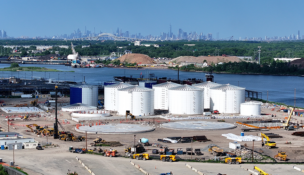
That same day in February, the New Jersey Economic Development Authority announced a “strategic review” of the planned New Jersey Wind Port, located in Lower Alloways Creek, Salem County. The site was slated to be a critical hub for the sector both here in New Jersey and for the entire region.
“In light of the significant uncertainties in the offshore wind market, we have decided to accelerate our strategic review of options and alternatives for the New Jersey Wind Port. While recent developments at the federal level and announcements from offshore wind developers are deeply disappointing, they were not unexpected,” said NJEDA Chief Executive Officer Tim Sullivan in a Feb. 3 statement. “We have taken a cautious approach to further development of the port since 2023, and we have worked to identify alternative uses that would maximize the economic development, job creation and financial potential of the site for the state.
“We remain believers in the long-term potential of offshore wind for New Jersey, but our role as stewards of taxpayer resources requires us to evaluate all of our options. We will continue to provide further updates as this evolves.”


And just last month, there was another major setback for Atlantic Shores’ project that is slated off the coast of Long Beach Island. The U.S. Environmental Protection Agency pulled the project’s Clean Air Act permit and sent it back for reevaluation.
“Atlantic Shores is disappointed by the EPA’s decision to pull back its fully executed permit as regulatory certainty is critical to deploying major energy projects,” Atlantic Shores said in a March 17 statement. “Atlantic Shores stands ready to deliver on the promise of American energy dominance and has devoted extensive time and resources to follow a complex, multiyear permitting process, resulting in final project approvals that conform with the law.”
The action was in response to a petition by Save Long Beach Island, an organization that has opposed the project.
“This is a significant event because to my knowledge it is the first time that a federal approval for any offshore wind project has been overturned, and it highlights the lack of full disclosure and questionable science and mathematics that has characterized other applications and approvals,” said Bob Stern, president and co-founder of Save LBI, who noted the move also means that the project does not currently have all of the federal approvals it needs.
“We are hopeful that other federal agencies, particularly the Interior Department and NOAA [National Oceanic and Atmospheric Administration], will take note of the EPA’s action and reconsider their prior approvals, especially those dealing with marine mammal impact. We have written to both asking for that.”
These developments follow Ørsted pulling out of what were supposed to be the state’s first offshore wind projects – Ocean Wind 1 and 2; and come amid no shortage of challenges faced in the wake of the pandemic, such as supply chain disruptions, rising interest rates, inflation and more.
Crystal ball’s not so crystal clear
The offshore wind issue has also spilled into the broader energy issue. In “Trenton lawmakers zero in on surging energy bills,” another story in the April 21, 2025, issue of NJBIZ, we outline a recent hearing held to discuss one of the biggest hot-button issues in the state: rising energy prices.
“Getting more generation connected from all possible sources will help suppress future prices increases and stabilize the market. That includes offshore wind,” Guhl-Sadovy testified last month during a joint hearing in Trenton. “The Trump administration’s actions are hindering our ability to bring new clean energy resources online, even though they are the fastest to be built. Uncertainty around federal permitting for offshore and onshore wind projects, along with potential tariffs and supply chain disruptions affecting solar, storage and other generating sources, is further complicating the situation.”
“As a coastal legislative district, our constituents are very familiar with what we can now say is the failed offshore wind turbine green energy venture prematurely and wrongfully touted by the Murphy administration as the answer to our state’s energy needs,” Republican 9th District lawmakers Sen. Carmen Amato Jr., Assemblyman Brian Rumpf and Assemblyman Gregory Myhre testified during that same March 28 hearing. “The resources wasted and the time lost to the fixation on offshore wind turbine projects will continue to prove costly to our state’s residents and businesses for years to come.”
“New Jersey’s offshore wind efforts are a prime example of the dilemma the state faces,” PJM Interconnection told NJBIZ in a statement. “New Jersey’s plan to meet its supply/demand imbalance was offshore wind.
“PJM worked hard to prepare the power grid for that infusion of power at New Jersey’s request. Then its offshore wind developers walked away. That is not New Jersey’s fault – but it has nothing to do with PJM.”


Following the joint statement from lawmakers across the aisle, Senate Select Committee Chair Paul Sarlo, D-36th District, along with Majority Leader Teresa Ruiz, D-29th District, and other members of the committee, released a statement saying that New Jersey’s clean energy future has been actively sabotaged.
“Trump-era policies and Republican obstruction have derailed transformative energy projects, including offshore wind. These cancellations erased the opportunity to deliver over 5,000 megawatts of clean power, enough to supply more than 2 million homes, and halted thousands of good-paying jobs tied to projects like the Wind Port and Paulsboro Marine Terminal,” the senators said in a statement. “The economic ripple effects are massive.
“The Wind Port alone was expected to generate over 20,000 jobs and bring in $500 million annually in state revenue. With continued uncertainty, even next-generation projects liked the new hydrogen hub are now in jeopardy.”
During his recent radio call-in show on WNYC, Gov. Phil Murphy spoke about offshore wind during a segment on rising energy prices. “Pushing off offshore wind is flat out stupid,” Murphy told host Nancy Solomon. “Let’s put aside – it’s clean. Let’s put aside – it’s thousands of building trades jobs. It’s 11.5 gigawatt in our program – folks may not get that – 2 million homes can get powered by this. The last thing we should be doing, if we’ve got a supply/demand imbalance, is taking a big supply lane off the table.
“I can’t tell you how frustrated I am with Washington on that front.”