Sign In
Upcoming Event
 Free Newsletter

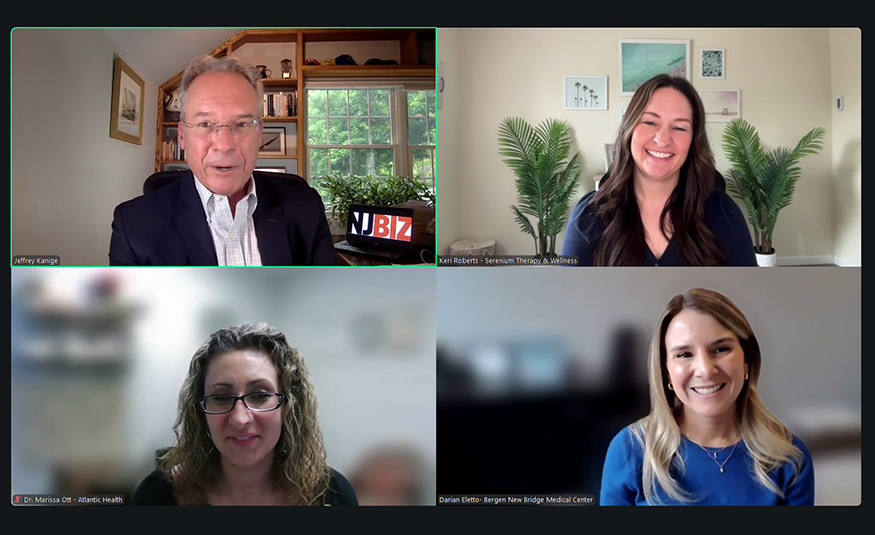
Clockwise from top left: Moderated by Editor Jeffrey Kanige, the May 27, 2026, NJBIZ Mental Health in the Workplace Panel Discussion included panelists Keri Roberts, director of communications & marketing, Serenium Therapy & Wellness; Darian Eletto, chief clinical officer of Behavioral Health Services, Bergen New Bridge Medical Center; and Marissa Ott, advanced practice nurse, Atlantic Health. - NJBIZ
Clockwise from top left: Moderated by Editor Jeffrey Kanige, the May 27, 2026, NJBIZ Mental Health in the Workplace Panel Discussion included panelists Keri Roberts, director of communications & marketing, Serenium Therapy & Wellness; Darian Eletto, chief clinical officer of Behavioral Health Services, Bergen New Bridge Medical Center; and Marissa Ott, advanced practice nurse, Atlantic Health. - NJBIZ
AI anxiety fuels workplace mental health concerns
Kimberly Redmond//May 28, 2026//


 Listen to this article
The basics:
- NJBIZ panel links AI fears to rising workplace stress
- Loneliness, social media drive demand for therapy
- Employers urged to improve AI communication, training
- Healthcare leaders stress human oversight of AI tools
As part of NJBIZ’s latest virtual discussion, stakeholders from New Jersey’s healthcare sector delved into the issue of mental health in the workplace.
Moderated by NJBIZ Editor Jeffrey Kanige, the May 27 panel featured:
- Darian Eletto, chief clinical officer of behavioral health services at Bergen New Bridge Medical Center in Paramus
- Marissa Ott, an advanced practice nurse with Atlantic Behavioral Health in Newton
- Keri Roberts, director of communications & marketing for growing New Jersey mental health practice Serenium Therapy & Wellness
Topics covered during the 90-minute roundtable discussion include artificial intelligence’s impact on mental health, balancing compassion with business continuity during employee crises, and creating a culture that values and supports employees.
A more detailed recap of the discussion will appear in the June 8 edition of NJBIZ.
Stress tests
When it comes to the overall climate regarding mental health, panelists say they have observed anxiety over everything from the economy to technology to medical coverage to geopolitical matters.
Eletto said, “I think a lot of what we’re hearing is the concerns about the state of the world and how can we respond to the state of the world … There’s a lot of economic turmoil; there’s a lot of economic demands. There’s a lot of stress regarding what’s going on in the healthcare space in itself.”
“We have patients who come in every day and they come in at such an acute place because they don’t know if their coverage is carrying or they don’t know if they have coverage … And that is a huge stressor on our staff because we see patients that we know that we care about, we’ve been caring for years who let their health fall off because they were so stressed over whether or not they had the coverage needed to care for themselves,” she said.
I think a lot of what we’re hearing is the concerns about the state of the world and how can we respond to the state of the world.
– Darian Eletto, Bergen New Bridge Medical Center
Roberts said, “What’s been really interesting for us, especially in the last year or so with the changes going on with technology and AI, for the first time ever, one of the top reasons people are coming to therapy is the state of the world.
“So, whether that’s from a government standpoint, from what’s going on in the workplace or the economy, people just feel overwhelmed, stressed and not sure how to handle things,” she explained.
“In addition to that, we’re also seeing a high element of loneliness. People are feeling so attached to their streaming devices, their phones, social media, AI, Zoom calls, that they’re really missing on real relationships and friendships,” Roberts said.
Replay: Mental Health in the Workplace
Click through to register to watch the full panel discussion!
The practice also sees more parents of middle school through college-aged children asking how to help their kids navigate challenges and uncertainty, Roberts added.
Social media has become such a trigger it prompted Serenium to launch a digital detox program last year, Roberts noted.
“There’s this feeling of feeling like ‘I need to keep up’ or, ‘Oh my gosh, my phone is showing me every war image going on … And it just feels like you feel helpless. And so, what can I control? What can I not?” she said, noting the sentiment presents across age groups. “…Our 30-day digital reset is in response to people feeling a sense of addiction for a better word to their phone and whether that’s an adult that’s on it or even teens.”
Artificial feelings
Concern over job stability due to the growing adoption of AI is another big stressor, panelists said.
Roberts said AI has been marketed to business “as it’s easy, it’s quick, it’s going to save companies a ton of money.” But, employees are increasingly stressed by fears that AI could replace their jobs, while also feeling pressured to dramatically increase productivity using AI tools, she said.
Panelists all agreed AI can be helpful in some ways – especially in the healthcare industry – for tasks like notetaking, documentation and scheduling. However, human oversight is always necessary.

Eletto said, “This is a tool. It’s not something that’s meant to replace someone. … A lot of what we’re also doing within Bergen New Bridge is teaching digital literacy. So, that’s understanding what is AI, why are we using it, what can it help with and how do we use it in your role?”
Because patients often worry that AI will replace human healthcare providers, Eletto said Bergen New Bridge has found that clearly explaining how it uses AI and reassuring patients they will still interact with doctors, nurses and therapists helps ease concerns.
“I think the biggest thing that we need to do for a lot of our institutions is making sure that people understand what AI is as opposed to what it is not,” she went on. ” … So, really letting them know how we utilize AI and being open and disclosing that really helps alleviate some of those concerns we’re finding.”
User experience
For companies that roll out AI tools, panelists urge transparency with employees. They also advocated for clear communication, boundaries and training around using the technology.
Join us
Stay tuned to our events page for the latest panel discussions and in-person events. Bookmark this page.
Eletto said, “We really want to have our staff understand the what are we bringing on and the why are we bringing it on and really making sure we have policies that align that help support our staff as they kind of onboard this into their day-to-day structure.”
Roberts agreed. “Sometimes it’s a process,” she said. “A lot of times decisions are made at the top without really thinking about how it affects the people every day.”
Ott emphasized the importance of “understanding the level of competency of your staff.” Along with tailoring training to different job roles, experience levels and schedules, she said organizations should give employees dedicated, paid time to learn and ask questions.
“Honestly, my biggest thing is just listen to your employees. They’ll tell you a lot of things. Obviously grain of salt for sure, but I think if you’re present and you pay attention, I think they’ll give you what you need to help guide them,” she said.