Sign In
Upcoming Event
 Free Newsletter

PHOTO: DEPOSIT PHOTOS
PHOTO: DEPOSIT PHOTOS
New Jersey builds on legacy of leadership in life sciences
Matthew Fazelpoor//June 29, 2026//


The basics:
- NJ’s life sciences workforce now exceeds 127,000 employees
- State ranks No. 1 in pharmaceutical manufacturing employment
- Biomanufacturing space has grown by 1.5M square feet since 2021
- Report highlights continued investment in innovation, research, cell therapies
New Jersey’s reputation as the Medicine Chest of the World is more than a marketing slogan. According to the newly released 2026 New Jersey Life Sciences Report, the state continues to strengthen its position as one of the nation’s premier destinations for biotechnology, pharmaceutical research, medical device development and advanced biomanufacturing.
The report, released by Choose New Jersey in partnership with BioNJ, the HealthCare Institute of New Jersey, JLL and the New Jersey Economic Development Authority, provides a comprehensive snapshot of a life sciences ecosystem that spans more than 127,000 workers, world-renowned research institutions, major pharmaceutical manufacturers and a growing network of innovation centers designed to help emerging companies scale.
“New Jersey offers one of the most advantageous environments in the world for life sciences companies,” Gov. Mikie Sherrill wrote in the report’s introduction. “Our state already has much to offer life sciences companies looking to grow and invest in a region with unmatched potential, and my administration is committed to making New Jersey even more business-friendly.”
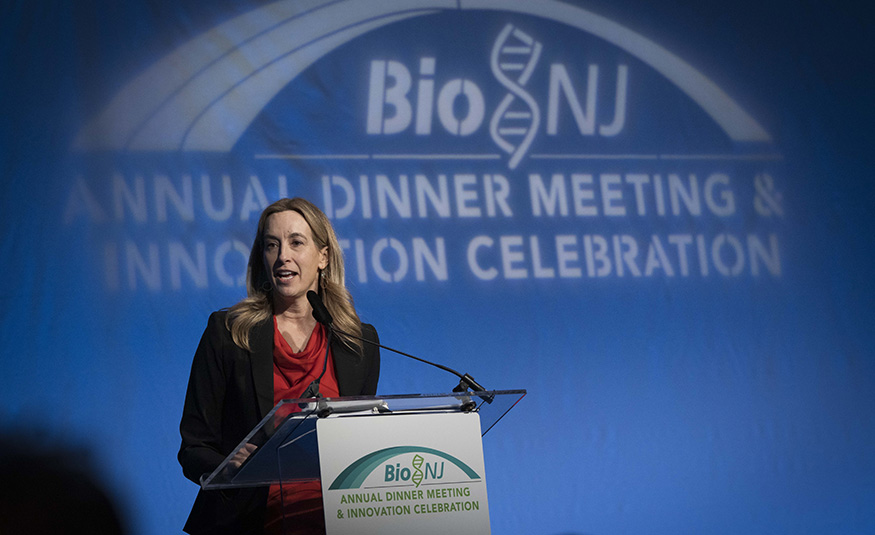
The study arrived as New Jersey leaders gathered at the BIO International Convention in San Diego, the industry’s largest global event. But beyond promoting the state’s strengths to investors and industry executives, the report offers evidence that New Jersey’s life sciences sector continues to expand across multiple fronts.
Biomanufacturing boom
Among the most notable findings is the state’s continued growth in biomanufacturing. Since 2021, New Jersey has added approximately 1.5 million square feet of new contract development and manufacturing organization and biomanufacturing space. Nearly half of that growth came from companies already operating in the state, signaling confidence among existing employers.
The state ranks first nationally in pharmaceutical manufacturing employment, and Food and Drug Administration-registered manufacturing sites. More than 40,000 workers are employed in pharmaceutical manufacturing statewide, a concentration roughly three times the national average.
The report notes that New Jersey is home to eight of the world’s top 10 pharmaceutical companies and 13 of the top 20 global biotechnology companies. More than 5,600 life sciences establishments operate across the state, spanning pharmaceuticals, biotechnology, medical technology, diagnostics and research services.
Fast-growing field
New Jersey’s leadership position extends into one of the industry’s fastest-growing fields: cell and gene therapy. The report notes that six of the 13 FDA-approved and insured cell and gene therapies available in the United States are produced in New Jersey.
Industry giants including Bristol Myers Squibb, Johnson & Johnson and Novartis anchor the sector, while companies such as Legend Biotech, Rocket Pharmaceuticals, Amicus Therapeutics and Century Therapeutics continue to expand the state’s footprint in next-generation therapies.
The report also highlights the growing role of advanced manufacturing companies, such as Cellares, which opened a 118,000-square-foot “Smart Factory” in Bridgewater in 2024 that focuses on scaling cell therapy production through robotics and automation.

“Everyone’s been very welcoming, very supportive. We appreciate the support that we are getting from the local community,” said Fabian Gerlinghaus, CEO and co-founder of Cellares. “New Jersey is known for biopharmaceutical manufacturing. We fit right in. New Jersey and Bridgewater, in particular, are used to biopharmaceutical manufacturers setting up shop there.”
Welcome to the Garden State
The state’s appeal is also attracting international companies looking to establish or expand U.S. operations.
Biocon Biologics, an Indian-headquartered leading biosimilars company, opened its first U.S. manufacturing facility in Cranbury in 2025. A year earlier, the company established its North American headquarters in Bridgewater.
“We are excited to establish our first North America headquarters within the hub of the biopharma sector of New Jersey, where we can leverage the strong life sciences ecosystem of innovation, talent, and excellent quality of life for our employees and be well-positioned for future growth,” said Joshua Salsi, head of North America for Biocon Biologics.

South Korea-based Celltrion established a major manufacturing presence in Branchburg after acquiring a former Eli Lilly facility, which opened earlier this year. For Celltrion, the decision underscored the advantages of locating in an established life sciences market with ready-made infrastructure and an experienced workforce.
“With this U.S. plant acquisition, we have saved about 1.5 trillion won [$9.73 million] by eliminating tariff risks, avoiding the cost of building a new facility, securing production capacity, and retaining skilled talent,” Celltrion Chairman Seo Jung-jin said in the report.
Job creation
Meanwhile, Indian-headquartered global biotech company Enzene Biosciences opened a state-of-the-art biopharmaceutical manufacturing facility at the Princeton West Innovation Campus in Hopewell. It plans to grow from an initial workforce of 50 employees to approximately 300 workers as operations expand.
Himanshu Gadgil, CEO of Enzene Biosciences, said New Jersey offered the combination of workforce, infrastructure and academic resources the company sought. “Enzene Biosciences is thrilled to establish our manufacturing operations in New Jersey, as it allows us to extend our local manufacturing capabilities to our valued North American clients,” Gadgil said. “We are excited to provide them with access to our cutting-edge continuous manufacturing platform, which enables streamlined and efficient production processes.”

“New Jersey’s highly skilled workforce, state-of-the-art infrastructure, and renowned academic institutions make it an ideal location for Enzene, ensuring that we can deliver exceptional services and support to our clients in the U.S.”
Where the talent is
The report identifies workforce development as one of New Jersey’s greatest competitive advantages.
Five medical schools, a veterinary school, major research universities and an extensive community college network help produce a steady pipeline of talent for life sciences employers here. Programs such as NJBioFutures partner with industry and educational institutions to prepare workers for careers in biomanufacturing and laboratory operations.
The state’s life sciences workforce exceeds 127,000 employees, with particularly strong concentrations in pharmaceutical manufacturing, research and development, medical devices, and cell and gene therapy.
The Roundup
Significant developments in the pharmaceutical industry from around the state
- Johnson & Johnson to build $1B Florida distribution hub
- J&J to buy Firefly Bio for $1B to boost cancer pipeline
- Bristol Myers Squibb inks $15.2B drug deal with Hengrui
- Advance bringing 1M-SF life sciences campus to Bridgewater
- NJ to get $125M from $7.4B nationwide opioid settlement
- Merck completes $6.7B Terns acquisition
Beyond its corporate presence, New Jersey continues to rank among the nation’s leading centers for research and development. The state is home to five medical schools, a veterinary school and numerous research universities, while more than 15,000 active clinical trials are underway across New Jersey healthcare institutions. The report also notes that New Jersey has the nation’s second-highest concentration of contract research organizations and contract development and manufacturing organizations, with more than 700 operating statewide.
“The depth of New Jersey’s life sciences ecosystem presents a compelling case to investors and companies around the world,” said Amy Herbold, president and CEO of Choose New Jersey. “Our presence at the BIO International Convention amplifies that message, creating opportunities to attract new investment, strengthen partnerships and reinforce New Jersey’s leadership in the life sciences sector.”
Location, location, location
Real estate is another area where New Jersey has a distinct advantage, according to the report.
Unlike many competing life sciences markets, the state offers a significant inventory of former pharmaceutical campuses that have been redeveloped into business-ready research and manufacturing sites. These so-called legacy campuses provide companies with existing laboratory infrastructure, utility capacity and regulatory approvals that can dramatically shorten development timelines.
According to the report, companies occupying these facilities can begin operations 12 to 24 months earlier than if they pursue new construction; and can reduce buildout costs by as much as 90%.
Major sites highlighted in the report include:
- HELIX in New Brunswick
- Former Sanofi campus now known as Continuum in Bridgewater
- NJ Bioscience Center in North Brunswick
- Northeast Science and Technology Center (NEST) in Kenilworth
- ON3 in Nutley
- Princeton West Innovation Campus in Hopewell

Daniel Loughlin, vice chairman at JLL, said the state’s real estate portfolio provides significant advantages for companies seeking to grow quickly.
“New Jersey offers one of the most compelling life sciences real estate markets in the country,” said Loughlin. “From fully built-out pharmaceutical campuses to emerging innovation districts and lab-ready facilities, the state provides companies with opportunities to accelerate growth, reduce costs and bring newproducts to market faster.”
Investing in SICs
The report also highlights more than $190 million in state investments supporting incubators, accelerators and innovation-focused initiatives. Through the NJEDA and related programs, New Jersey has developed a growing network of Strategic Innovation Centers that provide startups and emerging companies with laboratory space, mentorship, commercialization support and access to investors.
Those initiatives include:
- Coriell Institute for Medical Research in Camden
- NJ Innovation Hub at HELIX NJ
- New Jersey Accelerator for Innovation in Medtech
- New Baby New Jersey in Trenton
- NJ AI Hub in West Windsor
- Hackensack Meridian Health Center for Discovery and Innovation in Nutley
- SciTech Scity in Jersey City
The state has also expanded financial support through programs such as the Angel Investor Tax Credit Program, the Innovation Evergreen Fund, the Emerge Program and the Technology Business Tax Certificate Transfer Program.
Case in point
The report points to Sun Pharma as one example of how those incentives can influence investment decisions. In 2025, the global pharmaceutical company relocated its U.S. headquarters to a 100,000-square-foot facility in Plainsboro with support from the NJEDA’s Emerge Program, nearly doubling its corporate headcount in New Jersey.
“With our long history as a valued corporate member of the state of New Jersey and the Princeton community, Sun Pharma is proud to participate in the Emerge Program,” former Sun Pharma North America CEO Abhay Gandhi said in the report. “As we continue to bolster investments in our innovative medicines, generics, and consumer medicines business, we look forward to seeing the positive impact our growth will have for New Jersey, the Princeton community, and the patients we support.”
The India-based company selected New Jersey over a competing location in Pennsylvania, citing the state’s workforce and proximity to higher education institutions as key advantages.

NJEDA Chief Executive Officer Evan Weiss said those investments are designed to ensure the state remains competitive as life sciences companies make decisions about where to locate and grow. “New Jersey’s continued leadership in life sciences is the result of a sustained focus on innovation, talent, and business growth,” Weiss said. “By working to cut red tape, bring down costs and make smart investments in high-growth industries, Gov. Mikie Sherrill is building an environment where companies can scale, create jobs and bring transformative technologies to market.
“This report reflects the strength of New Jersey’s innovation economy and the opportunities ahead.”
Key to success
For industry leaders, the report reinforces a message that has long defined New Jersey’s economy: innovation thrives when research institutions, healthcare providers, government agencies and private industry work together.

“New Jersey has long been at the forefront of life sciences innovation, bringing together the expertise, collaboration and resources needed to transform scientific discoveries into meaningful patient outcomes,” said Debbie Hart, president and CEO of BioNJ. “This report showcases the strength of our ecosystem and the many advantages that continue to attract companies, talent and investment to New Jersey.”

HINJ President and CEO Chrissy Buteas said the report demonstrates why New Jersey remains a top destination for life sciences investment. “New Jersey is known as the ‘Medicine Chest of the World’ due to our unparalleled partnerships between the life sciences, government, academia, organized labor, and workforce and economic development efforts,” Buteas said. “This report demonstrates why New Jersey remains a critical hub and top choice for life sciences companies in research, development and advanced manufacturing.”
And New Jersey continues to build on that legacy that has shaped the global pharmaceutical industry for generations. As companies invest in new manufacturing facilities, expand research operations and advance next-generation therapies, the report suggests the state’s combination of talent, infrastructure and industry expertise will remain a key competitive advantage in the years ahead.