Sign In
 Free Newsletter

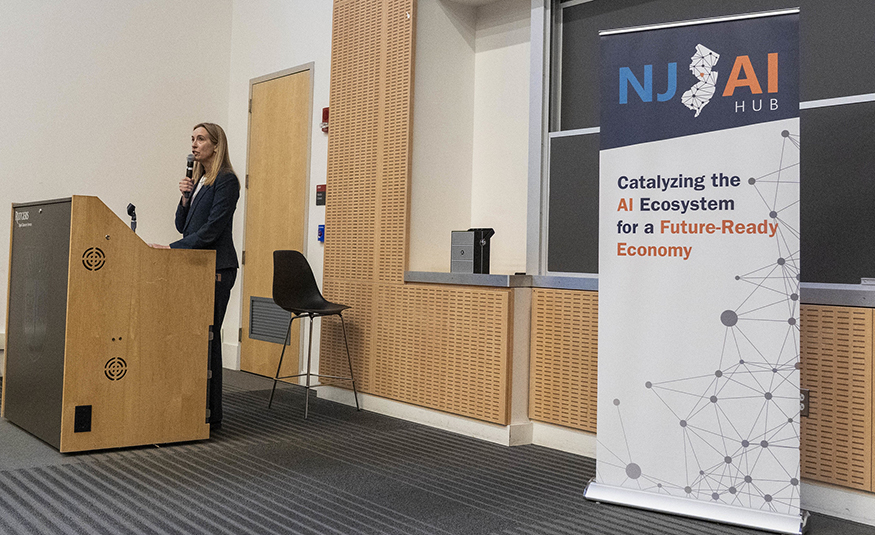
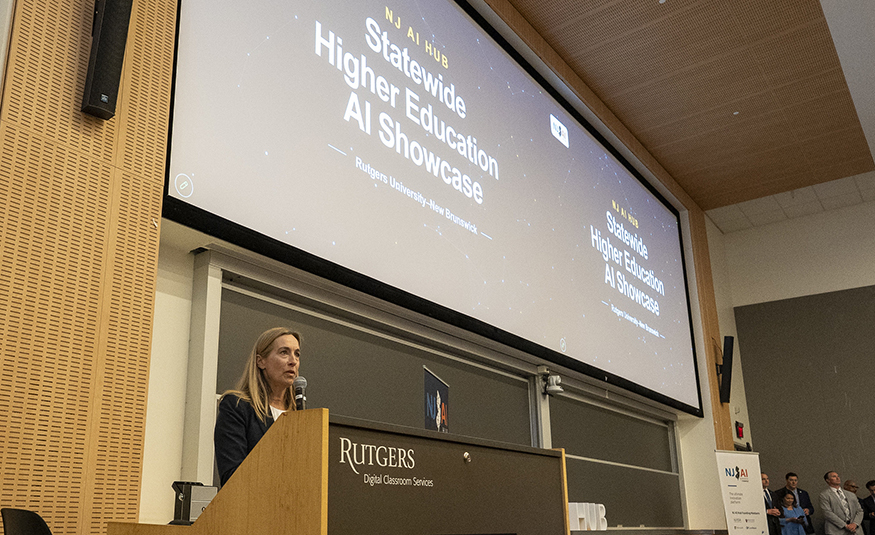
Gov. Mikie Sherrill kicked off the New Jersey AI Hub’s Statewide Higher Education Showcase at Rutgers University in New Brunswick on June 17, 2026. - PROVIDED BY NJ GOVERNOR'S OFFICE/TIM LARSEN
Gov. Mikie Sherrill kicked off the New Jersey AI Hub’s Statewide Higher Education Showcase at Rutgers University in New Brunswick on June 17, 2026. - PROVIDED BY NJ GOVERNOR'S OFFICE/TIM LARSEN
NJ AI Hub charts next phase of statewide AI growth
Matthew Fazelpoor//June 25, 2026//


The basics:
- NJ AI Hub marks 1st anniversary with statewide expansion beyond Princeton HQ
- NJ AI Library Learning Network brings AI training to public libraries
- AI Ready NJ expands community college workforce, faculty development programs
- Employers report growing demand for AI skills amid statewide talent shortages
As the New Jersey AI Hub marks its first anniversary, the organization is moving beyond its West Windsor headquarters and into communities across the state. The effort is expanding AI education, workforce training and innovation initiatives through community colleges, public libraries and workforce development organizations.
The organization’s June 17 Statewide Innovation Showcase at Rutgers University-New Brunswick on June 17 served as both a look back at the Hub’s first year and a preview of its next phase, bringing together educators, industry leaders, startup founders and government officials including Gov. Mikie Sherrill. The event featured new statewide partnerships, presentations from companies participating in the Hub’s startup accelerator – powered by Plug and Play – and fresh data showing how colleges and universities are increasingly integrating AI into teaching, research and workforce preparation.
The announcements build on the AI Ready NJ initiative unveiled earlier this month in partnership with the New Jersey Council of County Colleges. Together, the programs reflect the Hub’s growing focus on creating a statewide AI ecosystem that connects universities, community colleges, employers, libraries and workforce organizations while preparing residents for the technology’s increasing influence on the economy.
Challenge accepted
For the NJ AI Hub – whose founding partners include Princeton University, Microsoft, the New Jersey Economic Development Authority and CoreWeave – the challenge is no longer simply introducing people to artificial intelligence. It is figuring out how to build a statewide ecosystem capable of helping residents adapt to a rapidly changing technological landscape.
“It’s been crazy, amazing, exciting,” Liat Krawczyk, executive director of the NJ AI Hub, told NJBIZ. “I think we’re just really trying to build something pretty comprehensive, and thinking about how do you reach like any individual, any company where they are, and how do you bring them in in a meaningful way, where you’re actually adding value?”
That philosophy has increasingly shaped the Hub’s work during its first year of operation.
The Hub comes to you
One of the centerpiece announcements at the event was the launch of the NJ AI Library Learning Network. The pilot program will bring AI literacy, job-seeker training and small-business education into public libraries across the state. The Hub also announced a partnership with the Garden State Employment and Training Association to help workforce boards gather real-time information on how AI is changing employer skill needs.
The initiatives complement the recently announced AI Ready NJ program, which is designed to support AI readiness across New Jersey’s 18 community colleges through faculty development, experiential learning opportunities and work-based learning experiences.

Marie Pryor, director of workforce at the NJ AI Hub and Microsoft TechSpark, said the strategy is intentionally designed to extend beyond the Hub’s headquarters in Princeton.
“Our scaled strategy is to meet people where they are, not to summon everyone to the hub and to Mercer County,” Pryor told NJBIZ. “The NJCCC partnership with AI Ready is a great example of that, as well as our library initiative.”
Accessing AI education
Under the AI Ready NJ initiative, up to 100 faculty members across the state’s community college system will receive support to incorporate AI into teaching and learning, while students will gain access to project-based experiences and AI-focused work opportunities through partnerships such as Break Through Tech’s Sprinternships program.
Pryor said the goal is to ensure New Jersey residents can access AI education regardless of where they live or whether they are enrolled at a major research university.
“Making sure that folks … have that local anchor they can go to, whether it’s nimble, one-off sort of AI exposure training or, more importantly, AI for job seekers, for our youth, for those that may be disconnected from education or employment. That they have a place to go to get those AI skill sets that could then put them on the path to demonstrating value for employers,” Pryor explained.
AI-ready workers
The workforce focus reflects findings from new data released during the event, derived from the ongoing NJ AI Hub Intelligence Project. The collaboration involves the New Jersey AI Hub, the New Jersey Office of the Secretary of Higher Education, New Jersey higher education institutions, and industry partners.

Learn more about the NJ AI HUB here.
According to the data, employers identified talent shortages as one of the biggest barriers to AI adoption, with 52% citing the availability of skilled professionals as a challenge. More than 6 in 10 employers said the ability to work alongside AI tools and automation was among the most important skills they seek, while 59% highlighted comfort using AI interfaces and 57% pointed to the ability to identify AI solutions to business problems.
The findings suggest businesses are increasingly in search of workers who can effectively use AI technologies rather than build them from scratch.
For higher education leaders, the data also highlighted the speed at which institutions are moving from exploration to implementation.
The Hub’s Intelligence Project identified more than 200 AI initiatives across 36 colleges and universities statewide. And many institutions report that their efforts have moved beyond planning stages and into active deployment.
Teaching the teachers
New Jersey acting Secretary of Higher Education Margo Chaly presented the findings along with Krawczyk at the event. She said one of the most notable trends has been the rapid growth of faculty development efforts.

“We really can’t train our students until we prepare our educators,” Chaly told NJBIZ, crediting Passaic County Community College, in particular, for its efforts on this front. “And Passaic is leading the way.”
Chaly said AI readiness must extend well beyond college campuses.
“If we wait to teach employees to manage and navigate AI, we’ve waited too long,” she said. “I’ll sit here and say if we wait till they’re in college, we’ve waited too long.”
Working together
At the same time, higher education leaders are increasingly focused on collaboration rather than working independently.
Data presented during the showcase found strong interest in statewide cooperation around AI curriculum development, resource sharing and workforce preparation. Chaly said the key is blending those efforts together.
There are incredible initiatives and advancements in different spaces, and we want to make sure those resources are connected to each other.
– Margo Chaly, New Jersey acting secretary of higher education
“We need it all. Two things can happen at the same time,” she said. “Different sectors can thrive in their lane and bring to the table the innovation that they are subject matter experts in, but all together is what makes it successful.
“What comes next is the network – to continue to break down the walls and the silos,” Chaly continued. “There are incredible initiatives and advancements in different spaces, and we want to make sure those resources are connected to each other. It requires the network to scale. So, where some things might be happening in small spaces on campuses, we can begin to scale statewide.”
This is the moment
That theme surfaced repeatedly throughout the day.
Krawczyk noted that while New Jersey possesses an unusually dense concentration of universities, companies and research institutions, many organizations are still learning about work happening beyond their own campuses and sectors. The Rutgers event offered that opportunity to bring all of the different stakeholders into the same room – and further break down the silos.
“I want everyone in a room to know each other,” said Krawczyk. “Because personal trust ultimately translates into institutional trust. If you know somebody well enough over time, that becomes a real partnership, and I think you can really build from a place like that. It’s a good beginning. There’s a lot to do. But it’s the beginning.”
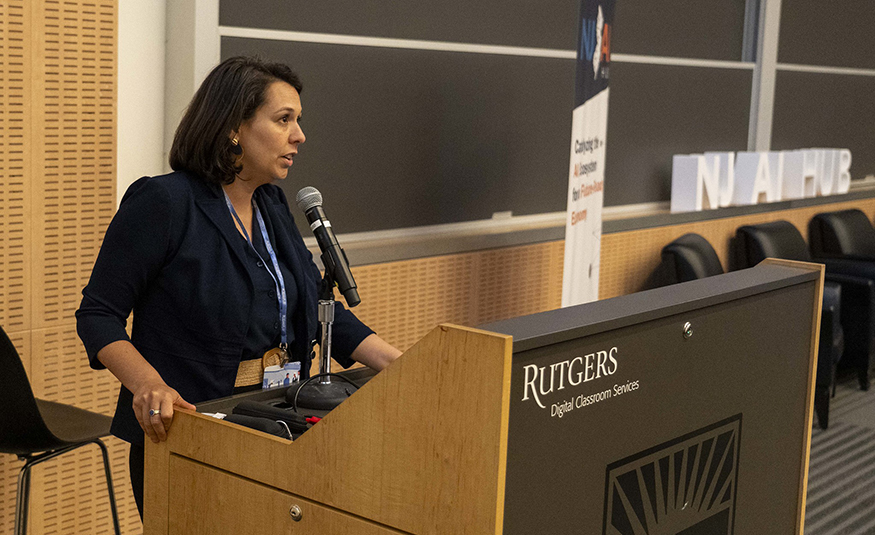
The Hub’s efforts increasingly focus on serving as connective tissue among universities, community colleges, employers, startups and government agencies. Officials argue that approach will become increasingly important as AI reshapes not only workplaces, but education itself.
“This is not about hype,” said Krawczyk. “This is all about, practically today, what do we do to prepare individuals for this moment?”
Not waiting around
Sherrill echoed that message during her keynote remarks, framing AI as the latest chapter in New Jersey’s long history of innovation, from Bell Labs and the transistor to today’s emerging AI technologies.
“New Jersey isn’t going to wait for answers. We are going to answer the questions,” said Sherrill. “We’re going to harness our greatest strengths, our talent, our technology, and our top-tier universities to make sure AI works for all of us. The NJ AI Hub is making sure we lead the way.
New Jersey isn’t going to wait for answers. We are going to answer the questions.
– Gov. Mikie Sherrill
“The Hub brings together researchers, educators, and entrepreneurs to think about how we can drive responsible AI innovation into our state,” the governor continued. “Along the way, they built new initiatives that will help us unlock discoveries in the lab, spin out new businesses and those new jobs, build more effective curricula, and create good-paying jobs.
“The Hub launched an accelerator for New Jersey startups like the ones you heard about this morning.”
Sherrill said preparing New Jersey for AI will require building that foundation even earlier in the educational pipeline.
“We can’t wait until students arrive on campus at 18 or 20 to prepare them for an AI-driven economy,” she said. “It has to start earlier in our elementary, middle, and high schools.”
What’s ahead
Looking ahead to its second year, Hub leaders say their focus will remain on scaling successful programs, strengthening industry partnerships and helping institutions adapt to rapidly evolving technology.
Pryor said one of the most encouraging developments during the Hub’s first year has been seeing organizations that do not traditionally work together begin collaborating around AI education and workforce development.
“Everyone’s really eager to make this work and to see this happen. I think we see a lot of silos breaking down … Because everyone’s navigating this moment together to try to meet and adapt to AI in this evolving landscape,” ” said Pryor. “We’re seeing a lot of collaboration, a lot of coming together, a lot of walls coming down, so that folks can really build and innovate together.”
Krawczyk echoed that sentiment. She stressing the ultimate goal is to ensure AI becomes a tool that expands opportunity rather than limits it.
“It’s just incredible to see so much momentum, so many people who are amazing partners,” she said. “People really think of New Jersey as a siloed place. But what this moment is doing is because everyone understands the urgency of it. People are really, really working together. So, it’s great.”