Sign In
Upcoming Event
 Free Newsletter


Nokia Bell Labs President Peter Vetter speaks at the company's centennial celebration in Murray Hill on April 9, 2025. “There is a responsibility to carry this unique research culture. This ability to deliver groundbreaking innovation with a real, measurable impact in society,” he said. - MATTHEW FAZELPOOR/NJBIZ
Nokia Bell Labs President Peter Vetter speaks at the company's centennial celebration in Murray Hill on April 9, 2025. “There is a responsibility to carry this unique research culture. This ability to deliver groundbreaking innovation with a real, measurable impact in society,” he said. - MATTHEW FAZELPOOR/NJBIZ
Nokia Bell Labs celebrates a century of innovation
Matthew Fazelpoor//May 12, 2025//


The basics:
- Nokia Bell Labs celebrates 100 years at its Murray Hill campus
- CEO Justin Hotard outlines the past, present and AI-powered future
- Gov. Murphy praises Bell Labs’ legacy and future move to HELIX in New Brunswick
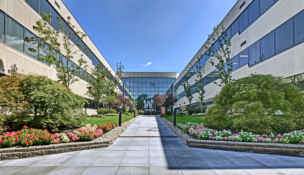
A recent event hosted by Nokia Bell Labs highlighted the past, present and future of the iconic company. The 100th anniversary celebration, held at the legendary Murray Hill campus, featured Nokia executives, customers, partners and analysts, along with industry leaders and government officials including Gov. Phil Murphy.
“I’m really pleased to be able to welcome you to celebrate 100 years of world-changing technology,” said Justin Hotard, the newly minted Nokia president and CEO, who recently succeeded Pekka Lundmark.
As he spoke about the importance of innovation, Hotard noted the significant contributions to science, technology and innovation. “And it brings me back to one consistent truth about technology and our broader industry. Technology is really all about people,” said Hotard. “It’s about the engineers, the creators, the developers, and, especially, the users whose lives are better as a result of their innovations. And as you think about previous technological leaps, they proved this time and time again.”
Hotard discussed the company’s history, citing the work of inventor Alexander Graham Bell. “His innovation, of course, led to the creation of Bell Labs – and more broadly, initiated the telecommunications revolutions, which ultimately became the foundation for many other technological innovations,” Hotard continued. “One of those was the internet revolution, which connected our world; 97% of Americans are now internet users and the number of mobile subscriptions worldwide is 9.1 billion.
“As I think about history, I think we’re in the midst of another revolution, which is the AI revolution,” said Hotard. “And I fundamentally believe it will be just as impactful.”
Hotard pointed out that these technological super cycles have a significant impact on productivity – and as a result, on economic growth, wage growth and living standards. “Throughout its 100-year history, Nokia Bell Labs has helped create and accelerate these super cycles,” said Hotard, highlighting three of those innovations: One from the past (transistor), one that’s directly relevant today (AI) and one he believes will be largely relevant in the future (space and lunar networks). “These are just a few examples of Nokia Bell Labs’ track record of developing transformative innovations.”
As he closed out his remarks, Hotard came back to the people aspect of Nokia Bell Labs’ work.
“It goes back to the commitment to commercial, real-world impacts – beginning in communications and networks, and radiating out from there,” said Hotard. “All Bell Labs research is geared toward improving people’s ability to communicate with each other – in their businesses; in their communities; and in their personal lives. The technology developed in this building will continue to boost growth, innovation and living standards around the world.
“Nokia Bell Labs has had a century of tremendous impact. It has shaped all of our lives – and it will continue to shape the lives of every citizen around the world. I cannot wait to see what the next 100 years brings.”
‘A New Jersey icon’
“Happy 100th birthday to a New Jersey icon,” said Gov. Phil Murphy. “And here in the Garden State, our legacy of excellence in innovation, in particular, could really be summed up in two words: Bell Labs.”

The governor said that over the past century, Bell Labs has put the Garden State at the center of some of the most profound technological developments in human history. And that the world, as we know it, would simply not exist without Nokia Bell Labs.
“Time and time again, your team has revolutionized the way we live – from physicists in Murray Hill creating the transistor to Willard Boyle and George Smith inventing the eye of the digital camera to so many other trailblazers within the halls of Bell Labs, who discovered breakthroughs in radio, astronomy, cellular technology, artificial intelligence, and on and on,” said Murphy. “And while yes, Bell Labs’ legacy of innovation can be quantified in all of the accomplishments and accolades, including the extraordinary Nobel Prize winners here with us today; the Turing Prize winners; the thousands upon thousands of patents.
“The truth is, not withstanding all those accolades and all those numbers – as stunning as they are, that does not tell the whole story,” Murphy continued. “Because I think one of the core ingredients that has defined the lab since the very beginning is the spirit of collaboration and curiosity. You have fostered that recipe, if you will, throughout your labs and facilities. In Arthur C. Clark’s words – Bell Labs has always been a factory for ideas, which I think captures it. A factory for ideas that is powered by the world’s brightest minds and generations of engineers, scientists, and researchers coming together to learn from one another and to discover new possibilities, again, together.”
Murphy noted that ethos mirrors New Jersey itself in many ways.
“Because New Jersey has always been that small state with world-changing ideas – a state with more scientists and engineers per square mile, still, than anywhere else on the planet; and a state that convenes our nation’s industry leaders, institutions of higher learning and emerging innovators, like many of you in this hall: to redefine what is possible.
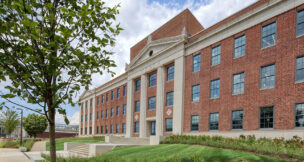
“That is exactly why we consider it as such a badge of honor that Nokia Bell Labs has made a commitment to pioneer, not just the last century, but the next century of excellence in innovation right here in the Garden State – with your new state-of-the-art facility in the HELIX,” said Murphy, noting the company’s upcoming move to the Health & Life Science Exchange in New Brunswick. That facility (HELIX 2) is slated to open by 2028.
New Bell Labs Venture Studio
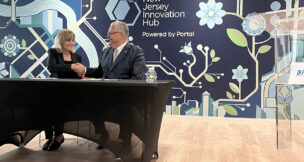
The state has also partnered with Nokia Bell Labs on a new Strategic Innovation Center, which will feature the NJ Nokia Bell Labs Innovation Center and Bell Labs Venture Studio. Officials say the effort will focus on enabling startups to accelerate and commercialize intellectual property from Nokia Bell Labs and local universities. The SIC will emphasize areas such as communication, artificial intelligence, cloud computing, and optical and wireless networks.
During the centennial event, the ribbon was officially cut on the new Bell Labs Venture Studio, which will be housed at the Murray Hill campus — until the move to HELIX.

“This co-investment partnership that Nokia has forged with NJEDA has been nothing short of phenomenal,” said Mike Chen, CEO of the Bell Labs Venture Studio, and vice president of ventures and partnerships at Nokia Bell Labs.
“This partnership has been fantastic with the State of New Jersey with NJEDA,” said Nishant Batra, chief strategy and technology officer. “We’re very, very excited to launch this Venture Studio. It has great potential. And my belief is, this is going to be a game-changer for Bell Labs for the future.”
Shaping the next 100 years
During remarks about the 100-year anniversary, Nokia Bell Labs President Peter Vetter noted that the turnout of so many distinguished guests is a testimony to the importance of big innovations over a century – with real impact on humanity.
He said it is humbling for himself and his co-president, Thierry Klein, to be the custodians of this research institute, especially at such a critical time.
“There is a responsibility to carry this unique research culture. This ability to deliver groundbreaking innovation with a real, measurable impact in society,” said Vetter. “To bring that forward to the next generation. This is not only a celebration of the past 100 years. But also putting the spotlight on groundbreaking research that we do today – and how we aspire to shape the next 100 years.”
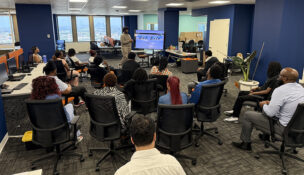
Throughout the day, reporters had the chance to see some of the things that Nokia Bell Labs is working on in a series of demonstrations — everything from how AI can transform into the physical world (including a contextually-aware robot); quantum computing and the goal to build the first effective, stable and scalable qubit; how its technologies can optimize mining processes; how next generation hybrid glass is enabling world-class performance for mm-Wave & sub-THz communication and sensing modules; how to extract environmental information from a real-time digital signal processing engine; and the aforementioned space and lunar network initiative.

NJBIZ spoke with Tod Sizer, who is the head of optical system and device research.
“The team that I lead today is doing work in optical communication – so where do we use optics in communication,” Sizer told NJBIZ, noting its fibers are used in homes, between cities and even undersea. “My team invents new ways to try to increase the amount of information that we need to send. Historically, the amount of information that you and I have asked for has been growing about 60% per year – over 40 years. It’s simply remarkable. And yet we’re able to keep up with 60% per year.
“And in this day of AI, it’s now even more challenging – because it’s 100% per year. It’s all on those thin pieces of glass, optical fiber. And I like teasing my wireless colleagues that all communications are on optical fiber – except the last 100 feet, which might be on 5G or Wi-Fi. But everything else, and it’s actually a very true statement, whether it’s under the ocean or under the ground or to the home, within the data center – there’s fibers going everywhere. So, my team invents new types of devices that can make things more energy efficient.”
Sizer said his team includes folks that invent new types of devices all the way up to people that invent new types of systems. “And so having all those in one group is one of the things that’s an unfair advantage for us at Nokia,” he stressed. “We have that breadth.”
‘Reliability … has to be there’
He noted the challenge of the pandemic because that marked a point in a time where having fiber to the home went from being a luxury to an absolute essential, just like gas, electric and water.
“When we got to the point where we were educating our kids from home; when we were working from home to a greater degree – the reliability, it has to be there,” he said, reiterating. “It has to be there.”
“That changed dramatically in the 2020–2023 timeframe. So, while we continue to push the envelope on trying to put more information on a single piece of glass – and we will continue to do that. We also have to do it at the same time that we’re saying: How do make these systems even more reliable?” Sizer continued. “Everything is online. So, if you don’t have a high-speed connectivity, you are uninformed. It’s unacceptable for a population to be uninformed. So, the reliability, the expectations are so much higher now.”
Sizer also explained how the company can build the necessary infrastructure while staying ahead of the curve.
“We’re lucky in Bell Labs – that we have owners that expect us to be thinking five to 10 years in advance. If you cover other industries, here in New Jersey, there are very few that have that kind of a look-forward,” Sizer explained. “We’re blessed. So, how do we do that? Well, we have a vision about where we think we need to go. Whether it’s people that are designing devices or people building systems or software systems – each of us kind of know where we need to be.

“And we don’t have a crystal ball – so we’re probably wrong most of the time,” he continued. “But at least we have a direction. And every couple of years, we go back and say, ‘What’s the vision?’ And it’s really driven research through the year. Where did the work on the Big Bang come from? Well, it’s because we knew wanted to connect more efficiently between the U.S. and Europe. So, we knew we needed to try to bounce information off of satellites. And that’s when we built telescopes. And the telescopes happened to have a noise problem – and that was the Big Bang.”
That is a reference to the work by Bell Labs scientists Arno Penzias and Robert Wilson, who played a key role in confirming the Big Bang Theory in 1964.
“This vision driving research across so many different disciplines is kind of the hallmark – and so it is today,” said Sizer. “We believe that the thirst for information – not only people’s thirst for information. But also, machines’ thirst for information – that thirst is unrequited and will be for the next decade.”
Sizer, who has a PhD and manages 150 researchers, said the company’s organization is flat, without a lot of layers. “And high expectations on the researchers to drive their own technology, their own direction. I do not tell the 150 people what to do – they tell me what the right direction is and then I help find money to help them do that.”
Sizer stressed there is an evaluation, and it has to make sense.
“They have the expectation – because I need 150 minds to be thinking crazy thoughts. And then 10% of them are really crazy – and then we can change the world, right? And so that motto has been there since I started, and it continues to today,” said Sizer. “Being a manager is like herding cats. It’s not an easy job. But I also get to work with 150 type-A, double charged, always know they are right, really smart people from every place on the planet.
“We hire the best of the best of the best from all over the planet. You give them a lab. You give them some challenges to think about and then you sit back,” said Sizer.