Sign In
Upcoming Event
 Free Newsletter

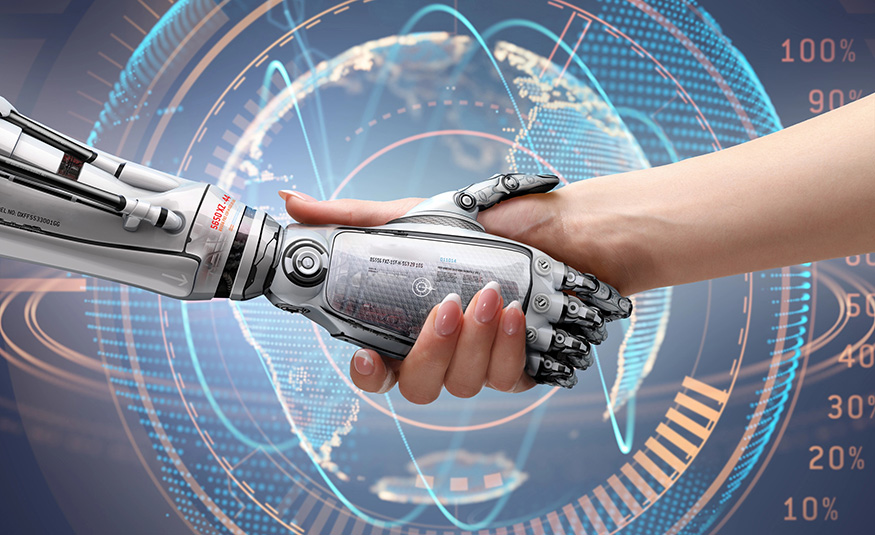
PHOTO: DEPOSIT PHOTOS
PHOTO: DEPOSIT PHOTOS
OPINION: Human intelligence and higher education in the AI era
Jeffrey Senese//July 13, 2026//


The basics:
- Caldwell University president says AI enhances rather than replaces human intelligence
- Higher education must blend AI literacy with ethical reasoning
- Universities should balance workforce needs with intellectual growth
- New Jersey AI Hub highlights the state’s leadership in AI innovation
In an era defined by rapid advances in artificial intelligence, it is tempting to frame the future as a contest between human cognition and the capabilities of AI. Yet, from the vantage point of a university president, this framing overlooks a deeper truth: artificial intelligence does not diminish the value of human intelligence — it clarifies and elevates it. At the same time, the growth of AI compels us to reconsider the role of higher education, not only as a social good but also as a complex and evolving business enterprise that must demonstrate value in both intellectual and business terms.

Artificial intelligence excels in pattern recognition, data processing, and predictive modeling. The big problem is that data are typically flawed, imperfect, and not always available. While the strength of AI lies in its ability to process copious amounts of information quickly and achieve probabilistic precision, it is not discerning, critical or values based. The old adage, “garbage in, garbage out,” potentially still applies; no matter how sophisticated AI appears, its foundation is data. Human intelligence operates in a fundamentally different domain — one shaped by judgment, creativity, ethical reasoning, and the capacity to navigate ambiguity. As Pope Leo XIV has so eloquently pointed out, “AI is, above all else, a tool and its ethical force comes from the intention of the individuals that wield it.” Thus, it is arguable that human intellect is required in concert with AI.
Human beings interpret context, reconcile competing values, and make decisions under conditions where data is incomplete or uncertain. These capabilities are essential not only in the arts and humanities but also in business, leadership, scientific discovery, and civic life. Moreover, human intelligence is inherently social. It is expressed in collaboration, empathy, and the capacity to inspire others. These qualities, at least for now, remain beyond the reach of even the most advanced AI systems. In this sense, artificial intelligence should be seen not as a replacement for human intellect but as an extension of it.
Refining human intelligence
Rather than replacing human intelligence, AI challenges us to refine it. Routine cognitive tasks are increasingly automated, shifting the value of human contribution toward higher-order thinking. Skills such as critical analysis, interdisciplinary reasoning, ethical judgment, and creative synthesis become more, not less, important. For those of us in the business of higher education, it also calls us to think more directly about our values and missions, and how to make the greatest difference for our students, assisting them develop their human intelligence and become AI-literate contributing members of society.
[A]rtificial intelligence does not diminish the value of human intelligence — it clarifies and elevates it.
Helping students to engage in this transformation underscores the enduring relevance of higher education. Universities are not merely repositories of knowledge; they are environments in which students learn how to think, make mistakes, question, and adapt. In the age of AI, these capabilities are indispensable. At the same time, higher education must evolve and place the AI revolution in context for students, in time for when they enter society. Curricula must integrate AI literacy with philosophical inquiry, technical skills with ethical reflection. Students must graduate not only with proficiency in emerging technologies but also with the intellectual resilience to question their applications and consequences. This ideal graduate serves the business community and the community writ large in ways that bode well for society’s future. As Albert Einstein famously remarked, “The true sign of intelligence is not knowledge but imagination.” It is this imaginative capacity, paired with ethical discernment, that can enable humanity to innovate responsibly and lead wisely.
An AI-driven economy
As universities navigate the AI landscape and future, they also operate within economic realities. Higher education is undeniably a business, one that manages significant resources, competes for talent, and must demonstrate a return on investment to students, families, and society. However, it is a distinctive business. Its product is not a commodity but a transformation. The value it provides extends beyond employability and includes intellectual growth, civic engagement, and lifelong learning. In an AI-driven economy, this value becomes more tangible. Employers increasingly seek individuals who can adapt, learn continuously, and bridge the gap between technology and human need, precisely the qualities cultivated through a broad and rigorous education. There is tangible, real value in professional higher education across fields as disparate as the sciences, medicine, and engineering. From a business perspective, universities must also be accountable. They must ensure that their programs align with evolving workforce demands, that their operations are efficient, and that their outcomes justify their costs. This requires innovation, not only in teaching and research but also in delivery models, partnerships, and resource management.
Employers increasingly seek individuals who can adapt, learn continuously, and bridge the gap between technology and human need, precisely the qualities cultivated through a broad and rigorous education.
At the same time, the business model of higher education cannot be reduced to short-term and solely financial returns. Its true value lies in long-term individual and societal impact: the advancement of knowledge, the preparation of thoughtful citizens, its contributions to the culture, and the fostering of innovation ecosystems. These outcomes, while difficult to quantify at times, are essential to economic vitality and social cohesion. That is to say, an English degree can help students cultivate versatile, useful business skills in writing, analysis, and communication; develop a deep understanding of language and literature; and prepare graduates for a broad spectrum of careers and intellectual and real-world pursuits. There is value to society in such pursuits in the humanities, and the arts as life would be quite bland and boring without these pursuits.
A critical balancing act
The challenge for higher education is to balance financial sustainability with intellectual integrity. Universities are complex institutions that must reconcile diverse interests — academic, economic, and societal. In the age of AI, this balancing act becomes even more critical. Universities must demonstrate clear outcomes while resisting the temptation to define value too narrowly. The return on education cannot be measured solely in starting salaries; it must also include the capacity for lifelong learning, civic engagement, and ethical leadership.

The intersection of human intelligence, artificial intelligence, and higher education presents both a challenge and an opportunity. Universities must lead in defining how AI is developed, applied, and governed. In New Jersey, the “New Jersey AI Hub,” launched in 2025 by the state and Princeton University, has been a focus on this work. The AI Hub is connecting universities across the state, helping with startup funding, building infrastructure, and training students.
Universities must serve as conveners of diverse perspectives — bringing together technologists, humanists, policymakers, and industry leaders. In doing so, they reaffirm the centrality of human intelligence. AI may inform decisions, but it is human judgment that must guide and live with them and decide when to start over. AI may generate insights, but it is human curiosity that asks the questions worth pursuing. The rise of artificial intelligence does not signal the obsolescence of human intelligence; it underscores its indispensability.
As AI grows more capable, the qualities that distinguish human thought, creativity, ethics, empathy, and the ability to find meaning become more valuable than ever. Higher education, as both an intellectual institution and a business enterprise, sits at the heart of this transformation. Its responsibility is not only to equip students with skills but to cultivate the wisdom to use those skills well. In fulfilling this mission, universities ensure that the future shaped by artificial intelligence remains, fundamentally, a human one.
Jeffrey Senese is the president of Caldwell University.