Sign In
Upcoming Event
 Free Newsletter


PHOTO: DEPOSIT PHOTOS
PHOTO: DEPOSIT PHOTOS
AI panel shares business strategy, cybersecurity insights
Kimberly Redmond//August 10, 2026//


The basics:
- Experts urged businesses to develop AI strategies before adopting tools
- Panelists highlighted cybersecurity, legal and data privacy risks
- Companies should pair AI governance with employee training
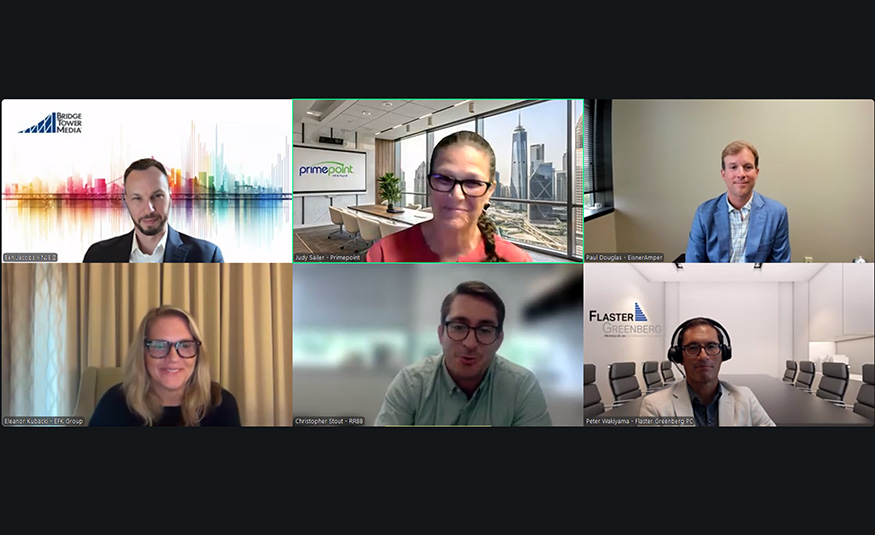
As part of NJBIZ’s latest virtual discussion, executives at New Jersey-based businesses delved into what company leaders should consider as they move to leverage artificial intelligence.
Moderated by BridgeTower Media East Business Division Content Lead Ben Jacobs, the July 29 panel featured:
- Paul Douglas, a partner with Eisner Advisory Group LLC
- Eleanor Kubacki, founder, president and CEO of Trenton-based marketing and advertising agency EFK Group
- Judy Sailer, director of learning & development at Westampton payroll processing service Primepoint
- Peter Wakiyama, an AI, privacy and cybersecurity lead with Flaster Greenberg PC
- Christopher Stout, partner at Rosenberg Rich Baker Berman PA in Somerset
Topics covered during the 90-minute roundtable discussion included the importance of adopting an AI strategy, the risks associated with using public-facing platforms and how to measure return-on-investment of the technology. They also spoke about real-world applications of AI, as well as cybersecurity measures.
Where to start
When it comes to incorporating AI into business operations, panelists called for a deliberate and thoughtful approach.
Stout said, “From my perspective, you’re inundated with various tools every day. You see new things coming out and new versions. And it could be tempting to just jump in and grab something that might seem appealing at the time. But I don’t think that’s the hard part of getting into the AI. I think the difficult part or the part that might be missed sometimes is understanding those workflows and processes where there could be redundancies or wasted time.”
“So, I think there should be a use case for identified areas where you could be more efficient before starting to look at the different solutions that might be available to everybody. If you jump in without really looking at those workflows, you could have a bad process,” he said, adding, “You’re going to get not a great result and you’re just going to have it done faster.”
Wakiyama said, “Every organization has its own sort of unique appetite for risk or risk tolerance. Some companies are willing to take on more risk and to be further out there on the edge with adopting AI on their own, maybe developing their own tools, licensing third party tools and really sort of pushing the envelope. Others are more conservative just by nature. Some industries, like legal, finance and banking, are very measured and deliberate and they’re going to move a little bit slower and be more concerned about legal pitfalls.”
He went on, “What I’m seeing is it’s not a one size fits all legal approach for clients. It’s really a tailored and measured approach … One of the things that I emphasize with clients is to determine what your use cases are going to be before you decide you’re going to use something. Otherwise, you’re going to open yourself up to some unexpected consequences, which could include significant legal exposure.”
‘Be more human’
As for what companies are experimenting with AI for, just a few of those tasks include summarizing lengthy documents, developing spreadsheets, giving a first look at job applications, conducting recruitment, completing background checks, handling social media accounts and better targeting marketing demographics, according to panelists.
They all cautioned that any AI-generated output should always be verified for accuracy, sources and completeness – especially in professional settings. “It’s all about that prompt and teaching people how to get to that prompt … the intent is to make their lives easier so that they are utilizing their time to the best of their ability,” Sailer said.
She stressed that the focus right now should be on teaching people the safest way to use it and making sure they understand the fundamentals before moving on to anything more advanced. The more we learn, the better off we are. And this is not meant to take your job. This is to elevate you to the next level of your job.”
Replay: Artificial Intelligence
Click through to watch the full panel discussion!
Douglas feels the technology has the potential to allow us “to be more human.”
“You’re going to be able to leverage AI to do things that free you and be more human, which could be great for your service as well and for the mission … I think the winners are those who can leverage the technology and be outstanding on the human side. And I think the losers are either ones who don’t leverage the technology or leverage it if they’re not outstanding on the human side because that’s our differentiator moving forward,” he said.
[T]he intent is to make [employees’] lives easier so that they are utilizing their time to the best of their ability.
– Judy Sailer, director of learning & development, Primepoint
Free to decide
Participants also weighed in on the pros and cons of free AI-powered platforms, like Copilot and ChatGPT, versus customized ones that can require significant investment for small businesses.
Wakiyama said, “With the free versions, the terms and conditions are very one-sided in favor of the providers of those tools. There’s virtually little, if any, recourse against them. And if a company puts its confidential information into ChatGPT, Claude or some other publicly available tool, whatever rights it had in that information, for example, trade secret rights, are probably lost.”
“I’ve had clients call me to say, ‘Hey, we had an employee do this. They put this information into this tool. What should we do now?’ Well, there really isn’t a way to fix that. You can’t extract, remove or force one of the providers to extract and remove trade secret material that may have been uploaded,” he said. “So, that’s a significant risk with these publicly available tools.
“You get what you pay for. There’s no such thing as a free lunch. Free versions can be helpful but proceed with caution and use them in only appropriate ways. Now what’s appropriate? That should be dictated by your policy. Every organization should have a policy, and it should set forth which tools are proof for use, under what circumstances and for which use cases, whether it’s private or public,” he explained.

Wakiyama noted that the regulatory landscape regarding AI remains uncertain and expects it is “going to be that way for a while until we have a Congress that decides it wants to focus on this.”
“I think it’s just going to continue to be a patchwork quilt of laws, statutes, regulations, industry specific regulations and case law. So then of course, contracts are really important. A lot of what a company can do to protect itself from legal risks can be addressed through effective contracting with the service providers … and with the parties that are providing the data,” he said.
The next step
With respect to developing a framework for AI use within a company, panelists said multiple stakeholders, such as legal, human resources, finance, marketing, sales, R&D and IT, should be involved in the process.
Wakiyama said, “Think about the main areas of the business that should be represented and have a voice in governance. A smaller organization may not have all those departments. It may be a smaller number of people that sit on the governance committee and that implement a charter or guiding set of principles for governance … but, I think it’s important to have a legal voice in governance, whether it’s an in-house attorney or an outside lawyer who’s providing advice. Because all these decisions that a governance committee makes may have some legal implications.”
Stout emphasized the importance of including the voice of “a champion or a professional from the actual workforce that is doing the operations” as a way to bring “perspective as to what it [AI] can be used or what people are actually using it for.”
I think this is the biggest business revolution we’ve ever seen … if we use AI to do all those redundant tasks, then the humans can focus more on the bigger scope of work.
– Eleanor Kubacki, founder, president and CEO, EFK Group
Kubacki said, “I think this is the biggest business revolution we’ve ever seen … right now, at just the lowest implementation – and this is Microsoft’s stats – we’re seeing a 25% faster work coming out of staff, 40% higher quality of work and 64% better innovation. And that’s because if we use AI to do all those redundant tasks, then the humans can focus more on the bigger scope of work.”
Her firm invested in a customized platform to house everything from its knowledge to workflows to financials to performance.
“Productivity just at our agency alone has definitely been around 20%, 22% more efficient,” she said. “What we’re doing is taking that more time per employee is rethinking how we use it. And for us in the creative field, we’re going to be able to do more video, more content and more social. We’re going to be able to do things at a bigger, more substantial level for our clients. So for us, the increase in productivity and the increase in having more time to do better, more thorough work is a winning combination. That’s how we will predict success.”
Pricetags
According to Kubacki, a basic, off-the-shelf AI integration can typically be implemented in two to six weeks and costs about $5,000 to $30,000 annually.
More customizable AI platforms generally take two to four months to deploy and cost $15,000 to $75,000 per year, while fully customized AI systems can require nine to 12 months to build and cost $75,000 to $200,000 or more for initial setup and first-year development, according to Kubacki.
“As you’re building or deciding which pathway, realize you always have to be looking in the back to make sure that other and newer technology isn’t catching up,” she said.
Kubacki shared, “I think there’s a lot of opportunity and I think this is just the beginning … If we embrace it and we do it ethically and we really work together to make sure that there are ethical guidelines and that our government protects all of our businesses, I think we’re going to be okay. But at this point, I just look at it as the wild, wild west. It’s fun, it’s different, and there is a lot of success to me out there.”

Douglas compared AI adoption to the shift to cloud computing. While many initially expected both technologies to significantly reduce costs, cloud computing ultimately proved valuable not because it was cheaper, but because it freed organizations to focus resources on higher-value work. He believes AI will follow a similar path. Rather than dramatically cutting labor costs, it may help businesses work differently and more efficiently, even as AI tools become more expensive over time, Douglas feels.
“I think we’re kind of speaking in terms of how far can we push the boundaries of the triangle of speed, quality and cost. Does AI now for the first time enable us to have all three things at the same time?” he said.
[H]ow far can we push the boundaries of the triangle of speed, quality and cost. Does AI now for the first time enable us to have all three things at the same time?
– Paul Douglas, partner, Eisner Advisory Group LLC
Stout added, “To me, the efficiency is what gets business leaders interested. But without a quality outcome that it’s for all for nothing — you might be faster at doing the same thing badly. If it introduces unreliable work, then it’s not something that any efficiency is worth sacrificing.”
If [AI] introduces unreliable work, then it’s not something that any efficiency is worth sacrificing.
– Christopher Stout, partner, Rosenberg Rich Baker Berman PA in Somerset
Mind the machines
Participants also highlighted cybersecurity issues that companies should be aware of as they implement more AI usage into operations.
Wakiyama said, “I think it’s only going to get worse because we know the bad actors are leveraging AI to their benefit right now. And it’s becoming more difficult to harden systems effectively because AI it’s like any tool and it can be weaponized. And it’s being weaponized with deepfakes and phishing … And I get calls from clients after these incidents happen. So, we’re helping with incident response.
“Companies that are investing in AI and adopting AI need to be, at the same time, giving appropriate attention to their cybersecurity posture internally with their experts and planning for those data incidents that will occur,” he said.
Companies that are investing in AI and adopting AI need to be … giving appropriate attention to their cybersecurity posture internally …
– Peter Wakiyama, AI, privacy and cybersecurity lead, Flaster Greenberg PC
Panelists also said employee training is a critical part of AI adoption because many cybersecurity and operational issues stem from human error rather than sophisticated attacks. They emphasized that businesses should pair AI policies and governance frameworks with ongoing employee education to help prevent mistakes and misuse.
“Make sure your managers know how AI works in that organization, where AI is used and where it is not,” Sailer said. “Validate AI outputs and coach your staff. If we’re not on top of our staff and we’re not giving them the latest and greatest of what is actually going on in our building, there will be consequences.”