Sign In
Upcoming Event
 Free Newsletter

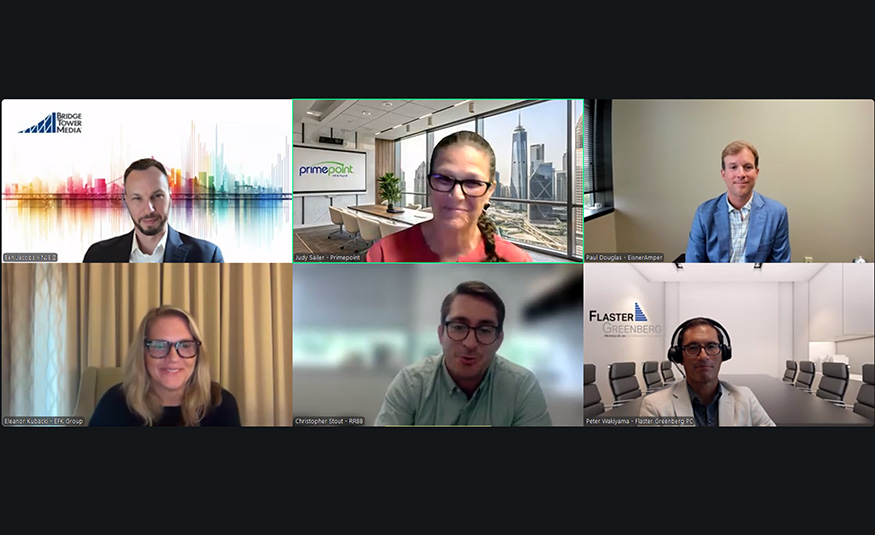
Clockwise from top left: Moderated by BridgeTower Media Content Lead Ben Jacobs, the July 29, 2026, NJBIZ Artificial Intelligence Panel Discussion included panelists Judy Sailer, director of learning and development, Primepoint; Paul Douglas, partner, Eisner Advisory Group LLC; Peter Wakiyama, IP & technology shareholder, AI, privacy & cybersecurity practice lead, Flaster Greenberg PC; Christopher Stout, partner, Rosenberg Rich Baker Berman PA; and Eleanor Kubacki, founder, president and CEO, EFK Group. - NJBIZ
Clockwise from top left: Moderated by BridgeTower Media Content Lead Ben Jacobs, the July 29, 2026, NJBIZ Artificial Intelligence Panel Discussion included panelists Judy Sailer, director of learning and development, Primepoint; Paul Douglas, partner, Eisner Advisory Group LLC; Peter Wakiyama, IP & technology shareholder, AI, privacy & cybersecurity practice lead, Flaster Greenberg PC; Christopher Stout, partner, Rosenberg Rich Baker Berman PA; and Eleanor Kubacki, founder, president and CEO, EFK Group. - NJBIZ
NJBIZ panel explores risks, rewards for businesses using AI
Kimberly Redmond//July 30, 2026//


The basics:
- Business experts urge measured approach to AI adoption
- NJBIZ panel covers cybersecurity, ROI, AI governance
- Leaders stress verifying AI-generated content
- Artificial intelligence should enhance employees, not replace them
As part of NJBIZ’s latest virtual discussion, executives at New Jersey-based businesses delved into what company leaders should consider as they move to leverage artificial intelligence.
Moderated by BridgeTower Media East Business Division Content Lead Ben Jacobs, the July 29 panel featured:
- Paul Douglas, a partner with Eisner Advisory Group LLC
- Eleanor Kubacki, founder, president and CEO of Trenton-based marketing and advertising agency EFK Group
- Judy Sailer, director of learning & development at Westampton payroll processing service Primepoint
- Peter Wakiyama, an AI, privacy and cybersecurity lead with Flaster Greenberg PC
- Christopher Stout, partner at Rosenberg Rich Baker Berman PA in Somerset
Topics covered during the 90-minute roundtable discussion included the importance of adopting an AI strategy, the risks associated with using public-facing platforms and how to measure return-on-investment of the technology. The participants also spoke about real-world applications of AI, as well as cybersecurity measures.
A more detailed recap will appear in the Aug. 10 issue of NJBIZ.
‘A measured approach’
When it comes to incorporating AI into business operations, panelists called for a deliberate and thoughtful approach.
Stout said, “From my perspective, you’re inundated with various tools every day. You see new things coming out and new versions. And it could be tempting to just jump in and grab something that might seem appealing at the time. But I don’t think that’s the hard part of getting into the AI.
“I think the difficult part, or the part that might be missed sometimes, is understanding those workflows and processes where there could be redundancies or wasted time.”

Navigating change
Another recent NJBIZ panel addressed the growing mental health challenges in the workplace amid the AI boom … and what companies can do to address them. Read more here.
Wakiyama said, “Every organization has its own sort of unique appetite for risk or risk tolerance. Some companies are willing to take on more risk and to be further out there on the edge with adopting AI on their own. Maybe developing their own tools, licensing third party tools and really sort of pushing the envelope.
“Others are more conservative just by nature. Some industries, like legal, finance and banking, are very measured and deliberate and they’re going to move a little bit slower and be more concerned about legal pitfalls.”
‘Be more human’
As for how companies are experimenting with AI, just a few tasks include summarizing lengthy documents, developing spreadsheets, giving a first look at job applications, conducting recruitment, completing background checks, handling social media accounts and better targeting marketing demographics, according to panelists.
They all cautioned that users should always verify any AI-generated output for accuracy, sources and completeness – especially in professional settings.
Sailer said, “It’s all about that prompt and teaching people how to get to that prompt … The intent is to make their lives easier so that they are utilizing their time to the best of their ability.”
She stressed that the focus right now should be teaching people the safest way to use the technology. And making sure they understand the fundamentals before moving on to anything more advanced.
Replay: Artificial Intelligence
Click through to watch the full panel discussion!
Sailer said, “The more we learn, the better off we are. And this is not meant to take your job. This is to elevate you to the next level of your job.”
Douglas feels the technology has the potential to allow us “to be more human.”
“You’re going to be able to leverage AI to do things that free you and be more human, which could be great for your service as well and for the mission … I think the winners are those who can leverage the technology and be outstanding on the human side.
“And I think the losers are either ones who don’t leverage the technology or leverage it if they’re not outstanding on the human side because that’s our differentiator moving forward,” he said.

Strategizing the next step
With respect to developing a framework for AI use within a company, panelists said multiple stakeholders, such as legal, human resources, finance, marketing, sales, R&D and IT, should be involved in the process.
Stout advised that the importance of including the voice of “a champion or a professional from the actual workforce that is doing the operations” as a way to bring “perspective as to what it [AI] can be used or what people are actually using it for.”