Sign In
Upcoming Event
 Free Newsletter

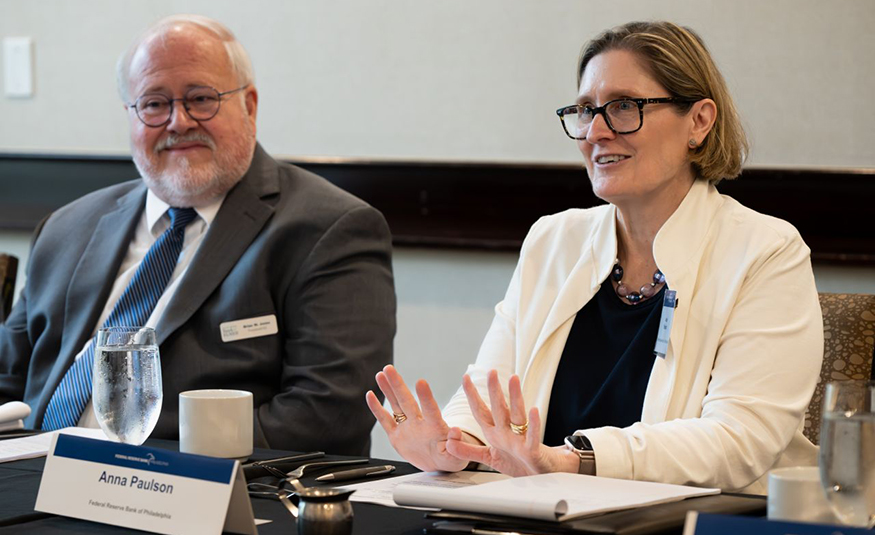
On May 29, 2026, Philadelphia Fed President and CEO Anna Paulson connected with South Jersey business and energy sector leaders to discuss what they’re seeing in their markets. Topics explored workforce availability to operational changes driven by new technology. At the event, from left: Philadelphia Fed board member and president and CEO of The First National Bank of ElmerBrian Jones and Paulson. - PROVIDED BY FEDERAL RESERVE BANK OF PHILADELPHIA
On May 29, 2026, Philadelphia Fed President and CEO Anna Paulson connected with South Jersey business and energy sector leaders to discuss what they’re seeing in their markets. Topics explored workforce availability to operational changes driven by new technology. At the event, from left: Philadelphia Fed board member and president and CEO of The First National Bank of ElmerBrian Jones and Paulson. - PROVIDED BY FEDERAL RESERVE BANK OF PHILADELPHIA
Philadelphia Fed’s Paulson sees resilience in South Jersey
Matthew Fazelpoor//June 12, 2026//


The basics:
- Philadelphia Fed CEO meets with South Jersey business, community leaders
- Energy costs, housing affordability emerge as top concerns
- Business outlook described as a mix of resilience, caution
- AI adoption growing, though widespread integration remains early
Federal Reserve Bank of Philadelphia President and CEO Anna Paulson said conversations with South Jersey business and community leaders revealed a mix of resilience and caution as employers navigate higher energy costs, housing affordability challenges, economic uncertainty, transportation hurdles and the emergence of artificial intelligence.
Paulson became the 12th president and CEO of the Philadelphia Fed in July 2025, succeeding Patrick Harker. She has spent much of her first year in the role traveling throughout the Third District to hear directly from workers, employers, financial institutions and community organizations. The region includes South Jersey counties Atlantic, Burlington, Camden, Cape May, Cumberland, Gloucester, Mercer, Ocean and Salem, as well as Eastern and Central Pennsylvania, and all of Delaware.
During a recent two-day swing through South Jersey, Paulson met with workforce-development leaders, business owners, bankers and logistics stakeholders while visiting organizations including the Port of Camden and nonprofit Hopeworks, which provides technology training, paid work experience and job placement services for young adults facing barriers to employment.
At Camden-based Hopeworks, Paulson met with trainees and interns to learn more about the organization’s efforts to prepare workers for careers in fields including information technology, AI and cybersecurity.
The trip also included an economic outlook presentation and discussion hosted by the Chamber of Commerce Southern New Jersey. During the event, business leaders raised concerns ranging from inflation and energy costs to workforce challenges and economic uncertainty.
Getting the job done
“One theme in the whole trip was this opportunity to hear from different parts of the economy,” Paulson told NJBIZ in a recent interview. “Starting with Hopeworks trainees and interns. Folks who are overcoming some really important barriers and are super excited to join the economy and have a ton to offer.”
She described Hopeworks as “totally impressive.” The nonprofit’s model has proven so successful in Camden that it is now expanding into Newark.

“That was really interesting – and the just the way they’re teaching and giving people experience in accountability, and what it takes to be an effective member of a team and to contribute on the job,” she said. “So, combining that with some conversations with employers who, for the most part, are saying that they can find the workers they need. But there are spots where they’re struggling to fill jobs and they need to train people.
“And they need people who are willing to do complicated, messy work sometimes,” Paulson noted. “A lot of why these on-the-ground experiences and the conversations are so important to me is that I like to put those dots together.”
Beyond the numbers
Stressing the importance of such visits, Paulson continued, “A lot of what we do is analyze data, look at numbers, understand the latest economic trends. But there are real people and real businesses and real communities behind those numbers.”
Paulson said those conversations are an important complement to the economic data policymakers analyze every day.
“Going out and getting to have those conversations and to see how the economic environment is shaping people’s behavior and their decisions is really important for both grounding myself in what’s really going on, but also getting a little bit of a glimpse into the future as people are making decisions right now that haven’t yet been reflected in the data,” she said.
Going out and getting to have those conversations and to see how the economic environment is shaping people’s behavior and their decisions is really important for both grounding myself in what’s really going on, but also getting a little bit of a glimpse into the future…
– Anna Paulson, president and CEO, Federal Reserve Bank of Philadelphia
She referenced ongoing dialogue on supply chains and the cost of transportation.
“So, then getting to spend some time at the port, actually being on a ship, seeing the steel unloaded,” she said. “Seeing all this structural steel piled up that’s destined for a data center somewhere. Seeing the train tracks piled up that are destined to help somebody get from point A to point B — and just the journey that it’s taken.
“And the folks who are working on the ship, the folks who are unloading it. All the expertise and commitment that that takes. Again, for me, it’s really important to have that concrete, on-the-ground experience that complements the data and the analysis.”
Common theme
She then discussed the top challenges and issues brought up by the businesses she visited.
“I think a lot of the themes were how are people coping with higher energy prices and what did that mean for their businesses,” Paulson said. “That was one theme that came up in all of our conversations, whether we were talking to employers, to bankers, at the port.”

Paulson said businesses across sectors described different approaches to managing rising costs. Some companies are able to pass transportation and fuel expenses through to customers, while others are absorbing additional costs or finding creative ways to support suppliers and customers.
She pointed to a discussion involving the agricultural sector, where a business was helping finance fertilizer purchases for downstream customers facing elevated costs stemming from the war in Iran and the resulting bottleneck in the Strait of Hormuz. “It’s just really interesting the creative ways in which businesses are coping with the myriad of challenges,” said Paulson.
Change can be good, but not uncertainty
The theme of uncertainty surfaced repeatedly throughout Paulson’s South Jersey conversations.
“A theme I heard from especially from bankers was change is fine, but change that goes back and forth and back and forth is actually harder to deal with,” she explained. “Sometimes uncertainty is more challenging than actually something that might be hard to adjust to, but there’s certainty about it.”
A theme I heard from especially from bankers was change is fine, but change that goes back and forth and back and forth is actually harder to deal with.
– Anna Paulson
Businesses across industries are trying to determine how long current conditions may persist and what that means for investment and planning decisions, she added. “People are processing all of that.”
Housing affordability also emerged as a significant issue, particularly in communities seeking to attract and retain workers.
“You want to bring workers in; housing is expensive,” said Paulson. “You kind of have this dichotomy between vacation homes and workforce housing, and what’s going to get built.”
She noted that developers often have stronger economic incentives to build higher-priced homes than workforce housing, creating challenges for employers trying to grow their workforce. “So that’s a challenge for folks, and Southern New Jersey does have housing affordability challenges, for sure,” she said.
Mood check
Asked to characterize the mood among business leaders, Paulson described it as a combination of caution and resilience.
“Really waiting to see,” she said. “A lot of people’s outlook depends on what happens, how the conflict in the Middle East gets resolved — and when it gets resolved. And when energy prices come down. And yet, they’re seeing relatively steady conditions, and people are powering through.

More to come, ‘obviously’
Paulson is approaching her first anniversary next month since taking the helm at the Philadelphia Fed.
“What’s that been like navigating all of that?” NJBIZ asked.
“I’ve gotten to explore a little bit – more to come, obviously. But that part’s been fantastic,” she explained. “I think it is actually really healthy to have this compare and contrast. We’ve got rural areas, which are dominated by a relatively older population, who are really looking to bring folks into those communities.
“They have some exciting jobs. There’s lot of manufacturing, the defense industry is strong,” she explained. “Then there’s Philadelphia, the urban area where we’ve got lots of service jobs. And it’s also just been a time where there’s been tremendous changes in public policy. So, you really do learn a lot – all three areas are a little more heavily weighted toward education and healthcare than the rest of the country.
“A lot of the policy changes affect those industries specifically, so it’s been a really good opportunity to learn about what drives the economics of a university or a hospital system.”
Where does AI fit in?
Paulson also discussed the growing role of AI, which emerged as a topic in many of her conversations across the region.
“We’re really trying to gather a lot of information. The themes and the conversations that we hear, they kind of come in two flavors,” said Paulson. “Most of my conversations over the last week in Southern New Jersey were, people are trying AI. They’re using it for certain things. They’re still gathering examples of how folks in their company are using it versus like starting a process or a company that’s AI native and from scratch.
“So, we’re seeing both things.”

Making cash even cooler
Want to take the family on a patriotic field trip? The Philadelphia Fed’s reopened – and free – Money in Motion attraction features interactive displays, rare currency and U.S. monetary history. Find out more here.
She described each of those use cases as “putting a piece in a mosaic.”
“And we don’t know what that picture is yet. I can see a few different scenarios,” she said. “There’s a scenario where it really drives productivity higher, it’s complementary with labor, it increases our standard of living and it’s just a fantastic thing in terms of economic progress.
“There’s versions of that where there’s more labor displacement, too – where we have to be more concerned about winners and losers. And then there’s things that are kind of in the middle,” Paulson explained. “We have an existing economy. We have a lot of ways in which we’re doing things already – and so, layering something on top and getting it fully integrated into your process.
“When I think about our own process building in AI at the Fed, we’re probably more on the, ‘I used it for a task, but haven’t fully automated a process.'”
She acknowledged there are also concerns about labor displacement and said the Federal Reserve is closely monitoring how employers are incorporating the technology into their operations.
“So far, pretty consistently across all of these surveys, people are saying, ‘Look, it’s going to slow my hiring, but it doesn’t mean I’m going to lay folks off,'” she said.
Economic outlook
Looking more broadly at the national economy, Paulson said labor-market conditions remain strong and economic growth continues at a sustainable pace, even as inflation remains above the Federal Reserve’s target.
“When I think about the national economy, all of these individual experiences and specific conversations in one business or another kind of feed up into this – like, let’s understand everything all together,” Paulson explained.
“We’ve got what I would characterize as close to full employment,” she said. “And that seems like it’s been pretty steady. There were a few hiccups, but it’s been really steady. We’ve had pretty solid growth, in the 2%-ish region. And I think that’s pretty consistent with economic potential.
“So, we’re growing at the rate we should be, without creating pressure one way or another.”
‘Inflation is too high’
At the same time, she said inflation continues to pose challenges for policymakers.
“Inflation is too high, and it’s been too high for too long,” Paulson stressed. “Part of that is the hangover from inflation during COVID. We made a ton of progress, but we didn’t get all the way back to our goal of 2%.”
We’re at a good place now with monetary policy … But I’d like to see more progress on inflation …
– Anna Paulson
Tariffs and rising energy costs have added to price pressures, she noted, contributing to a complicated economic outlook.
“We’re at a good place now with monetary policy,” Paulson explained. “We can react either way if something breaks. But I’d like to see more progress on inflation and be more confident that we’ve got some of this stuff behind us before we make any adjustments.
“But the bottom line is we’re in a good place right now.”
The road ahead
With her first year at the helm nearing completion, Paulson said she plans to continue engaging directly with businesses, workers, financial institutions and community organizations across the district.
She mentioned one area of focus in learning more about AI and getting into some of the communities where data centers are being built.
“I really want to continue to combine the on-the-ground conversations with community groups, employers and financial institutions and keep all of those connections so that we can really do our work,” said Paulson. “So, I can feel like I understand on the ground what’s going on with employment, inflation, and how it’s affecting families and communities.”
Asked where New Jersey may have opportunities for future growth, Paulson pointed to both the state’s location and innovative workforce-development efforts.
“You’re so close to so many consumers,” she said, noting this region’s proximity to major population centers. “And then I think there’s the innovative things, like the workforce development program [Hopeworks] that we started our conversation with. That’s really cool and innovative. Expanding that is really exciting.
“Lots of optimism to be tapped into.”