Sign In
Upcoming Event
 Free Newsletter

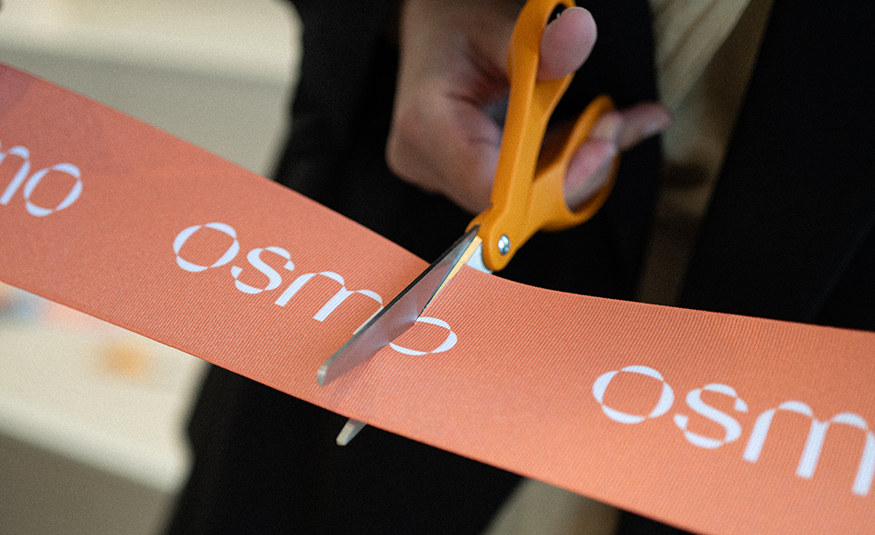
Digital scent startup Osmo celebrated its new 60,000-square-foot headquarters and production site in Elizabeth with a May 12, 2026, ribbon cutting. - PROVIDED BY OSMO
Digital scent startup Osmo celebrated its new 60,000-square-foot headquarters and production site in Elizabeth with a May 12, 2026, ribbon cutting. - PROVIDED BY OSMO
Osmo brings AI-powered fragrance innovation to New Jersey
Kimberly Redmond//July 13, 2026//


The basics:
- Osmo opens AI-powered fragrance headquarters in Elizabeth
- Technology cuts fragrance development from months to days
- Company plans to grow to 150 employees by early 2027
- AI platform helps brands create sustainable custom fragrances
New Jersey has long been a hub for the flavors and fragrances industry because of its strong chemical manufacturing base, scientific talent and proximity to major consumer brands in New York City.
Of the dozens of F&F-centered companies located here, four rank among the biggest players in the $35 billion global market: Firmenich Inc. (Plainsboro), Givaudan (East Hanover), International Flavors & Fragrances (Hazlet) and Symrise (Teterboro).
Now, that legacy is undergoing a high-tech makeover as more companies tap artificial intelligence for discovery and development. Digital scent startup Osmo is the newest entrant to the scene, with its 60,000-square-foot headquarters and production site in Elizabeth.
Google spinoff
A spinoff of Google’s AI division, the four-year-old venture uses artificial intelligence to develop custom fragrances found in an array of consumer goods, such as fine perfumes, household products and personal care items.
Through its proprietary platform, Osmo says it can effectively shrink the development of environmentally friendly aroma molecules from months to days for clients. Beyond fragrance formulation, Osmo also provides manufacturing, bottling and packaging, allowing companies to bring concepts to market more quickly and more efficiently.
“We’re democratizing access and unlocking a new world of fragrance for brands of all sizes, and this facility will expand that potential exponentially,” said Osmo founder and CEO Alex Wiltschko. “We chose New Jersey because of its long history of manufacturing excellence. As we grow, we look forward to demonstrating The Garden State’s potential to become the modern epicenter for AI-driven industrial growth and workforce development.”
Smells like savings
When it comes to research and discovery, the industry has long relied on a process in which chemists create molecules one at a time in the lab and test them individually with perfumers. That cycle can take months or even years and it can require companies to expend significant capital and resources.

Osmo says its Olfactory Intelligence platform enables both global and emerging brands to reduce fragrance costs, accelerate timelines and develop unique proprietary molecules.
Specifically, the technology screens and analyzes billions of molecules through AI modeling, predicting how they’ll smell, their intensity, their performance in different applications and their safety profile before any physical molecule is created.
Because only the most promising candidates are then synthesized and tested, Osmo says its approach dramatically reduces time and cost while increasing success rates of research and development.
For large consumer packaged goods clients, Olfactory Intelligence allows them to reduce fragrance costs and accelerate time to market. For small, independent brands, the approach lets them access custom fragrance development at accessible price points, Osmo says.
Turning ‘dreams into fragrance’
The company also touts its approach as a more sustainable, eco-friendly way to go about R&D. In reducing reliance on traditional trial-and-error research, the company also aims to minimize the need for animal testing during early-stage fragrance development.
“What’s really important is to use the correct ingredients to achieve the outcomes that you want, Wiltschko said. “What we’re very good at doing – and this is a real benefit of having AI – is that there’s no wasted ingredients. If you’re creating a fragrance because you’re launching a shampoo, fine fragrance or candle, you want it to smell really great. But you also want a great price. And then, you want to make sure there’s nothing in there that shouldn’t be in there. That’s really the core – efficiency and efficiency of formulation.”
At its new home on Kapowski Road, Osmo integrates cutting-edge robotics, fragrance development and artificial intelligence to support scent design and production across multiple industries.
By working with domestic manufacturing specialists for filing, secondary packaging and logistics, Osmo is a growing contributor to business activity within the region.
“People can basically turn their dreams into fragrance and we design that fragrance in a minute or two … We’ll manufacture it for you and send it to you in a matter of days. The whole process is just so much faster than the traditional legacy process, where it might be three months before perfumers created you a custom fragrance,” Wiltschko said.
“We still use perfumers – we have great perfumers and talent at our company. But even they’re using these tools to speed themselves up. So, it’s enhancing their creativity … it’s a totally new way of thinking about creating and delivering actual fragrance product to people,” he said.
Future of fragrance
Wiltschko, an olfactory neuroscientist, said Osmo originated as a research project during his time leading the digital action team at Google Brain. “We had some major scientific milestones. We learned that it is possible to actually digitize our sense of smell. So, we decided to build a company around that concept,” he said. “We ended up producing an AI system that could predict what a molecule smelled like better than a person could actually describe it. It was a real breakthrough for us. That’s when we realized, ‘Oh my gosh, we really need to scale this up and we need to take this opportunity seriously.’ And the right form that it took on was as a startup.”

“It took us about six years of work at Google Brain with the resources of Alphabet behind us … And then we spent about three years as a company just building up the R&D and the technology. Now, we’re in this chapter in New Jersey where we’re bringing these technologies to market.”
While traditional fragrance houses have used AI to enhance the creative process, newer companies such as Osmo are taking a more data-driven approach by using the technology to predict how fragrances will smell and help design new formulations.
Established industry leaders such Givaudan, Symrise and IFF have already deployed AI to analyze consumer preferences, identify trends or help perfumers refine formulas.
Osmo differs in that its AI system is designed to understand the underlying science of smell. Since its models are trained to predict how chemicals will smell, Osmo says it discovers new scent molecules and designs fragrances in a more data-driven way.
Building the team
As of February, Osmo has raised $130 million in capital to help scale commercial operations and spur market growth. Backers include Two Sigma Ventures, Google Ventures, Lux Capital, Valor, Atreides, Amplo and Stripe co-founder Patrick Collison.
As part of its expansion, Osmo made new hires in its C-suite, including a chief commercial officer, chief operating officer and chief financial officer.
Industry veteran Mateusz Brzuchacz said he was excited to come on board as COO because “it’s super clear that this is something that hasn’t been done before and something that’s about to change the industry.”

After noting prior posts at Phoenix Flavors & Fragrances, Givaudan and IFF, he said, “What drew me to this company is this company is doing something that hasn’t been done before … After seeing what I had seen at some of the companies that I’ve worked, I can truly say we are going to revolutionize and change the industry and how we work with the customers. And change the way customers are looking at the industry.”
Brzuchacz said, “The beauty of our setup is that the AI capabilities are infinite. When we generate our formulas, they are regulatory compliant, so they’re safe to use … The future is getting closer and closer and we are on the forefront of a lot of the work related to how AI can improve our lives.”
Where it all began
Osmo’s story began in Boston, a city that is highly regarded for biotechnology, pharmaceuticals, chemistry and life sciences.
“When I started the company, I honestly thought I’d be able to go get all the chemists I needed and all the other skills I needed there,” Wiltschko said. “It turned out that we could get really strong software development and some chemistry talent, but that the vast majority of the talent we needed was in the New York-New Jersey area.”
After outgrowing its space at the Alexandria Center for Life Science in New York City, Osmo began hunting for a base in New Jersey. “At the time we were not manufacturing. We were doing research to start. So, we moved to New York and we were able to continue our mission. But as we scaled the business, it became very, very clear that all signs were pointing to New Jersey,” Wiltschko said.
[W]e could get really strong software development and some chemistry talent [in Boston], but that the vast majority of the talent we needed was in the New York-New Jersey area.
– Alex Wiltschko, Osmo founder and CEO
“There was so much talent that are residents in New Jersey that are from the fragrance industry. And also, we’d be able to get people from New York to work in New Jersey. We’ve maintained a Boston office for talent there as well, but New Jersey has allowed us to build out the physical infrastructure required to grow our company,” he said. “ … It’s a delight to be in our new offices and to be building the company in this context.”
NJ = ‘The Silicon Valley of the fragrance industry’
Osmo’s new home is at Bridge Point Port Elizabeth, a recently completed, modern, Class-A industrial and logistics park near Port Newark-Elizabeth Marine Terminal, the Mills at Jersey Gardens outlet mall and Newark Liberty International Airport.
The 217,344-square-foot complex was developed by Kurv Industrial and Elberon Development Group on a former landfill site that was remediated as part of broader redevelopment effort.
During a May 12 ribbon-cutting ceremony, Osmo was joined by Elizabeth Mayor Christian Bollwage and New Jersey’s first chief operating officer, Kelli Doucette, in celebrating the occasion.

Brzuchacz said, “New Jersey is like the Silicon Valley of the fragrance industry – there’s a lot of companies. That was one of the reasons that we chose this location because of the talent that we see here. You can obviously get software engineers … but we can also get access to perfumers, compounders and variety of those functions that we need to properly scale up.”
“At the same time, we’re also working with a lot of the colleges here. We want to draw the talent and help a lot of those junior hires we have in here grow with the company, learn the new ways of doing things and evolve and take us to the next level,” he explained.
“The company started with three employees. And then over the next four years, here we are in a brand-new facility with over 110 people and building up manufacturing capabilities,” Brzuchacz said, adding that he anticipates Osmo will have 150 employees by early 2027.
Wiltschko said, “We’re grateful to be up and operating in New Jersey. We are creating really great scents for our customers and doing it using data, so that the customer actually wants it and we’re doing it quickly.
“And for folks that are building their businesses in a way that depends upon scents, we are here to create amazing scents. Nobody buys a product the first time because of what it smells like, but it’s usually the only reason people keep buying it,” he said. “And we are really, really good at designing a scent that helps people coming back to a product.”
Making scents of it all
With the Olfactory Intelligence platform, users can input text, pictures, video or audio and design a manufacturable formula based on those inputs.
“It’s so impressive how high quality the product is that you get and how well matched it is with what you are trying to accomplish,” Brzuchacz said. “And this is all within a matter of minutes. From that perspective, it is super cool and impressive.”
He went on, “But by generating the scent, you also have to take a step back to understand the scent. And there’s a tremendous amount of market data available about what’s being sold, what’s trending and so on. So, we can ingest a lot of that data and create a value to our customers by giving them different options.
“If you think about how AI models work, the more data you feed it, the better they get. So, we have this spindle effect where every formulation we generate, we properly annotate. We capture all of the data we can and feed that back into the model so next time when we do it, it’s better. And then that’s just a constant spindle process.”
‘Smelling the whole world’
Wiltschko said, “We’re smelling the whole world. We’re collecting every smell and we’re starting with smells that are on the market. We’re starting with the scents of products in stores and that allows us to build a very large database of what the world smells like in a commercial context. And of course we build AI models on top of that and that’s what allows us to create Olfactory Intelligence.”
By using AI modeling to predict smell, intensity, performance and safety profile before any physical formula is created, Osmo says it’s been able to screen billions of potential molecules. Its technology delivers a tenfold improvement in discovery success rates and is five to 10 times more cost-efficient than traditional methods.
Learn more about Osmo:
The company also says the approach has enabled it to build a pipeline of 43 molecules in less than three years and file more fragrance ingredient patents last year than the rest of the industry combined.
Osmo Director of Synthetic Chemistry Ben Amorelli remarked, “Osmo’s Olfactory Intelligence is optimized for speed, novelty, and accuracy, where prediction drives synthesis, not the other way around. We’re not just finding individual molecules, we’re discovering entirely new ingredient families. While a traditional patent might cover one or two molecules, ours can include 50 to 250 new molecules built around novel core structures that have never been explored in fragrance.”
Capturing the data for AI use
Brzuchacz added, “That just speaks volumes of how big of the potential we have as far as growth and capabilities … There are companies in the industry that are over a hundred years old and obviously they’ve created more formulas than us. But the formulas they created didn’t really capture the data in a way that AI can use.”
“From our beginning, any data that we could capture is properly annotated in a way that AI can use and go. So, we have the largest data sets within the industry at this point,” he said.
He added, “The industry hasn’t really caught up to the point where it knows how to use all that data and resources. And because we have such a huge library of all of the different fragrance molecules, we can start linking those together and creating a really valuable tool for our customers.”
What’s next?
Osmo has delivered several scents to the market, including ones found in body lotions, shampoos and perfume. Clients include nostalgia-inspired fragrance, cosmetics and candle maker Xyrena; home fragrance brand Zeya; masculine scent brand Temperatures; clean beauty creator Alice Panikian; and functional roll-on fragrance Loucil.
Osmo also developed a signature fragrance to celebrate the 25th anniversary of the Museum of Pop Culture in Seattle. Additionally, it created several custom scents featured in an exhibit in the Arte Museum New York at Chelsea Piers.
While Osmo’s current business centers on fragrance development, the company says its technology could eventually be used in areas such as breath-based health diagnostics and environmental monitoring.
“We’re step by step building a library of the data, learning the scents and creating virtual or mechanical noses that can detect different things,” Brzuchacz said. “We don’t want to stop just on the fragrance industry … when we get to a certain point, we will have enough data and capabilities to take it a step farther.”