Sign In
 Free Newsletter

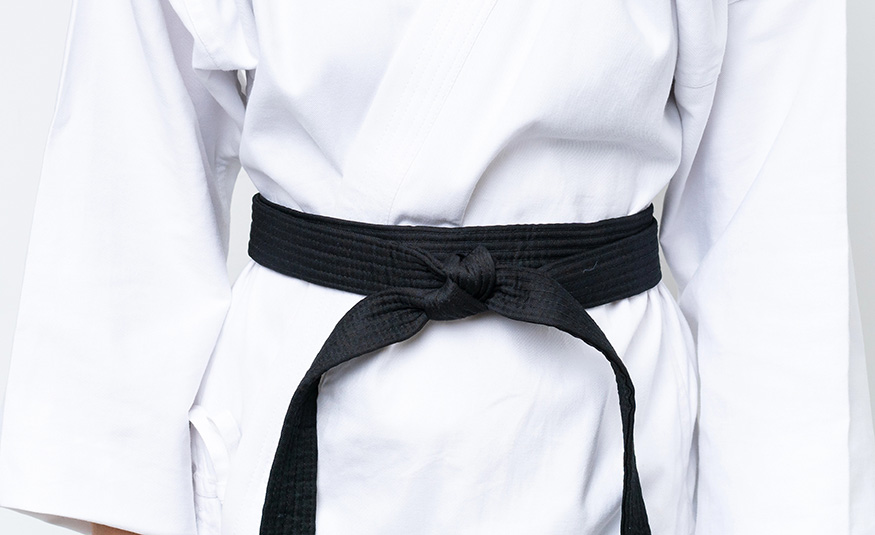
PHOTO: DEPOSIT PHOTOS
PHOTO: DEPOSIT PHOTOS
Martial arts gives Barnes & Thornburg lawyer an edge
Kimberly Redmond//June 29, 2026//


The basics:
- Barnes & Thornburg partner credits martial arts with courtroom success
- Second-degree black belt has competed in 100-plus tournaments
- Martial arts helps sharpen strategy, discipline, composure
For Barnes & Thornburg LLP litigator Kaitlyn Stone, success in the courtroom starts long before cases reach the judge. The Morristown-based partner credits the martial arts mat as being a place that has taught her how to think quickly, object decisively and adjust strategy in real time under pressure.
Because of the discipline, focus and emotional control required to train, the American Bar Association has described martial arts as “particularly beneficial to lawyers.” Besides offering skill parallels, the activity can give lawyers stress relief from adversarial work and a physical reset after long workdays.
Many high-profile business leaders, like Meta CEO Mark Zuckerberg and Nvidia CEO Jensen Huang, and actors such as Keanu Reeves and Tom Hardy, also have turned to martial arts in recent years.
Mental workout
Those well-known practitioners often emphasize that the benefits extend beyond physical fitness. They also consider it a structured way to build calm under pressure and sharpen strategic thinking in high-stakes environments.

As a defense litigator, Stone counsels leading health and life sciences, pharmaceutical and medical device companies in product liability and mass tort matters. Her nationwide practice spans multidistrict litigation (MDL), class actions and coordinated state proceedings involving thousands of plaintiffs to single-plaintiff disputes.
An alumna of the University of Rhode Island and Seton Hall University of Law, Stone worked at Gibbons PC (now FBT Gibbons) in Newark and Faegre Drinker in Florham Park before joining Barnes & Thornburg in 2022.
In addition to her focus on complex product liability matters, she has broad experience in commercial litigation, including toxic torts, intellectual property, insurance defense, business torts, real estate and land use.
Stone also does pro bono work helping low-income clients clear their criminal records and supporting survivors of human trafficking as they rebuild their lives. She helps lead a team of nearly 40 attorneys across the firm tasked with advancing practical use of artificial intelligence into practice groups and day-to-day client work, too.
From AI to ancient practices
One of her newest roles at Barnes & Thornburg is co-chairing the firm’s AI group.
“It’s an exciting group because many of our practice groups, like most law firms, operate sort of as verticals. They’re sort of the standalones and they operate somewhat independently from one another. AI certainly operates as a vertical at our firm too, and we do plenty of AI-specific substantive legal work, but it’s also a true horizontal at our firm and touches all practice areas, all practice groups, and all of our clients’ interests,” she explained.
“We take a really holistic and pragmatic approach to AI and how it can be efficient for our clients, what we can build in for benefits for our clients while also being intentional about mitigating the risks that can be associated with the technology,” Stone said
While Stone is passionate about the intersection of technology and law, she said, “I also have this interest that’s rooted in varied ancient practices that will always be separate and apart from anything that AI can do.”
There are so many capabilities that artificial intelligence has as we sit here in 2026. But sort of anything related to martial arts is going to be one of those things that is well outside the scope of Gen AI forever.
– Kaitlyn Stone, Barnes & Thornburg LLP, litigation partner
“There are so many capabilities that artificial intelligence has as we sit here in 2026. But sort of anything related to martial arts is going to be one of those things that is well outside the scope of Gen AI forever,” she said.
Not a newcomer
Martial arts have been part of Stone’s life since she was 6 years old. That’s when her father introduced her to the practice. “He had started training when he was a teenager in Carteret and had stepped away to focus on portions of his career,” she said. “Then, he decided – and my mother agreed – that it was important for his two daughters to have a basis of martial arts and the ability to defend themselves should that ever become necessary.”
Even as a teenager, Stone stuck with it. That’s typically a time when many girls stop practicing because “it can feel a little bit awkward at that particular point in your life to be doing chokeholds on guys that maybe you think are cute,” she recalled.
“I remember going through that phase, but by that time, I trained in a dojo that didn’t have many other females to begin with,” she said. “So, I had always been one of few or the only female in the room for a long time and by then I was so enthralled with the lessons that it was giving me and how it was equipping me to tackle other things in my life.”
‘A major focus of my life’
As Stone advanced through the ranks, training included reading assignments and discussions of works such as The Art of War. She earned her Shodan (first-degree black belt) when she was 15 and now ranks as a Nidan (second-degree black belt). She has also participated in more than 100 tournaments.
“It just became a major focus of my life. Even in the seasons of my life that have taken me away from New Jersey. I went to the University of Rhode Island for undergrad, but I’d still come back for tournaments. And when I would come back on breaks, I would be able to pop into the dojo and sort of blend right into the classes and pick it right up again,” she said.
“It’s been a real blessing in that it’s a true constant in my life and there’s real value in this stability that it provides someone,” she said.
“And some of that intersects with things that I came into this world with. I’m a highly competitive person. I’m a person that holds myself to exceedingly high standards and this sort of a solo sport that isn’t necessarily focused on a lot of external validation that requires participants to find the confidence and the discipline that they need to excel within themselves was a natural fit for me,” she said.
It’s been a real blessing in that it’s a true constant in my life and there’s real value in this stability that it provides someone.
Stone added, “I say to people all the time that human beings are not that complicated. We like things that we’re good at. I excelled at it reasonably quickly, so I liked it all more because I was pretty good at it.”
‘Unflappable, unshakeable’
Stone “immediately fell in love” with Isshin-ryu. A form of Japanese karate, it emphasizes practical self-defense, efficiency and straightforward technique.
Like law, Isshin-ryu shows that success depends less on size and strength and more on discipline, dedication and resilience, she said. She also applies those principles to her legal practice to help stay composed under pressure, think clearly and respond decisively — skills that “all fall into the category of demeanor,” Stone said.
Isshin-ryu: A form of Japanese karate that emphasizes practical self-defense, efficiency and straightforward technique.
“There can be certain pieces of that, especially if you’re a more junior lawyer, where you can feel intimidated or overwhelmed, or a little bit shaken up by the pace and pressure of a trial site … I was very fortunate having a background in martial arts,” she said. “ … Even when I was junior in my career, I would see it in my evaluations where I was often described as unflappable, unshakable and the exact personality for trial. And all of that came from my background in karate.”
“The reality is once you’ve gotten into a ring and fought in tournaments against guys that have 50, 60, 70 pounds on you, going into any deposition, any oral argument, any trial site, there’s not really anything that’s intimidating because the stakes just aren’t high in the same sort of immediate way,” she said.
For Stone, it’s hard to imagine life without martial arts. “It has been so woven into the person that I was growing up and the person that I am today and long predates my practice of law,” she shared. “All the black belts I know, pieces of the martial arts practice end up being integrated into the way you live your life.”
The reality is once you’ve gotten into a ring and fought in tournaments against guys that have 50, 60, 70 pounds on you, going into any deposition, any oral argument, any trial site, there’s not really anything that’s intimidating…
“If I’m at a trial site and we’re sleeping four hours a night, I can still integrate mediation as part of my morning to get centered again and ready to go,” she said. “I’m also affiliated with a dojo in Madison, so to the extent that my schedule permits, I’ll go for routine classes, if they’re having tournaments or ceremonies for promotions as long as my calendar has gaps for that.”
‘Be prepared for everything’
Working on a case and martial arts training are similar in that “you need to be prepared for everything, including maybe the things you can’t be prepared for,” Stone explained.

Life lessons
Master Chris Malarkey – U.S. Martial Arts Hall of Fame inductee, owner of a Taekwondo studio in Belleville, author and relationship manager with the New Jersey Chamber of Commerce – says all his roles are rooted in the same foundation and principles. Read his story here.
“We need to try and achieve the impossible because the stakes are either that high for you personally within yourself in a fight that might happen or certainly on behalf of your clients because we represent their interests,” she said. “And of course we need to be prepared even for those things we can’t prepare for because that’s what excellent client service demands.”
“There’s a lot of overlap when you’re focused on these things and you’re trying to be as prepared as you can be. At least for me, they’ve both embodied a lot of time in quiet and in silence with myself to think about the possibilities and to game out strategies,” she said.
“And beyond that, the way you prepare for things you can’t prepare for is that you need to know that you just have an absolutely stellar skillset that you can fall back on in the moment,” she said.
“I think that’s the clearest overlap for me is that if you are going to, heaven forbid, find yourself in a fight, you’re going to fare far better if you’re a highly capable black belt, if you’ve thought about this in the hypothetical a hundred times before in the same way in any challenge that might arise before a litigator,” Stone said. “If there’s a surprise fact that comes out at a deposition that you’ve never heard about, if you have a phenomenal skill set that you can fall back on, you’re going to navigate that well for your client.”
Over the past two decades, society has developed a better understanding of martial arts, largely because more people either practice it or know someone who does, which has helped improve perceptions, Stone believes.
“That said, I do think there are still some misperceptions out there. I think there are some people that associate MMA [mixed martial arts] as all martial arts might be because MMA gets a lot of pay-per-view attention … it even has celebrity overlaps. So, it’s just in the zeitgeist a little bit more,” Stone said.
A little level up
She’s also a big advocate for getting kids involved with martial arts. Stone’s background includes teaching children’s classes for nearly a decade. She began when she was a teenager to introduce youngsters to the practice, as well as pass on her enthusiasm for it.
When it comes to benefits for little ones, Stone said, “The first one that comes to mind is discipline. Which is maybe not something we associate our minds with young children, but it gives them a structure and a perspective in terms of viewing whether it be a challenge or a series of tasks that are put in front of you.
“I’ve had the opportunity through teaching at various dojos to see that children pick up these skills very quickly in the context of martial arts … And so by the time if you’ve gotten your children into the practice of martial arts when they’re in elementary or middle school, certainly by the time they make it to high school, these are the kids that have no issue sort of prioritizing and understanding how to get a long list of homework done in addition to attending all their sports, their games and everything else,” she said.

“The second is confidence, without a doubt … Martial arts, in general, is not necessarily a place where you’re getting a lot of external validation, people telling you you’ve done a good job or you’re great at this. You really learn to build that feedback internally on a loop for yourself. And I just find the confidence that that embodies is something that is really concrete and unshakable and translates cleanly into just about every other area of your life,” she said.
Stone and her husband hope to enroll their 17-month-old son in martial arts.
“It’s a little early for him. My husband has never participated in martial arts, but he knows how important it is to me and we’ve had discussions about how we think it’ll be something that’ll be really valuable to get our son involved when the time is right,” she said.
Finding balance
The legal profession is widely recognized as one of the most stressful fields in the U.S., with American Bar Association-affiliated studies finding elevated rates of anxiety, depression and substance use compared to other professional groups. Many practitioners have reported difficulty maintaining consistent outlets outside of work to handle stress.
Stone said, “Although I would say over the course of my career so far, if you would ask me in the first year of practice, I would say that yes, people are having a hard time connecting with activities like this and the demands of the profession are so great that it can be hard to find the time.”
“But I really think over the course of my career, I’m seeing industrywide that people are understanding the benefits of creating additional time in your life for these things that you will find fulfilling and will fill your cup back up and make you better at all the other things that you do, including the practice of law,” she said. “And so certainly martial arts is a great piece for that. I would add too that it comes with the added benefit that if you’re looking for an activity that you can do with your children or other family members, it’s a great fit for that.
“I am seeing a trend – and I’m happy to see it – that lawyers are finding more time in their lives for things that help them sort of recharge,” she said. “I think attorneys understand that we want to be the best we can be for our clients and that starts with making sure that we are in the best head space we can be and that means we need to have these outlets in our life.”