Sign In
Upcoming Event
 Free Newsletter

Holy Name’s work in Haiti just one example of extraordinary efforts by N.J. hospitals
Brett Johnson//April 28, 2015//
Holy Name’s work in Haiti just one example of extraordinary efforts by N.J. hospitals
Brett Johnson//April 28, 2015//


 Listen to this article
After seeing firsthand the massive destruction the magnitude-7.0 earthquake had caused the country of Haiti in March 2010 … after observing just how overwhelmed an already taxed health care system was coping … after trying to figure out just how his hospital in Teaneck could aid a population more than 1,400 miles away, Holy Name…
He was on hand as heavy machinery dug out a mass grave.
There wasn’t enough medicine or IV fluids to answer a cholera epidemic approaching on the heels of the earthquake, Maron said. So the area needed to prepare for an onslaught of deaths that was expected.
“After I left, they filled it,” he said.
“And this thing was big.”
The New Jersey Hospital Association releases an annual report of just how much charity care its members provide each year. While much of the total — more than $1 billion last year — involves caring for the uninsured that arrive at their emergency rooms, plenty goes to causes many don’t know about.
At Holy Name in Teaneck, a big part of its mission has become helping Haiti.
Maron’s initial effort — overseeing the implementation of a $70,000 oxygen generator, for which his hospital had raised funds following the earthquake — is now just a fraction of what Holy Name does to support the Caribbean country.
Through the Holy Name Medical Center Foundation, it has over the past few years donated more than $4 million dollars to keep a 120-bed, financially strained hospital in Sacre Coeur from closure.
In 2012, it moved to officially make the hospital’s funding organization, located in the northern part of the country, an officially owned subsidiary of Holy Name’s foundation.
— — —
The cholera epidemic that hit Haiti was equally devastating as the earthquake that came before it.
It just didn’t get the same international headlines. And just as the world didn’t hear about it, many Haitians didn’t understand it, Maron said.
“The effect of an earthquake is visually obvious — it’s easy to understand buildings falling and crushing limbs,” he said. “But cholera wasn’t so easily understood. They didn’t know how people were dying, so panic and fear set in.”
People in Haitian villages were making roadblocks out of the deceased to keep people out. Many people — even prominent, intelligent people, he said — believed that it was a voodoo spell, Maron said.
PowerPoint presentations on white sheets inside village church buildings were often what Sacre Coeur’s leadership used to combat misinformation about the spread of cholera.
Years later, the fear — and the epidemic itself — is still real there, Maron said. Meanwhile, much of the foreign aid that met the 2010 earthquake has left.
It’s a reason Holy Name has stayed.
— — —
Sacre Coeur, the Haitian hospital that Holy Name now supports, grew from a 70-bed operation to more than 400 at the peak of caring for victims of the earthquake, and the climax of aid.
“But as quickly as it came, it died off,” Maron said. “The problem for Sacre Coeur was that it only shrank down to about 150 beds. It never went back to 70. … But the funding support went back to the traditional giving level.”
Dire financial straits led to the hospital’s managing board to conclude that the facility would have to be closed.
Maron, who was visiting the hospital at least twice a year, knew this meant people would die, and a region would lose its economic engine.
His hospital stepped in to close the gap in funding. The contributions of Holy Name’s foundation support the $3 million annual hospital operation, which admits more than 7,000 patients each year.
In the U.S., Maron said a hospital of that size would have an operating budget of $200 million. Salary and compensation are a fraction for Haitian nurses and physicians of what they are here.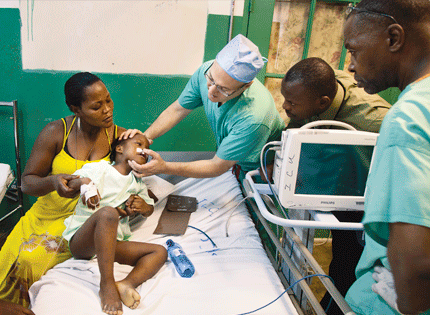
— — —
Health care issues in Haiti obviously are far different than those in the U.S.
Maron said it’s important to be aware of the region’s limitations.
“I always say, it’s a place full of bad cases of good intentions,” he said. “As an example of people not understanding the environment: We had (a company) send containers of $10,000 worth of equipment to help people breathe after earthquake, powered by a car’s charger.
“No one in Haiti has a car.”
Another example: A team of heart surgeons doing a medical mission in Haiti took someone who had a valve problem and implanted a mechanical valve in her. The surgery was a success, Maron said, and they could show off that outcome back home.
“The problem is,” he added, “after the surgery, you need to have a ready supply of blood thinner to keep the valve from clotting. You can’t get that drug in Haiti. And without it … you pretty much put her on a limited lifespan — maybe five years before she dies from complications.”
So as Holy Name continues to invest in Sacre Coeur, Maron has a pledge he’s issuing to the people of Haiti:
“We’re not going to abandon you.”
Holy Name’s mission in Haiti can be simplified into one (difficult) goal.
“We want to show that we can build a model that is sustainable and can be supported long-term and that ultimately Haitians themselves can act with accountability and can provide a great level of care,” Maron said.
Trying to reach that goal can bring benefits to New Jersey, too. Maron says Holy Name’s involvement in Haiti makes them better.
The teams from the Teaneck medical center that go to Haiti to provide care return with similarly profound experiences that deepen their commitment to the profession.
But it’s more than just inspiration.
“There were many lessons learned as to how Haiti handled cholera that we were able to apply here at Holy Name in our preparation for Ebola,” Maron said.
There were sterilization, isolation and communication procedures that the staff borrowed from Haiti’s cholera wards. For example, they found that keeping a chlorine-soaked sponge mat at the threshold to zones of isolation was an effective way of avoiding fluid contaminants from getting spread.
“And while people were scrambling here to get ready for Ebola,” he added, “we feel we were way ahead because of the experiences our staff had in Haiti.”
Experiences Maron will never forget.
E-mail to: [email protected]
‘The Haitian way’
Here’s a portrait of life in Haiti, as Holy Name CEO Mike Maron saw for himself: Many of the people live in muddy shacks with dirt floors and bamboo lining. The unemployment rate nears 90 percent.
Melancholy as that seems, Maron said there’s things he sees there that inspire him beyond all else.
“(One time) we had to move equipment that weighed more than 2,500 pounds without a forklift. … I was told, ‘We’re going to do it the Haitian way,’ ” Maron said. “Twenty people were paid a full day’s wage each to pick it up. … I didn’t think it could be done.
“One of them was an older gentleman with flip-flops. I got worried when the container was teetering, saying that he was going to lose his foot. … He told me, ‘Better that I lose my foot doing something productive than keep it idle on the street.’”
That, Maron said, tells the whole story.
Another Haiti connection
Last year, the Trinitas School of Nursing in Elizabeth was part of a short-term educational program for a dozen students from the University of Notre Dame in Jacmel, Haiti.
Marybeth Kelley, the dean of the Trinitas School of Nursing, said volunteers, students and faculty helped generate a curriculum for these Haitian nurses-in-training based on the health care needs of the region.
Using translators, the students were certified for CPR and were taught other nursing necessities.
“They had heard about CPR, but had never even seen it demonstrated,” Kelley said. “They were thrilled to have their certification card. We did a lot of maternal and child health scenarios, too.”
It was a wonderful experience, she added.
“Everyone was surprised at the emotional tone of the visit,” Kelley said. “Our students were very involved in the project and ended up having an appreciation of what we have.”