Sign In
Upcoming Event
 Free Newsletter

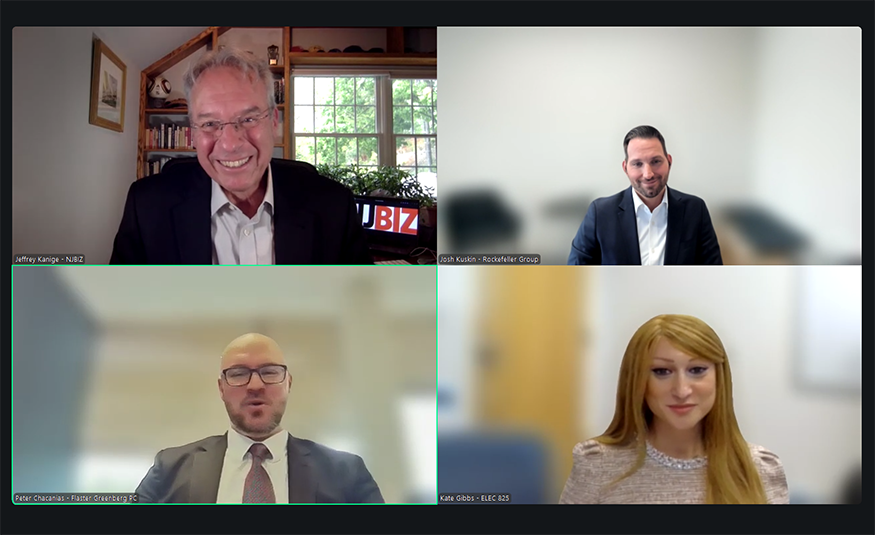
Clockwise from top left: Moderated by Editor Jeffrey Kanige, the April 29, 2026, NJBIZ Construction & Development Panel Discussion included Josh Kuskin, director of design and construction, Rockefeller Group; Kate Gibbs, deputy director of the Engineers Labor-Employer Cooperative, ELEC 825; and Peter Chacanias, counsel – real estate and land use; Flaster Greenberg PC. - NJBIZ
Clockwise from top left: Moderated by Editor Jeffrey Kanige, the April 29, 2026, NJBIZ Construction & Development Panel Discussion included Josh Kuskin, director of design and construction, Rockefeller Group; Kate Gibbs, deputy director of the Engineers Labor-Employer Cooperative, ELEC 825; and Peter Chacanias, counsel – real estate and land use; Flaster Greenberg PC. - NJBIZ
Panel: NJ construction faces costs, labor, infrastructure gaps
Jessica Perry//May 1, 2026//


The basics:
- Panelists cite costs, labor shortages, regulation in NJ as key construction constraints
- Infrastructure availability seen as top factor in development decisions
- Energy demand tied to growth in pharma, logistics, data centers
- Aging systems, long timelines slow projects across New Jersey
When it comes to building in New Jersey, it seems the only guarantee is that there are none — and that’s not good for business.
For its latest panel discussion, NJBIZ convened a group of experts to explore the Construction & Development landscape. Moderated by Editor Jeffrey Kanige, participants included:
- Peter Chacanias, counsel – Real Estate and Land Use, Flaster Greenberg PC
- Kate Gibbs, deputy director, Engineers Labor-Employer Cooperative – ELEC 825
- Josh Kuskin, director of design and construction, Rockefeller Group
Uncertainty across costs, labor, regulation and infrastructure plays an outsized role in shaping how and what gets built in New Jersey. And while panelists note that geopolitical tensions and federal policy do play a part, in the Garden State, the call is very much coming from inside the house.
A disconnect between state agencies and the industries they regulate along with a shortage of public workers to provide adequate support, also hangs over the industry. But, with a new administration in office, there is potential – and perhaps even scant optimism – for reform, balance and progress.
Higher costs, a tight labor pool, unpredictable project pipelines and long pre-development timelines effectively constrain the work that builders and developers can achieve, panelists said. Aging and outdated infrastructure as well as rising and unstable energy prices – or sources – also play a part in making it difficult to support sector work.
Infrastructure in the lead
“[I]s energy a defining factor in where people are developing and wanting to go? I’d say the more pressing issue is lack of infrastructure and just the availability of infrastructure. … The cost of energy is high, it’s going to stay high.
“That is a little bit more predictable than wondering whether or not you can actually get power to your building or water to your building or sewer or gas, etc.,” Kuskin said. “So I think the more pressing and important factor in determining where you build is availability of infrastructure,” because “costs are going to be high for energy, most likely anywhere you go.”
Plus, “there are ways to offset that through solar programs and other energy efficiency type equipment, etc., that you can install and try to work with.”
Energizing the economy
Having enough energy is crucial. And the emphasis on affordability has bigger implications.
“When you look at what strategic economic development opportunities we have in this state, they’re big energy users, right?” Gibbs pointed out. “We’re the medicine chest of the world — pharma, from research and development to manufacturing, storing, to distributing, that takes a lot of energy. Manufacturing, AI, data centers, warehouse and logistics, all of that takes a lot of energy.”
Replay: Construction & Development Panel Discussion
Click through to register to watch the full panel discussion!
“So we need to make sure that we’re building that generation to support not only the residential side and make sure that people can afford to keep their homes and power their homes. But almost more importantly, to make sure that our economy is sustained with energy that they can rely on,” Gibbs said.
Living in the past
Speakers noted an overall lack of infrastructure plagues South Jersey in particular. Meanwhile, in the more developed parts of the state, different concerns emerge.
“But even in spots where the infrastructure exists, it’s incredibly dated in a lot of places in New Jersey,” Chacanias said. And then the can of worms is open.
“Then you get into, OK, it exists. But can it actually maintain and produce the required energy, for, something like a data center? … Do we update it? Do we build new? If so, where do we build it? Again, New Jersey is a very environmentally conscious state, which is one of those hurdles you have to get through. So it’s an interesting question.”
Stay tuned for more coverage from the NJBIZ Construction & Development panel discussion, coming to the May 11 issue, in print and online.