Sign In
Upcoming Event
 Free Newsletter

Leaders: There’s a lot to like in New Jersey’s $54B spending plan
Matthew Fazelpoor//July 10, 2023//

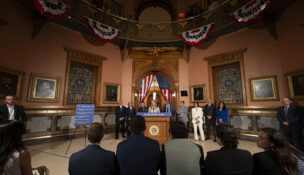
Gov. Phil Murphy held a press conference in the rotunda of the State House in Trenton on June 30 to announce the signing of the budget for Fiscal Year 2024. - RICH HUNDLEY III/NJ GOVERNOR'S OFFICE
Gov. Phil Murphy held a press conference in the rotunda of the State House in Trenton on June 30 to announce the signing of the budget for Fiscal Year 2024. - RICH HUNDLEY III/NJ GOVERNOR'S OFFICE
Leaders: There’s a lot to like in New Jersey’s $54B spending plan
Matthew Fazelpoor//July 10, 2023//


Gov. Phil Murphy signed the $54.3 billion Fiscal Year 2024 state budget just before the start of the holiday weekend on June 30 at about 8:36 p.m. — mere hours before start of the new financial year, and just avoiding an almost unthinkable government shutdown. The endorsement of the plan, Assembly Bill 5669/Senate Bill 2024, followed a wild few days coming down the stretch in Trenton as a number of factors merged while last-minute tweaks were made, leading to a race against the clock.
And while that chaotic ending occupied much of the story as lawmakers rushed to the finish line – and the Fourth of July weekend – there is much to offer in the record spending plan.
“This is probably the most business-oriented budget that the Murphy Administration has passed,” New Jersey Chamber of Commerce President and CEO Tom Bracken told NJBIZ. “There’s more things that are helpful to business in this budget than in any other budget I can think of since he’s been governor.”
New Jersey Business & Industry Association (NJBIA) President and CEO Michele Siekerka echoed that sentiment, telling NJBIZ, “Overall, it was probably the most pro-business budget we’ve seen from Gov. Murphy.”
Some toplines from the budget deal negotiated between Murphy and legislative leaders include:
- The sunset of the 2.5% corporate business tax (CBT) surcharge
- A surplus of $8.3 billion
- More than $2 billion in direct property tax relief for the second year of the ANCHOR program
- The phase-in of the recently passed and signed StayNJ senior property tax relief plan
- A record $11 billion in direct K-12 aid for public schools
- A third consecutive, full pension payment of over $7 billion
- Another deposit in the Debt Defeasance and Prevention Fund, bringing the current available balance to $2 billion and the total allocation to the fund to $9.25 billion over the last two years
- Back-to-school sales tax holiday
- Doubling the Child Tax Credit
- Waiving fees for the entrance into all state parks for another year
- No fare increase for NJ Transit commuters
- Providing $150 million in energy tax receipts-related payments to extend the Municipal Relief Fund
- $100 million for a new Boardwalk Fund
According to the governor, the budget was designed with a singular purpose — to continue building an economy where every family can afford to make their American Dream come true.
“Today we are delivering on that promise,” said Murphy. “Over the last two years, we have committed over $6 billion in direct property tax relief, tackling one of the single greatest and longest standing affordability challenges our state faces. This budget will also lower prescription-drug costs for seniors, help hardworking families by expanding free pre-K for kids, create good-paying jobs and fight climate change by building a green economy, expand mental health services for our kids, build and preserve affordable housing so everyone has a place they can call home, help first-generation homebuyers achieve the safety and security of owning a home, and so much more. We are accomplishing all of this in a fiscally responsible way. This budget continues to fully deliver on our commitments to our pension payments and school funding, while also maintaining a healthy surplus.”
“The budget signed by the governor continues our commitment to making the state a more affordable place to live, work, raise a family, and retire,” said State Treasurer Elizabeth Maher Muoio. “With unprecedented tax relief for our seniors and middle-class families, a third full pension payment in as many years, record funding of our best-in-the-nation schools and a budget surplus of approximately 15%, this budget maintains sound fiscal management that helps prepare for the Next New Jersey.”
Sending a message
The sunset of the CBT surcharge, along with separate recently passed and signed legislation (Assembly Bill 5323/Senate Bill 3737) that overhauls the state’s corporate business tax code, was top of mind for the business leaders.

“Both in terms of allowing for the sunset of the CBT surtax at the end of this year and legislation during the budget period – and now signed into law – that will make New Jersey more competitive with other states on how we take global intangible low-taxed income (GILTI),” said Siekerka.

“We obviously like the fact that the CBT surcharge is going to sunset,” said Bracken. “The CBT clean-up bill, the GILTI bill, which makes us more competitive.”
Bracken and Siekerka noted that beyond just the competitive and economic benefits, Murphy and lawmakers keeping their word on the CBT sunset – despite pressure from a number of advocacy groups to change course – sends a strong message to the business community.
“First of all, keeping the word of the Legislature and the governor by sunsetting it – you can’t underestimate that,” Bracken explained. “Because credibility is everything. And so that was a major component of why that needed to be sunset.
“Secondly, these companies that are going to benefit from this – there’s no corporate greed here,” Bracken continued. “These companies are all public companies who need to show profit because they have investors. And that helps them maintain their financial strength, which allows them to hire people. And there’s a great impact of the trickle-down economy of the people they hire because those people go out to Main Street. They spend money. They earn money. They pay income tax. They pay sales tax. There’s a huge benefit in keeping those companies in New Jersey and keeping them healthy. You can’t underestimate that. And that does not get a lot of airtime.”
“It was huge. Not only because it was the right thing to do, but because our businesses need that predictability for long-term planning,” said Siekerka. “Now, it was always our opinion that the CBT should sunset. We understood when the surtax was extended the last time because it was during the thick of the pandemic and all the economic uncertainty that went along with it. But the governor, to his credit, understood that this was the right thing to do and stuck to it. And I think the administration as a whole understands it’s not a good look nationally to have the highest corporate business taxes in the nation by a wide margin. Even going down to 9%, we’ll still have the fourth-highest CBT rate in the nation. So, we would like to see that CBT number eventually go down more, especially with Pennsylvania on the way down to 4.99%.”
In response to the criticism the sunset has received from many advocacy groups, both Siekerka and Bracken have been adamant in pointing out that these companies are not doing anything illegal, immoral or unethical, and are certainly not tax cheats, while countering the notion that this is a giveaway.
“They are following the rules and they’re doing what they’re allowed to do,” said Bracken.
“It’s important to acknowledge that the governor allowed the surtax to sunset despite some considerable pushback from progressive groups who often are in lockstep with his policies. It was really quite something to see these groups disingenuously frame this as some kind of corporate giveaway, without ever acknowledging that the surtax was, by law, temporary, without acknowledging New Jersey’s worst-in-the-nation CBT rate and property tax rankings, or without acknowledging the considerable amount of positive economic data that comes from states which have lowered their CBT rates,” said Siekerka. “Show me someone who doesn’t care about how we rate competitively with other states in terms of business taxes, and I’ll show someone who doesn’t understand what it takes to own a business.”
“With record revenues and a chance to make generational investments in the state, lawmakers prioritized a $1 billion corporate tax cut and hundreds of millions of dollars to Hollywood studios and real estate developers,” said Nicole Rodriguez, president of New Jersey Policy Perspective (NJPP), a vocal critic of the sunset, in a statement. “Make no mistake, there are great investments in the budget worth celebrating, but they pale in size and scope to the tax cuts and credits given to the wealthy and well-connected. When corporations and wealthy households are allowed to skirt the tax system and do not pay what they owe, that leaves less funding for our schools, mass transit, and other public goods we all rely on. These short-sighted tax cuts threaten the future of New Jersey, especially as federal aid expires.”
Wish lists
And while the business leaders pointed to a number of other positives from the budget, there was, of course, plenty more they would have liked to have seen included.
While Bracken reiterated that the plan had the most business friendly components and benefits of any Murphy has signed, he stressed that more help is needed for the business community.

“We would have liked to have seen some funding of the unemployment trust replenishment. We would have liked to have more grant funds available to all businesses throughout the state because there’s still a shortage of working capital going around, and there are no federal programs or really substantial state programs to help businesses,” Bracken explained.
He noted that as banks cut back on lending, capital is an especially precious commodity for businesses, so the more assistance they can get, the better chance they have of withstanding current economic headwinds and pressures.
“But they [businesses] need help,” said Bracken. “So, we would have liked to have seen a bigger grant fund available to them.”
The state Chamber president also wished that some of the record surplus would have been used to fund those initiatives, which he believes would make the business community healthier.
Siekerka pointed to the lack of unemployment insurance (UI) fund replenishment, as well, especially given the timing.
“As of July 1, New Jersey businesses are paying another $700 million in unemployment insurance taxes, when there was no federal COVID relief used to replenish the state’s UI fund,” said Siekerka. “We’ve said many times over the years, this is a tax on jobs that has equated to more than an additional $100 per employee for three years in a row now. We will forever maintain that our smaller businesses, which are struggling, deserve better than to be handed more than a $1 billion UI tax through no fault of their own.”
“We heard during the budget process that there was discussion about that [UI replenishment]. And we were hoping that there would be some movement on that to take the burden off the business community in the budget. But there wasn’t,” said Bracken. “That would be another very strong message to the business community — both to members of the business community in New Jersey and to companies from the outside looking in. It would be a huge message that we are starting to understand that businesses need help and that would create a much more business-friendly environment.”
Another request moving forward from the Chamber of Commerce is to re-energize the state’s Government Efficiency and Regulatory Review (GEARR) Commission to identify inefficiencies and overly burdensome regulations that hurt businesses and stifle economic growth.
“Having that put in place to start to reduce all the overregulation would be important,” said Bracken.
“Additionally, there has now been property tax relief for homeowners, renters and seniors, but none for businesses even though they pay nearly half of the state’s property taxes,” said Siekerka. “Some creative thinking on how smaller businesses can get some property relief would be greatly appreciated.”
Investing in the future
The business leaders also expressed some concern about the size of the budget and its sustainability, especially as the COVID-era federal money runs dry.
“We are facing a situation where – with the budget growing to the level it’s grown to – without any support from the federal government, which is partly how we got that surplus, we have to look at ways to find revenue to pay for everything we’ve created,” said Bracken. “And the best way to create ongoing organic income, that’s stable, is to have the business community create greater economic gains. And that’s why providing money to help the businesses grow and maintain themselves would have been very beneficial because it’s kind of an investment in the future.”
“We’re obviously concerned about sustainability. You can look at the 56% growth in the budget since Gov. Murphy took office, the 7.3% growth from the FY23 budget, or the $1 billion-plus added to this budget in the matter of a few months,” said Siekerka. “Now, we shouldn’t at all negate the third full pension payment in a row, a very fiscally responsible move. We like the bump in energy tax receipts restorations to municipalities to help with local property taxes. But without that surplus, we would be looking at significant structural imbalance with this budget. So, we’re concerned about this continued rate of spending and the notion that these tax relief programs will not be around for the long term. When you have short-term programs instead of real, long-term tax reform, it’s likely New Jersey will not be climbing out of its tax hole in a meaningful way.”
Bracken stressed that we have to find revenue and cannot do it through increasing taxes.
“Because that’s self-defeating from an affordability and a competitive standpoint,” said Bracken. “We need to start looking at some real comprehensive tax reform. And maybe it’s time to sit down and strategize on what real tax reform looks like with the governor and the Legislature and try to formulate a plan to start movement on that. Because that would help us immensely.”
Bracken said that, overall, the business community got some things in this budget, but not everything it wanted.
“We are pleased with the direction that this budget took,” he said. “And we just hope that we can build upon that and make it even more pro-business next time.”