Sign In
Upcoming Event
 Free Newsletter

New challenges
NJ businesses and schools steam ahead despite COVID-19
Martin Daks//October 12, 2020//
New challenges
NJ businesses and schools steam ahead despite COVID-19
Martin Daks//October 12, 2020//


 Listen to this article
The COVID-19 pandemic has upended societies across the globe, devastating human lives while disrupting businesses across industries. Despite the havoc, engineering firms and educational institutions around New Jersey are continuing to operate — carefully balancing social-distancing safety practices while getting the job done.
T&M Associates “quickly adapted” in March when the first COVID-19 cases emerged in New Jersey, according to President, Chief Executive Officer and Chairman Gary Dahms. “All employees were advised to stay home, he said, “and we established a COVID-19 response team,” that included C-level executives, an existing health and safety practice team and the company’s corporate counsel.
“Meetings are held remotely using the Microsoft Teams platform, and a web page was designed to keep employees up to date on issues like safety protocols, tips for maintaining client communications and internal communications,” he added.

Although New Jersey briefly shut down many construction activities, Gov. Phil Murphy reopened the industry in May, and T&M’s revenues were not affected significantly, Dahms noted. And the engineering firm continues to win new contracts, including a road inspection from Middlesex County for a stretch near Forsgate Country Club in Jamesburg; and another, near the Atlantic City airport, that was awarded by the South Jersey Transportation Authority.
Still, he noted, the industry is concerned about a possible slowdown in 2021 if the pandemic squeezes new budgets. And even if a vaccine is developed in 2021, Dahms thinks that the pandemic restrictions may be driving a new model of work. “In conversations with other professional services businesses — including engineers, architects and accountants — I’m hearing that more people are seeing an increase in the move away from office work and toward remote-work arrangements. Technological advances started this trend before COVID-19, but the pandemic appears to have accelerated a three- to five-year change into one that’s been accomplished in a month.”
Other organizations are also responding quickly. Earlier this year, for example, Stevens Institute of Technology shifted to a pure online learning platform. In the fall semester, it’s still mostly online — although the campus is open to the freshman class, with some restrictions. Most Stevens students live off-campus, said Jean Zu, the school’s dean and professor in its department of mechanical engineering.
“We’re limiting dorm occupancy to a maximum of two students per unit, instead of the usual four max.”
Many courses this semester are still online, although “some intensive hands-on ones, like engineering design,” may meet in-person, according to Zu. “But we’ve broken up the class sizes to about 25% occupancy — the numbers were never large to begin with — and in some cases we’ve relocated in-person classes to rooms that offer more space.”
At the same time, Stevens beefed up its online teaching tools and workshops. “Students have a greater choice of online workshops, including ones on how to do 3D printing,” she said. “The lack of social connections as we moved to more of an online format has been a shock to students, but we and they are adapting.”
A diverse pipeline
A diverse revenue stream helps Walters — a developer that designs and builds single family, and multifamily market-rate and income-restricted homes, along with some retail — to offset pandemic-related effects, according to founder and President Ed Walters. “We’re pretty well established,” with a range of projects, he said, adding that affordable-rate projects like Cornerstone at Howell — an income-restricted rental apartment community in Monmouth County — were able to move forward, “since the state issued 2020 tax credits during 2019, before the COVID-19 sweep. But applications for the 2020 tax credits have been delayed, so the 2021 projects may not be approved as quickly. But we should be able to cope with that.”
Project timing and supplies also present challenges. To keep onsite employees safe, for example, Walters said he’s stretched out the schedule for each project’s building activity, “so you don’t have a crowd of trades on a site at any one time. I don’t want a trimmer, painter and cabinet guy all in the same room at the same time.”
Supply chain disruptions spurred by the pandemic mean it takes longer to get some materials and fixtures, he added, “and lumber prices have jumped. But I don’t plan any layoffs as a result — we’ll just have to eat any cost increases.”
One interesting side effect is on the administrative side: “Instead of in-person meetings we’re doing Zoom calls and that seems to be more effective,” said Walters. “Going remote has been a major transformation in way we operate. I sometimes get emails from people at 2 a.m. — if they’re the most productive then, that works for me.”
For engineering and construction professionals, safety is a top priority, of course. When the pandemic first hit, “the construction industry responded quickly to ensure all workers could continue to operate safely,” said Mike Canuso, president of the New Jersey Builders Association, which represents builders, developers, engineers and others. “NJBA immediately issued alerts to its membership stressing the importance of worksite safety and relayed all pertinent health and safety guidance from national and state health departments along with OSHA and other industry professionals. Fortunately, the nature of construction takes place mostly outdoors, which medical professionals have agreed creates reduced exposure compared to being confined to an indoor setting.”
Canuso is also a builder – he’s president of the third-generation family owned Canuso Homes – and quickly shifted gears to meet buyer demand during the crisis. “After I framed a spec home in Haddon Township, I changed the floor plan – adding a formal home office in the front instead of flex space – because fewer people are going into an office.”
The pandemic-driven exodus to the suburbs has also meant more business. “We’re seeing more South Jersey activity, from Atlantic City to Cape May,” noted Canuso, who’s based in Cherry Hill. “There’s a lot of New York money coming into the marketplace.”
But he’s still feeling some supply chain blues. “The challenge now is lumber and other materials,” noted Canuso. “A couple of weeks ago I paid about $21,000 more for lumber for a 3,000-square-foot home. Every two weeks the lumber companies are sending out new [price] sheets. There’s also a window squeeze. Pre-COVID, you would order windows three weeks ahead of delivery, but now it’s more like nine weeks. There’s domino effect of delays – including approvals, site safety procedures, and supplies – that can add 60 to 75 days to the construction schedule.”
Initially, he was also concerned about doing walk-throughs, where a potential homebuyer tours a model home. Currently, of course, that’s out. “But the whole world is one big Zoom call these days,” Canuso observed. “So we adapted to it and now conduct virtual 3D walk-throughs, which are very popular. Technology has given us the ability to keep selling through the pandemic.”
Changing norms
When the pandemic first swept across the U.S. earlier this year, it was a nail-biter for Hoboken Brownstone Co. President George Vallone. “In mid-2019, we had opened the first phase of a three-phase multifamily development in Jersey City,” he said. “It leased up quickly. But in June of this summer, as the pandemic raged and the time for lease renewals approached, we were worried about whether or not people would re-up.”
And there were other challenges. “In a few North Jersey cities, it took the planning and zoning boards about three months to get up to speed on Zoom conferencing, so some of our new-project approvals were delayed,” he said. “But all of the sites that are currently in-progress were previously approved, so at least we’ve been able to keep busy on those.”
So far, Vallone’s pivots, along with some fundamentals like choosing good development locations, have helped his company to stay ahead in an uncertain market. “Considering the circumstances, we had been doing fairly well until September,” he said. “As June 2020 approached we initially delayed making cash distributions to investors as way to shore up our reserve in case lease renewals didn’t go well,” he recalled. “But as it turned out, we had a tremendous volume of renewals and new leases in June, July, and August and we maintained a near-100% occupancy rate. “
Still, September has been “quite different story,” he added. “We’ve dropped to around 85% which is worrisome but not as bad as other projects in the downtown market.”
Vallone is still optimistic, since “we’re so close to Manhattan – by light rail, ferry or car – so people can benefit from New York jobs without paying New York rents.”
He thinks demand will “roar back after the pandemic is behind us. Based on the lease-ups we saw during this summer — and assuming the slowdown in September doesn’t continue through the fall, it looks like our renters are thinking the same thing, and they’re staying put.”

Other companies are also hopeful. “Most of the projects we were working on were deemed essential, and then all construction here was opened anyway,” said Daniel Shea, Gilbane Building Co. vice president and business unit leader for New Jersey. “To keep people safe we’re limiting the number of people in the office, we disinfect frequently, and all the corridors have directional arrows. We’re also checking people’s temperature and put up sanitizing stations. At worksites, we’ve scheduled people so shifts are able maintain social distancing, and we take temperature and observe other safety protocols.”
That enabled Gilbane to complete in-progress projects like The Standard New Brunswick – a mixed-use development located about a half-mile southeast of Rutgers University’s main campus – that the company worked on with Landmark Properties.
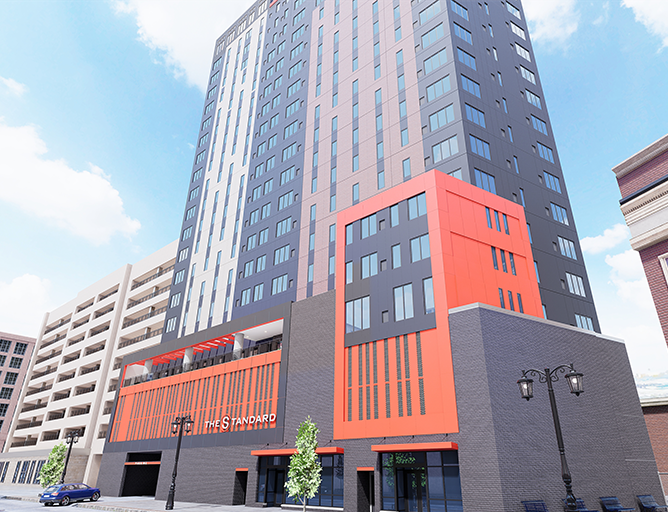
Like others, Gilbane has been affected by rising prices and supply chain slowdowns. “But we’re catching up,” noted Chris Cornick, Gilbane’s director of business development. “Our revenues this year should be on target, but if new projects are put on hold, we could see a slowdown in 2021. One good thing is that we do a lot of work in the life sciences and health care segments, both of which are very strong in New Jersey.”
Looking ahead, Cornick said that some trends – like the use of prefabricated structures and plumbing and other systems built offsite and then transported to the construction site for final assembly – are likely to accelerate, “so you can have fewer people at the construction site.”
Added Shea, “New Jersey may see more building opportunities as people exit New York City. Our pipeline of projects is still good and we anticipate it’ll get even better.”

The consulting engineering firm GEI Consultants has also been able to move forward despite the pandemic. “We’ve been able to continue work on a “large, ongoing South Jersey environmental remediation utility construction project,” reported GEI Senior Project Manager Ryan Sheaffer. “We followed CDC guidance, and issued office, field, and travel guidance to ensure that everyone stayed safe.”
He does see some long-term major changes, though. “Even if an effective vaccine is developed, I think the worksite and other social distancing standards are likely here to stay,” Sheaffer said. “And it also looks like working from home can be very efficient. Pre-pandemic there was some resistance to that, but there’ll probably be a lot more flex work. I don’t expect people to be rushing back to the office.”