Sign In
 Free Newsletter

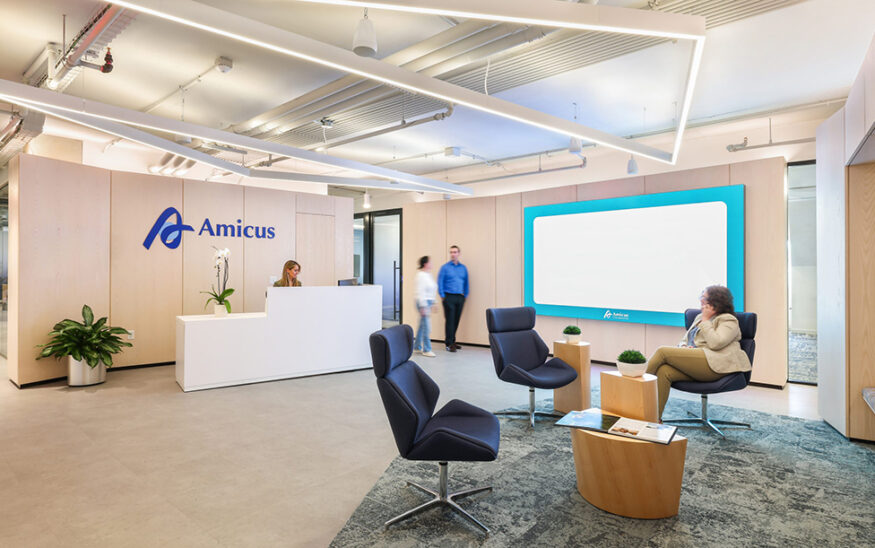
Ware Malcomb provided interior architecture and design services for Amicus Therapeutic's new, 27,200-square-foot global headquarters located in downtown Princeton. PHOTO: CHRIS LO BUE
Ware Malcomb provided interior architecture and design services for Amicus Therapeutic's new, 27,200-square-foot global headquarters located in downtown Princeton. PHOTO: CHRIS LO BUE
BioMarin cuts 58 jobs at Amicus HQ in Princeton
Kimberly Redmond//May 13, 2026//


 Listen to this article
The basics:
- BioMarin will eliminate 58 positions at Amicus Therapeutics in Princeton
- Layoffs will occur between Aug. 7 and Oct. 30, according to state WARN filing
- Cuts follow BioMarin’s $4.8 billion acquisition of Amicus
- BioMarin cites overlapping roles during integration
Amicus Therapeutics is reducing its workforce in New Jersey.
According to a filing with the state Department of Labor & Workforce Development, the company will eliminate 58 positions at the biotech‘s headquarters in Princeton between Aug. 7 and Oct. 30.
The move comes a few weeks after California-based BioMarin Pharmaceutical acquired Amicus in a $4.8 billion deal.
A media representative for Amicus did not immediately respond to a request for comment.
However, a BioMarin spokesperson told NJBIZ the downsizing is connected to the recent buyout.
“With the completion of the acquisition, we will leverage BioMarin’s global scale, commercial reach, and industry-leading manufacturing capabilities to build on Amicus’ legacy and bring its medicines to more people living with Fabry disease and Pompe disease worldwide. As with any integration of this scale, we are carefully evaluating how to align our organizations for long-term success. This process has resulted in headcount reductions, particularly in areas where there is overlap,” they said.
“We are deeply grateful to the employees at Amicus for their dedication and the meaningful impact they have made for patients. Our focus remains on ensuring continuity for these patients, supporting employees, and building an even stronger organization positioned to make a meaningful difference in the lives of people living with rare diseases around the world,” the spokesperson continued.
Billion-dollar sales potential
Aside from its global headquarters in Princeton, Amicus has research facilities in Philadelphia. The company also has a base in the U.K., as well as offices in countries such as Australia, Canada, France, Japan, Germany and Spain.
BioMarin has not said if it plans to keep the Princeton site open or whether layoffs are planned for any other Amicus locations, according to Fierce Pharma.

Founded in 2002 as a spinout based on research from the Icahn School of Medicine at Mount Sinai, Amicus has long been focused on developing treatments for rare genetic diseases. Its strategy was shaped by founder John Crowley‘s children who were diagnosed with severe neuromuscular disorder Pompe disease.
It was initially based in North Brunswick at the New Jersey Bioscience Center before expanding to Cranbury and Philadelphia. Amicus opened its 27,000-square-foot headquarters on Hulfish Street in Princeton in 2024.
As part of the deal that closed April 27, BioMarin gained access to Fabry disease drug Galafold and Pompe disease combination treatment Pombiliti-Opfolda. BioMarin has estimated that both products have the potential to each hit $1 billion in peak sales.
The transaction also added an experimental kidney disease treatment currently in late-stage development to BioMarin’s fold.
Accelerating progress for the rare diseases
BioMarin President CEO Alexander Hardy recently commented, “The completion of the Amicus acquisition advances BioMarin’s strategy to strengthen and diversify our growth profile while furthering our mission to deliver medicines for people living with rare diseases.”
“BioMarin’s global scale, established commercial infrastructure, and advanced in‑house manufacturing capabilities build on Amicus’ legacy and position us to bring Galafold and Pombiliti + Opfolda to more patients around the world,” he said.
Amicus President and CEO Bradley Campbell said he was “enormously proud” of his team.
“Together with our partners in the rare disease community, we created a truly patient-centric biotech and successfully developed two transformative medicines for people living with rare diseases, which impacted the lives of more than 3,400 patients around the world,” he said.
“With BioMarin’s unwavering commitment to patients, along with greater resources and scale, Amicus’ medicines will reach even more patients around the world, faster. We are confident that this agreement is in the best interests of our shareholders by providing compelling, certain and premium value, and will accelerate progress for the rare disease community,” Campbell added.