Sign In
Upcoming Event
 Free Newsletter

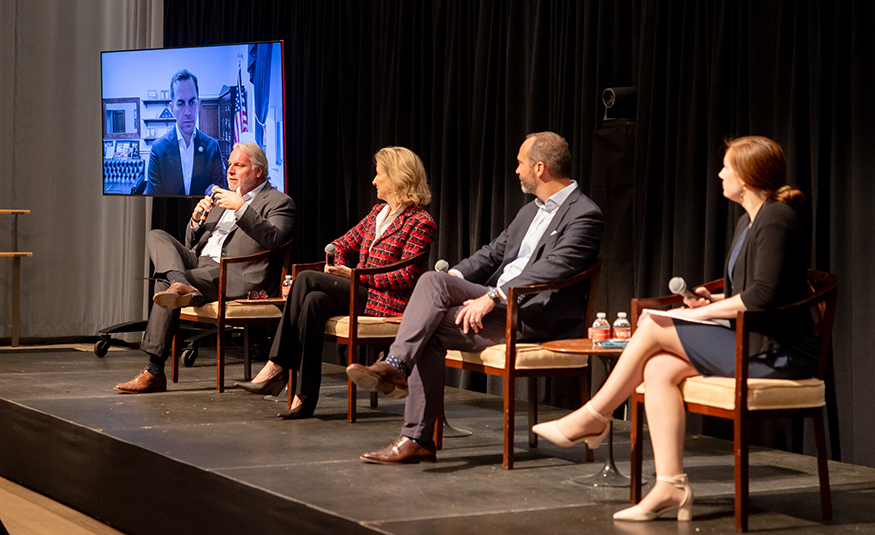
“The Cost of Doing Business: The Impact of Tariffs on the American Economy," part of the Business Partners Roundtable series, was hosted at the New Jersey Performing Arts Center in Newark on April 28, 2026. Moderated by Colleen Wilson (far right), transportation reporter for The Bergen Record, the discussion featured (from left): U.S. Rob Menendez (on screen), D-8th District, and former Port Authority commissioner; Francis Walsh, chairman and CEO of National Retail Systems; Jayne Millard, executive chairman and co-CEO of Turtle & Hughes; and Peter Jabbour, general counsel, Americas, A.P. Moller – Maersk. - PROVIDED BY NJPAC
“The Cost of Doing Business: The Impact of Tariffs on the American Economy," part of the Business Partners Roundtable series, was hosted at the New Jersey Performing Arts Center in Newark on April 28, 2026. Moderated by Colleen Wilson (far right), transportation reporter for The Bergen Record, the discussion featured (from left): U.S. Rob Menendez (on screen), D-8th District, and former Port Authority commissioner; Francis Walsh, chairman and CEO of National Retail Systems; Jayne Millard, executive chairman and co-CEO of Turtle & Hughes; and Peter Jabbour, general counsel, Americas, A.P. Moller – Maersk. - PROVIDED BY NJPAC
NJ business leaders examine tariffs, global trade shifts
Matthew Fazelpoor//May 13, 2026//


The basics:
- Business leaders discuss tariff impacts on supply chains, trade at NJPAC event in Newark
- Panelists say shifting federal trade policy creates uncertainty for logistics, manufacturing
- Speakers highlight Port of New York and New Jersey’s growing role in East Coast trade
- Industry executives warn continued instability could slow investment, economic growth
Tariffs, supply chain volatility and the future of global trade took center stage during an April 28 event in Newark. Transportation, logistics and business leaders came together to discuss how shifting federal trade policy is reshaping commerce through the Port of New York and New Jersey and beyond.
The conversation took part at the New Jersey Performing Arts Center as part of the Business Partners Roundtable series. “The Cost of Doing Business: The Impact of Tariffs on the American Economy,” featured:
- U.S. Rep. Rob Menendez, D-8th District, a former Port Authority commissioner
- Jayne Millard, executive chairman and co-CEO, Turtle & Hughes
- Francis Walsh, chairman and CEO, National Retail Systems
- Peter Jabbour, general counsel, Americas; A.P. Moller – Maersk
The conversation was moderated by Colleen Wilson, transportation reporter for The Bergen Record, moderated the event.
The trouble with tariffs
The discussion unfolded amid continued legal and political battles over President Donald Trump’s tariff policies. Earlier this year, the U.S. Supreme Court struck down tariffs imposed under the International Emergency Economic Powers Act, ruling the president lacked authority to impose broad tariffs under emergency powers.
The administration later pursued new tariffs under Section 122 of the Trade Act of 1974, prompting another multistate lawsuit joined by New Jersey.
On May 7, the U.S. Court of International Trade ruled in favor of a coalition of 24 states – including N.J. – invalidating those Section 122 tariffs, as well. New Jersey Attorney General Jennifer Davenport said the court agreed the president “cannot unilaterally impose these plainly unlawful tariffs.”
Meanwhile, U.S. Customs and Border Protection has begun processing repayments tied to invalidated IEEPA tariffs through its new CAPE refund system.
And of course, the trade picture has gotten even more complicated this year with the war in Iran that has led to a closure of the critical Strait of Hormuz — adding one more major hurdle for global trade.
The new normal?
Opening the event, NJPAC President and CEO John Schreiber emphasized the importance of the issue for New Jersey’s economy.
“As all of us who have driven down the Jersey Turnpike past all these shipping containers knows, the transport of goods from all over the world is an enormous business here in the Garden State,” Schreiber said. “The Port of New York and New Jersey is the largest containerized cargo port on the East Coast. Anything that impacts this interesting industry will impact all of us here today.”

One topic discussed was volatility in the global supply chain and whether tariffs represent a temporary disruption or a longer-term shift in how companies operate. Wilson asked whether recent disruptions are becoming normalized within the industry.
Walsh argued the logistics sector has grown accustomed to constant disruption, comparing supply chain operators to “doctors in the emergency room” responding to whatever crisis emerges next. He distinguished tariffs from major supply chain shocks – such as the Suez Canal blockage, the 2002 West Coast port lockout and the COVID-19 pandemic – describing those as true anomalies.
“Tariffs are just a tax. It’s a higher cost of doing business,” Walsh said. He added that the impact varies by company and industry because manufacturers, importers and retailers often absorb portions of the added costs before they ever reach consumers.
Raising questions
Walsh argued that while tariffs generate headlines and uncertainty, the real financial pressure for many consumers has come from other rising costs.
“The press told us tariffs are going to impact us,” Walsh said. “I talked to all my employees. Tariffs basically didn’t impact them. Fuel impact, high energy costs — that impacts them quickly, fast.”
Walsh also described how the business community initially reacted with alarm following Trump’s April 2025 tariff announcement before gradually adjusting to the uncertainty. “Everyone got nervous,” Walsh said. “Then everyone got numb to the word tariff.”
Everyone got nervous. Then everyone got numb to the word tariff.
—Francis Walsh, chairman and CEO, National Retail Systems
Millard said the constantly evolving tariff landscape has complicated pricing and project management throughout the supply chain.
“The challenge is, who absorbs the cost across the whole supply chain, and it’s always a negotiation,” said Millard. “There’s generally a lot of compromise between the manufacturer, the distributor and the end customer. Everyone’s pushing back. I think, if anything, this has taught our team to learn to negotiate and compromise in ways they never expected.”
She added that businesses are now grappling with how potential tariff refunds will be allocated.
“It’s a very complex system to manage, and even more complex will be if there are refunds that can be allocated to a specific project,” said Millard. “And we’ve been working on all the airports, the bridges, the Gateway project. When there is a refund to be applied, how do we apply it? How do we go back and really source who bore the most of the brunt of the tariff?
“So, it’s posing a lot of interesting questions.”
Sidelining capital
Menendez said many businesses had already started moving manufacturing operations away from China before the latest wave of tariffs disrupted those strategies.
“Folks thought that they were putting their manufacturing in tariff-tax friendly countries that would have easier time importing, and that was wildly disrupted by Trump’s tariff policies,” said Menendez. “I think when you start at the top of the economic chain, there has been an immense amount of disruption, especially for capital intensive companies and industries that were trying to do the right thing by U.S. foreign policy – that are now being penalized for trying to do the right thing.
“So, you’ve seen a lot of freezing up of capital because it’s such a chaotic, disruptive environment. That’s going to slow our economy. Because without that capital going out the door, you’re not going to see construction jobs, manufacturing, supply chain moving freely. And so, a lot of capital is on the sidelines,” Menendez continued. “We hear that from all different industries.”
[Y]ou’ve seen a lot of freezing up of capital because it’s such a chaotic, disruptive environment. That’s going to slow our economy.
Because without that capital going out the door, you’re not going to see construction jobs, manufacturing, supply chain moving freely.
—U.S. Rep. Rob Menendez
The congressman also warned that consumers ultimately bear the burden of economic instability tied to trade policy.
“They know things have become increasingly expensive,” said Menendez. “They feel like instead of the federal government addressing those affordability challenges, they’re doing something to worsen it.”
Seeking stability
Menendez also pointed to the impact on small businesses and consumers across his district, particularly immigrant-owned businesses reliant on imported goods.
“Our district, over 40% of the people that live here are born outside the country,” said Menendez. “If you’re in Jersey City, and you go to India Square, and you go to a shop there, they’re importing a lot of their products from India. And that’s similar to so many different small business owners in the district.”

He said many residents may not follow tariff policy closely but still feel the economic consequences.
“So from consumer to industry, it’s a wildly disruptive time, and the administration hasn’t done much to stabilize it,” said Menendez.
He added that businesses and consumers are looking for predictability amid ongoing policy shifts.
“I think people just want some sort of vision of what the next two years are going to look like,” said the congressman. “I’m a believer that Congress needs to reassert its tariff authority, which the majority has relinquished to the administration. But if we were exerting that, I think people would really want to be thoughtful about how we use tariffs. Some of it can derive good policy, but this is not good policy.”
The Jersey upside
Jabbour also said the movement away from China had already been underway for years and has reshaped global shipping patterns in ways that have benefited East Coast ports.
“I think decoupling from China has been ongoing for many years,” he said. “People have been looking, OK, where am I sourcing goods? Where are my supply chains?”
Be prepared
Supply chain disruption fears are rising across all industries in New Jersey. Experts say insurance policies can help cushion the blow. Read more here.
He said that shift has increased activity through East Coast gateways, including the Port of New York and New Jersey.
“As more and more goods are produced in Southeast Asian countries, it’s actually quicker to get them to the U.S. East Coast through the Suez than China to the U.S. West Coast,” he explained.
Still, Jabbour warned that continued instability in federal trade policy could create ongoing uncertainty throughout the supply chain and logistics industry. He noted that companies and importers have had no choice but to become duplicative in their supply chains and careful about how they deploy their capital.
“Without stability, those trade flows are going to continue to be unpredictable,” said Jabbour. “And that’s really where from a New York-New Jersey perspective, what is that impact? Where do those tariffs go? Because where the manufacturing goes will dictate what U.S. ports it comes into, where the manufacturing jobs are, where the warehousing jobs are.
“I think it’s too early to see how long the lasting impact it has. But in the short term, some of the decoupling from China has actually helped New York, New Jersey, in a very kind of strange way.”