Sign In
Upcoming Event
 Free Newsletter

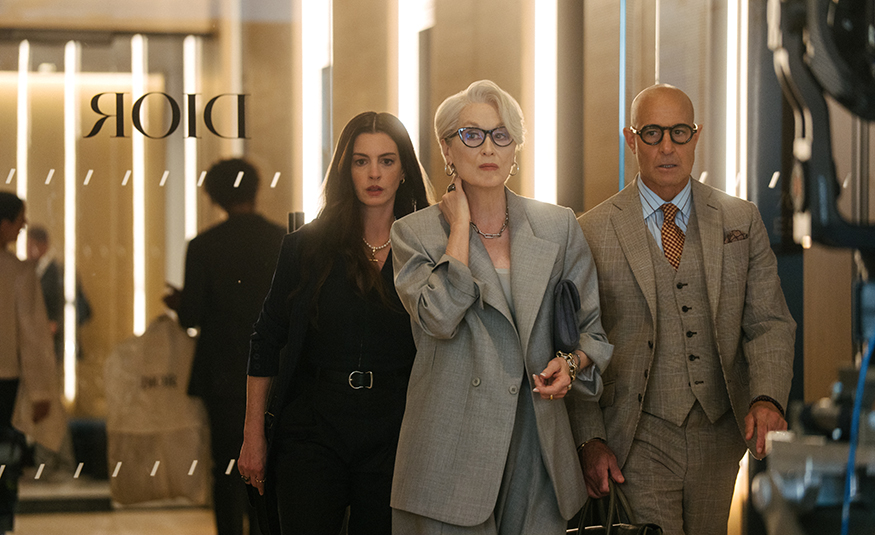
From left: Anne Hathaway as Andy Sachs, Meryl Streep as Miranda Priestly and Stanley Tucci as Nigel Kipling in 20th Century Studios' “The Devil Wears Prada 2." - PHOTO BY MACALL POLAY © 2026 20TH CENTURY STUDIOS/COURTESY OF DISNEY
From left: Anne Hathaway as Andy Sachs, Meryl Streep as Miranda Priestly and Stanley Tucci as Nigel Kipling in 20th Century Studios' “The Devil Wears Prada 2." - PHOTO BY MACALL POLAY © 2026 20TH CENTURY STUDIOS/COURTESY OF DISNEY
New Jersey roots run deep in ‘Devil Wears Prada 2’
Amy Kuperinsky//June 22, 2026//


 Listen to this article
The basics:
- ‘Devil Wears Prada 2’ screenwriter Brosh McKenna – along with cast, creative team – has NJ roots
- Sequel explores media industry, journalism challenges
- Film has grossed $676M worldwide as of June 17
Aline Brosh McKenna knew that “The Devil Wears Prada 2” wouldn’t just be about devastating one-liners, luxe high fashion and chic jet-setting. She had to tell the story of media in 2026, so it couldn’t all be pretty.
The disintegration of magazines and newspapers taking down once-robust print legacy outlets. Never-ending layoffs. Pressure to put business over journalism and deliver viral, algorithm-pleasing stories.
Andrea “Andy” Sachs, the character Oscar winner and Millburn native Anne Hathaway reprises in the sequel to the beloved 2006 movie “The Devil Wears Prada,” loses her New York reporter job at the top of the film. Andy and her newspaper colleagues are at an industry awards ceremony collecting plaudits when they receive text messages delivering life-altering news about their jobs.
Keeping it real
“I don’t know how else you would tell this story,” said Brosh McKenna, the screenwriter behind both films. “This is the reality that they live in. Even though these movies are fun and they’re enjoyable, they have to be real. They have to reflect what’s really going on in the world. The first one did, too. We try to keep it grounded, and to reflect what a journalist’s life is like. So right now, it’s got these undercurrents, but we tried to make as fun a movie as we could make about a massive financial downturn.”
Brosh McKenna, who grew up in New Jersey, has had her own taste of the troubles facing media. “Hollywood is exactly the same,” she says. “I think a lot of businesses where the creative and the business intersect are having these types of moments.”
But “The Devil Wears Prada 2,” in telling the story of crumbling, scrambling media, has become a resounding box-office success.
The film opened at No. 1 in the U.S. on May 1 and has grossed $676 million worldwide as of June 17. Currently standing as one of the biggest movies of the year, the film has already eclipsed the $326.5 million haul of the first “Devil Wears Prada,” released 20 years ago. As of June 17, the current box-office gross for the franchise has eclipsed the $1 billion mark.
“People are going in groups of 10 and 20 and 40 and having parties and it’s become like a social event,” says Brosh McKenna, who hails from Bergen County and is based in Los Angeles. “It’s great because I think we all got into this business to make movies that people go see in person. And so, the idea that people are going and having this in-person experience is very exciting.”
… I think we all got into this business to make movies that people go see in person.
– Aline Brosh McKenna, ‘Devil Wears Prada 2’ screenwriter
‘That’s all’
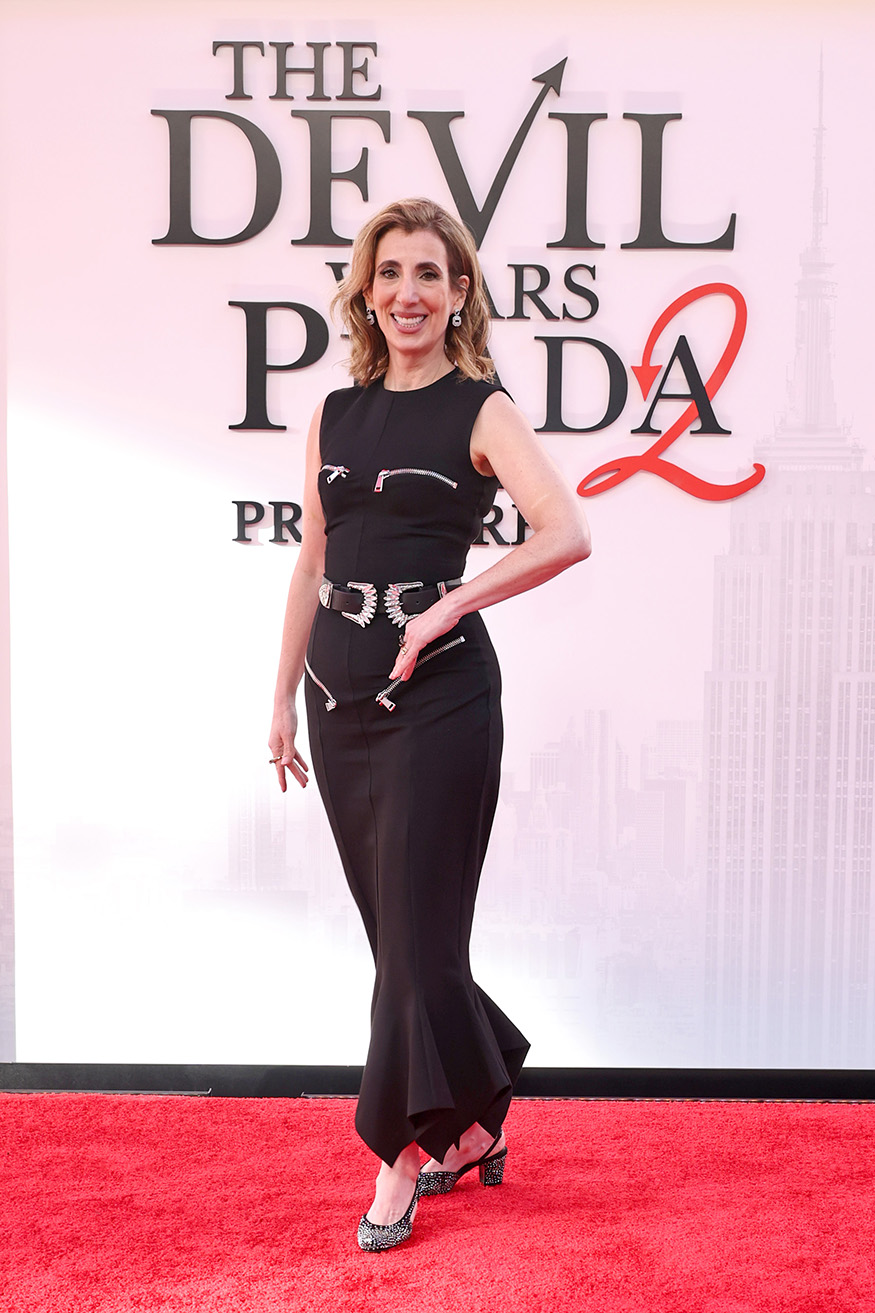
Brosh McKenna, 58, is known for her work in rom-coms and comedies (“27 Dresses,” “Crazy Ex-Girlfriend”). She adapted the first “Devil Wears Prada” from Lauren Weisberger’s bestselling 2003 book of the same name. The film delivered delicious quotables uttered by Oscar winner Meryl Streep‘s imposing Runway magazine editor-in-chief Miranda Priestly; Hathaway’s fresh-faced, in-over-her-head assistant Andy; Emily Blunt’s perpetually afflicted senior assistant Emily Charlton; and Stanley Tucci’s quip-ready fashion director Nigel Kipling.
The lines and scenes became etched in pop culture and were reinvigorated through social media: Miranda’s droll “Florals? For spring? Groundbreaking”; her subtly lethal “That’s all”; her exasperated “By all means, move at a glacial pace. You know how that thrills me”; Emily’s guffaw-inducing “Hideous skirt convention”; Nigel’s troop-mustering “Gird your loins!”; and Andy’s earnest “Can you please spell ‘Gabbana’?”
Of course, movie studios are often bound to finance films that have existing IP attached to them, so, coupled with the crowd-pleasing legacy of the first film, the idea of a “Devil Wears Prada” franchise was obviously attractive to Disney’s 20th Century Studios. The studio made “The Devil Wears Prada 2” for about $100 million, more than twice the budget of the original film.
Reality runway show
While the sequel touches on the challenges of keeping journalism afloat, there is luxury aplenty. Andy may have lost her job, but as she’s reemployed in a high-profile position for most of the film, she sports some pretty fine duds and gets a massive apartment upgrade. When Streep, Hathaway, Blunt and Tucci were filming on the streets of Manhattan, every day was like a fashion show. Paparazzi photos of production in New York and Italy gave fans a preview of the sharp looks in the movie, which served as early promo.
The movie launched with an $80 million marketing campaign and international press tour that started March 30, bringing the impeccably styled cast to Mexico City, Tokyo, Seoul and Shanghai – each red carpet like a runway show for impossibly glamorous premiere looks – before the April 20 grand finale in New York.
Besides dresses, gowns, suits and skirts from Schiaparelli, Chanel, Yves Saint Laurent, Givenchy, Louis Vuitton, Balenciaga, Celine, Valentino, and yes, Prada, the rollout of the film included appearances from Anna Wintour. The Vogue global editorial director served as a real-life inspiration for the novel from Weisberger, who briefly worked as her assistant. When you Google “The Devil Wears Prada 2,” a red shoe icon appears. Click it, and the film logo’s signature pitchfork-heeled pumps walk across your screen.
The stars align
“They did an incredible job with the marketing and promotion of the movie at Disney,” Brosh McKenna says. She’s basking in the success of the movie 20 years after the first “Devil Wears Prada” was scheduled to open as an alternative to “Superman Returns” (which claimed the top spot at the box office).
“It’s been really exciting that people have embraced it,” she says. “And it was a lot of hard work on the part of the actors who really, really worked very hard promoting the movie. And so, it’s just terrific to see the response.”
The screenwriter, who is also an executive producer of the sequel, says “just the fact that it exists” already surpassed her expectations. She returned for the second film alongside “Devil Wears Prada” director David Frankel. “For a long time we didn’t want to do one,” she says. “So many stars had to align for this to happen. I think we’re all in such a gratitude space that it exists and that people are digging it.”
Miranda flies coach
Runway chief Miranda Priestly is known for being an unflappable, proud steward of the magazine.
She dictates to others and almost always gets her way.
In 2006, she was feared and respected, with most of her staff wary of taking a single step out of line in her presence. However, the shifting currents of the media business increasingly put Streep’s Oscar-nominated character in a position of being dictated to — having to compromise with executives and kowtow to fashion brands who advertise in the magazine (Blunt’s former Runway assistant, Emily, is now working brand-side for Dior).

She’s also dealing with blowback from a disastrous lack of fact-checking on a story about a fast fashion operation. So, the chairman of Runway’s parent company brings in the unemployed Andy as the new features editor, charged with doing damage control and righting the ship. Miranda has no say in the decision. She claims to have no memory of Andy, her short-lived assistant of 20 years ago, but she does let her know she’s bound to fail.
This new era of the magazine business means more change. Miranda is no longer allowed to throw her coat at her assistants. She even – gasp – has to fly coach to Italy.
‘Punch’-lines
In making concessions to the powers that be, she must weather everyday indignities, like a bro’d-out arm punch from Jay Ravitz, the inexperienced exec played by B.J. Novak who only has his job because he’s the son of the company’s owner.
“I really love that choice,” Brosh McKenna says of Jay’s unwanted, cringeworthy dings. “That was B.J. He decided to start punching her in the arm and it was so funny. I mean, it was so, so disrespectful. That was a lot of what we had started talking about, which is that no matter what type of cultural institution Miranda is, or has become, it kind of doesn’t matter. People … they’re about the bottom line. And he really represents someone who is just all about getting the business done and having the numbers square up and make sense. And just doesn’t care much about her. I mean, he understands who she is, but given that he was a little kid (when he first visited the Runway offices) and has known her all his life, I think there’s a little glee that he takes in being in charge now and being able to make these calls and these decisions.”
Miranda’s power might be somewhat diminished in the sequel, but Streep continued to be a vital voice behind the scenes. The famous cerulean speech from the first film, where Miranda masterfully takes Andy to task using the assistant’s own cerulean blue sweater, only used that shade of blue because Streep selected it for the scene.

This time, Streep’s input can be felt when Miranda communicates her disappointment with “uh-uh.” Brosh McKenna also shares that the celebrated actor made an addition to one cathartic scene where the storied editor talks about motherhood and her career.
“I love working,” Miranda says with her whole heart, leaving little room for any doubt.
“It turned out to be a very important moment,” Brosh McKenna says. “That whole monologue was the same, and then she just said ‘I love to work.’ And then it evolved into ‘I love working.’”
Jersey joke, Jersey roots
Miranda Priestly might not claim any Jersey roots, but the state features prominently in one scene.
The Runway editor gets ready to deliver one of her famously withering critiques after watching scenes from a fashion photoshoot featuring a lifeless parade of models.
Did you know?

Meryl Streep is a 2024 inductee of the New Jersey Hall of Fame. Read more here.
“And you were there when these images were taken?” Streep’s Miranda asks. “And the models were encouraged to mill around like starving goats in the parking lot of a methadone clinic in New Jersey?”
Her assistant Amari, played by Simone Ashley, clears her throat as a warning. One of her regular tasks is to notify Miranda when she’s said something potentially offensive. (What would 2006 Miranda think?)
“Well, what am I not allowed to say?” the Runway boss asks. “Methadone? Hm.”
Then she flashes a quick, mischievous look.
“New Jersey?”
Brosh McKenna couldn’t resist.
“We got some Jersey humor in there,” she says.
Jersey strong
While “The Devil Wears Prada 2” filmed in New York and Europe, the cast and creative team strongly represents New Jersey.
Brosh McKenna, an alum of Saddle River Day School, spent her formative years in Demarest and Montvale. Hathaway grew up in Millburn, attended Millburn High School and got her start at Paper Mill Playhouse. Streep was born in Summit and grew up in Basking Ridge and Bernardsville, where she attended Bernards High.
“I will always be a girl from New Jersey and I think they would probably say the same,” Brosh McKenna says.
And that’s not all — Helen J. Shen, a 26-year-old actor from Basking Ridge (she’s an alum of Ridge High School), makes her film debut in the sequel as Jin Chao, enthusiastic assistant to Andy at Runway. Shen had her breakout Broadway role in “Maybe Happy Ending,” and pulled double duty filming with Streep and Hathaway during the day while starring in the Tony-winning musical at night.

The introduction of a new generation of Runway assistants is one way Brosh McKenna tells the story of “The Devil Wears Prada” 20 years later. While Weisberger went on to write more books about the lives of her characters, the script for the movie sequel is not based on any new text she wrote.
Brosh McKenna came up with a wholly original storyline to follow the first film. “I felt a responsibility to both the book and the original movie,” she says. “But also there was definitely something joyful and fun and exciting about being able to create from scratch. So, I did really enjoy that, too.”
Wearing Prada?
Andy Sachs feels the squeeze from Miranda and higher-ups to publish stories and land interviews that will put Runway in the spotlight. Preferably, for a good reason. Translation: Make something go viral. Now.
Miranda herself comes to Andy’s attention 20 years later precisely because she has become a meme (for a bad reason).
Brosh McKenna had to write a worthy follow-up to “The Devil Wears Prada” after years of GIFs, video clips and quotes from the first film had saturated the internet. So … no pressure.
“You can’t think about that,” she says. “That would be a crazy thing to think about. I tried to do how I thought the characters would express themselves, but that would’ve been very lame if I had been sitting at my computer trying to craft because you never can predict. I never would’ve predicted ‘Florals? For spring?’ taking off as much as it did. So, you just never really know.”
Brosh McKenna got a fun surprise when “spring florals” was the theme of a Runway gala early in the movie, which was released days before the actual Met Gala (the scene was filmed at the American Museum of Natural History, not the Met). “I had no idea they were gonna do that,” she says of the callback to the first film.
Watch the official ‘The Devil Wears Prada 2’ trailer, courtesy of 20th Century Studios:
Because she was an executive producer this time around, the screenwriter got to recommend another familiar face from her career: Rachel Bloom. Brosh McKenna and Bloom co-created the musical comedy series “Crazy Ex-Girlfriend,” which starred Bloom and ran for four seasons on The CW until 2019. In “The Devil Wears Prada 2,” Bloom plays Talia, Andy’s friend who works in book publishing and encourages her to write a tell-all about Miranda.
“All I did was put her on the list, she got that job completely on her own,” Brosh McKenna says. “She went on tape with everybody else (for auditions). She’s an amazing actor.”
‘The beginning of something’
Besides the movie’s depiction of media industry woes and existential threats to journalism, one lingering conversation about the film has centered on Andy’s love interest. Australian actor Patrick Brammall plays Peter, a man she meets and has a flirtation with as other more pressing matters dominate the story. In debriefing the sequel on social media, some believe the character feels superfluous to the story, or boring in the larger scheme of what’s happening.
“I think it’s interesting to see that she connects with the world that way, and that she meets new people and they get brought into her life, and that she has a romantic life,” Brosh McKenna says of Andy’s connection to Peter. “It’s not, like, a serious attachment, it’s just the beginning of something that could be something. And I think that’s very true to what single women experience. And so I don’t think that every love relationship in a movie like this needs to be the be-all and the end-all.”
While Andy and Peter may not necessarily be a sure thing, the “Devil Wears Prada” audience seems to be.
So, will we get to see how Andy, Miranda and Runway are doing after their feature-length 20-year reunion?
“Well, let’s see,” Brosh McKenna says of a potential third movie. “We’re trying not to get ahead of ourselves. If we do it, we don’t wanna wait 20 years.”