Sign In
Upcoming Event
 Free Newsletter

NJBIZ panel addresses opportunities, challenges for women in the workplace
Kimberly Redmond//January 8, 2024//

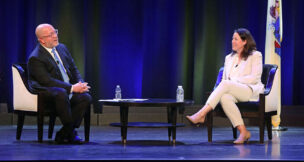
Clockwise from top left: Moderated by Editor Jeff Kanige, the Dec. 23, 2023, NJBIZ Women in Business Panel discussion featured Lisa Lombardo, director, Business & Commercial Litigation Group, Gibbons PC; Ginny Hall, CEO, Girl Scouts of Central and Southern NJ Inc.; and Christine Melilli, director, Smolin, Lupin & Co. LLC.
Clockwise from top left: Moderated by Editor Jeff Kanige, the Dec. 23, 2023, NJBIZ Women in Business Panel discussion featured Lisa Lombardo, director, Business & Commercial Litigation Group, Gibbons PC; Ginny Hall, CEO, Girl Scouts of Central and Southern NJ Inc.; and Christine Melilli, director, Smolin, Lupin & Co. LLC.
NJBIZ panel addresses opportunities, challenges for women in the workplace
Kimberly Redmond//January 8, 2024//


 Listen to this article
With a younger generation that is eager to make a mark on the world, the women who are joining – or will soon join – the workforce are passionate and looking for environments that will foster long-term professional growth and promote a strong work-life balance.
And while they have more opportunities than their mothers and grandmothers had, challenges persist in several areas, like career advancement, gender bias and pay equity.
As part of NJBIZ’s latest virtual discussion, women executives at New Jersey-based companies spoke to their experiences in the workplace, as well as offered guidance to females entering the business world.
Moderated by NJBIZ Editor Jeff Kanige, the Dec. 12, 2023, panel featured:
- Lisa Lombardo, director, Business & Commercial Litigation Group at Gibbons PC;
- Christine Melilli, director at Smolin, Lupin & Co. LLC;
- Ginny Hall, chief executive officer, Girl Scouts of Central and Southern NJ Inc.
During the hour-and-a-half roundtable discussion, panelists dove into topics such as dealing with pay inequities, the value of mentoring, and gaining access to capital and business opportunities. They also spoke frankly about corporate attitude as it relates to gender and leadership roles.
Lombardo said, “I see girls coming in with confidence, seeking the mentor opportunities, seeking the networking opportunities and knowing how to find them. They’re very adept … they know where to go and what’s available. And I think it’s all positive and it’s really a credit to the work the schools and organizations like the Girl Scouts are doing in preparing women for the workplace. While nothing is actually going to substitute getting your feet wet and working … I am very enthusiastic from what I’m seeing in the younger generation and the female attorneys starting to work at my firm.”
One of the most recent positive developments for women has been the transition to remote and hybrid work, panelists said.
“I think the big challenge in at least private law practice industry, and it may be in other areas also, is retention of female attorneys,” Lombardo said. “A lot of female attorneys go on to careers other than private law practice because of the challenges that are faced when women go on to have families. In my generation, I had colleagues that struggled with needing to leave the office by a quarter to five to pick up their child in day care or relieve the nanny. Now, with the virtual work environment and hybrid, that’s become a little better.
“I think with the advent of hybrid-remote working, it was a function necessity of COVID, but I think employers started to realize, ‘You know what? We can do this. We can still deliver to our clients with something other than that traditional Monday through Friday.’ So, it’s evolving into a different parameter where employers are, I think, are starting to realize there’s more than one way to accomplish the goal,” she said.
Replay: 2023 Women in Business Panel Discussion
Click through to register to watch the full panel discussion!
Lombardo went on to note that offering those alternate arrangements goes a long way toward retention, too, and a company can save on the time and money it takes to hire and train new employees. “So, there’s an economic reason behind this in addition to doing the right thing socially,” she said.
Melilli spoke about the greater flexibility companies now afford employees and its impact for women, many of whom are doing double duty as caregivers for their children, as well as their parents.
“There’s just different dynamics today than what it was and I’m happy to say I think we have progressed and we are progressing, but there are still – especially in some STEM industries – difficulties,” she said.
‘Checking the box’
Though many companies tout the number of women represented within their leadership ranks, panelists believe those employees may not always be set up for long-term success.
Melilli commented, “It’s a real problem – especially when you’re looking at the larger corporations whose identity is really a social responsibility. So, they tend to swing the pendulum a little bit too far to one side and they could be checking boxes, which I hope is not the case because you never want to set somebody up to fail. It is not good for the employer, the employee or the group as a whole.”
Empowering Women

In the inaugural Empower Women program, NJBIZ recognized more than 50 companies and organizations for their efforts to advance women in the workplace and community. Click here to see the honorees.
She said, “But what I can tell you is that statistically they shouldn’t have to, because if you look at the number of women ages 25 to 64 who have entered the workforce between the years of 1970 to today, the number who have entered with college degrees versus without has quadrupled. So, it makes sense that there’s a larger viable pool for women to be promoted, but never pre-promote. And everybody has a weakness, so if you have a viable qualified candidate, maybe she just needs a little extra support in a weak area, as would any good executive. But it is a real issue that’s being spoken about.”
Melilli went on to say, “To simply check a box without the programs and initiatives in place to support the women, there’s no point. You’re not going to retain those women and you’re not going to see the benefit of what you’re seeking … . There’s primarily a moral and ethical initiative behind it, but there’s also the business aspect that the corporate clients are looking for this. And, if you’re just checking a box, you’re undermining the whole point of having a goal of recruiting.”
Mentoring is key
Despite a growing number of organizations aimed at supporting women in business, providing networking opportunities and leadership content, Hall said it is important for females in leadership positions to continue encouraging and advocating for women who have not yet advanced up the ranks.
“There are still lots of places where the glass ceiling is real. We haven’t seen a majority of women in leadership in Fortune 500 companies. We know there is still a challenge with women on corporate boards and leading corporate boards and even just getting access to corporate boards,” she Hall.
Both Lombardo and Melilli echoed the importance of mentoring.
“Another positive development I’ve seen is with women coming up the ranks, there are more female mentors that they can look to and female networking groups that women can look to for advice, for guidance. So, we’ve come a long way,” Lombardo said.
“Having a female mentor is really key … I’m not saying that a male can’t be, but there’s going to be differences there that you’re going to gravitate to,” Melilli said. “I think that’s been vital and instrumental in my career personally. And I always remember that and love to give that back because if you’ve been given that gift, you have to give it back.”
A ‘warning sign’
When it comes to negotiating better pay, panelists stressed the importance of doing the necessary research before raising the issue.
“If you truly are being paid less than your male counterparts with the same skillset for doing the same job, then you do need to make the higher ups [aware], the people who are in charge of determining what your salaries are. You need to bring it to their attention. And look, if you’re not earning what you feel like you deserve to be making and what your skills would require and you’re not being heard, then maybe’s time to look for another job,” Lombardo said.

“Even if you’re working for someone a couple of years, you feel very comfortable. Maybe you don’t want to make the move, but if you truly are not earning what you think you should be earning and you’re not being heard, I think you go to the superior with the information of, ‘Look, this is what I bring to the firm. These are my achievements, these are my academic credentials, these are my work credentials. I’ve gotten X, Y, and Z results, I’ve accomplished this and I’ve gotten all this positive feedback.’ You need to be armed with that information on why you think and why you are a valuable employee, what you bring to the table and why they should want to retain you. And in order to retain you, you should be paid fairly,” she said.
Hall agreed, saying, “I think knowing the facts is really important. And that includes how does your employer’s compensation system work? What is it based on – cost of living increases? Merit increases? Bonuses? Incentives?”
“You have to know the environment that you’re in, in addition to what you have contributed. That’s typically where I see people mostly struggle,” she said, adding, “Most employers do the right things when it comes to that, but it’s really about understanding that and then making your case within that operating structure where you’re employed.”
However, Hall noted, “If you’re working in a place where you’re not getting regular feedback on what it is you are doing and the results you’re providing, that’s probably a warning sign that the compensation is also going to be a challenge.”
Opening access
As for gaining access to public contracts, Lombardo said there are several resources available in New Jersey, particularly for businesses certified by the state as a woman-owned enterprise.
“Pretty much each public organization or government organization has procurements on their websites and what’s coming down the pike … it just takes a little research digging on the individual websites and the type of government or public contracts you’re looking for, depending on your area,” she said.
Panelists also advocated for networking as one of the best ways to get connected with opportunities for capital.
Melilli said, “That’ll always go far. There are also venture funds that do target women-led organizations. Again, because you have this initiative, there are venture funds that are specific. They want to give their money to women-led organizations, so you might want to seek some of those out.”
There are also grant programs open to businesses certified as women-owned enterprises, many of which are listed on GrantsForWomen.org, as well as fellowships and non-financial resources, like free business courses for women from Goldman Sachs and Bank of America.
“I think if you start doing the research, you see that there is a lot available out there. You just need to figure out what works for the model business you’re looking to get into,” Lombardo said.
Upward or outward?
As for advancing through the ranks in a company, panelists said they believe it’s up to both corporations, as well as women, to determine how best to navigate those challenges.
Hall said, “I think that is the magic rhetorical question. And I have been in the role for some time now, being in the nonprofit sector where in addition to doing work for women and girls, I’m advocating for systemic change for women and girls. And I do see bright spots. I do believe that a lot of the change we’ve been talking about today is truly happening, that there are leaders in major institutions and organizations that are taking it seriously and looking at not just the activity of bringing more women in, but also what would it really take to change the culture? What’s it going to take to change the mindset?
“So, it’s why organizations like the Forum for Executive Women, as one example, have put these kinds of initiatives as part of the forefront. So yes, we network, yes, we get to know each other. Yes, we get great access to leadership content, and the organization is working hard to make sure those things change,” she continued.
“And in the meantime, yes, it is going to be up to those of us in these roles,” Hall went on. “Those of us who have accomplished in terms of leadership in our careers, what are we doing to lean back and give a hand to the next woman?”
Melilli also encouraged women to be vocal about their career objectives.
“We should also speak to expectations during our initial interview process … It’s a fair point to just set the expectation and that way decisions can be made. But if you lay it out that I have a goal to keep climbing within this company, then I think it’s on the employer to make sure that you are mentored, that they are checking in with you, that you’re getting the resources to do [so],” she said. “But in all fairness, not everybody wants to be that, but if you do and then you’re encountering that, well, I do think then the employee, the female needs to speak up. But I think best you do it right from the outset so that you’re setting your goals and you’re letting everybody know. Now, if that goal changes because something has changed in your life, that’s okay too. But just communication, I think, is key here with this broken rung.”
Climbing up the ladder may not be for everyone – and that’s perfectly fine, too, panelists said.
As Melilli put it, “I think one of the things you need to be aware of as a woman is even though the inclination may be to move up to get that higher title, you need to make sure that it’s the right move for yourself. So, take a step back if it’s a position that you’re in the organization and look at how many people have had this role in the past couple of years and why is it that no one has lasted in this role?”
“Or, if you are interviewing … maybe ask during the interview or ask people if you know people that work in the company, how long are people typically in this role? Because to take a position where you are potentially set up to fail is not necessarily a good move for your career otherwise. So, I think you’ve got to think for yourself, advocate for yourself, and then maybe something we’ll get to is negotiate for yourself also,” she said.
Lombardo agreed, saying that many women “have a hard time saying ‘no’” and tend to be people pleasers, so they feel as though certain professional moves are necessary – even if they aren’t prepared for a particular job.
“You really need to take a step back and objectively say ‘What would I counsel my friend? What would I counsel a colleague who’s faced with this?’ And sometimes you may be better off than taking that position if you really are set up to fail. Because if you’re in a position for a short amount of time or word gets around in the industry that you had that position and you didn’t do a good job, then maybe that’s not the best for your career. So, it’s hard to say no, but certain times you have to for your own self-preservation,” she explained.
Hall said, “One of the best pieces of advice I ever got from somebody was, ‘Yes, Ginny, you can do it all. You can have it all, but probably not at exactly the same time.’ And that speaks to Lisa’s point. Sometimes it is a step to the left or a step to the right to step off the ladder maybe and wait. And then the next rung will appear that it’s not necessarily linear or always in the straight line that we think our career should be.”